Strong, sculpted arms rarely come from chasing heavier dumbbells. Instead, Pilates arm exercises train your shoulders, upper back, and deep core to move as one connected unit. That teamwork is what creates a lean, capable look without bulk.
I have coached clients who could press a heavy weight yet still slumped at their desk by noon. So we shifted the focus. We started using slow, controlled arm work rooted in Pilates, and their posture changed within weeks. This guide walks you through the why and the how, with practical moves you can try at home today.
Here is the part most people miss, though. Pilates arm exercises are never really about the arms alone. They link the upper body to a stable, breathing core, so the strength you build actually holds up in real movement. That is a different goal than chasing a pump, and the results last longer too.
| Quick Answer Pilates arm exercises are low-impact movements that strengthen the arms, shoulders, and upper back while keeping the core engaged. They build lean muscle, sharpen posture, and improve shoulder stability. Because they use light resistance and high control, almost anyone can start them safely at home or in a studio. |
Why Pilates Arm Exercises Work So Well
Traditional weight training often isolates one muscle at a time. Pilates takes a different route. Every move asks your shoulders, arms, and trunk to cooperate, so you build strength that actually transfers to daily life. You reach, carry, and push with more ease.
Control matters more than load here. When you slow a movement down, your muscles stay under tension longer. As a result, you feel the burn with far less weight. That is why a simple set of light dumbbells, or even no equipment at all, can leave your arms shaking by the final rep.
There is also a posture payoff. Many of these moves strengthen the small stabilizers around the shoulder blades. Consequently, your shoulders sit back instead of rolling forward. Over time, that single shift makes you look taller and more confident. It also takes pressure off your neck, which is a welcome bonus if you spend long hours at a screen.
Lean Strength Without the Bulk
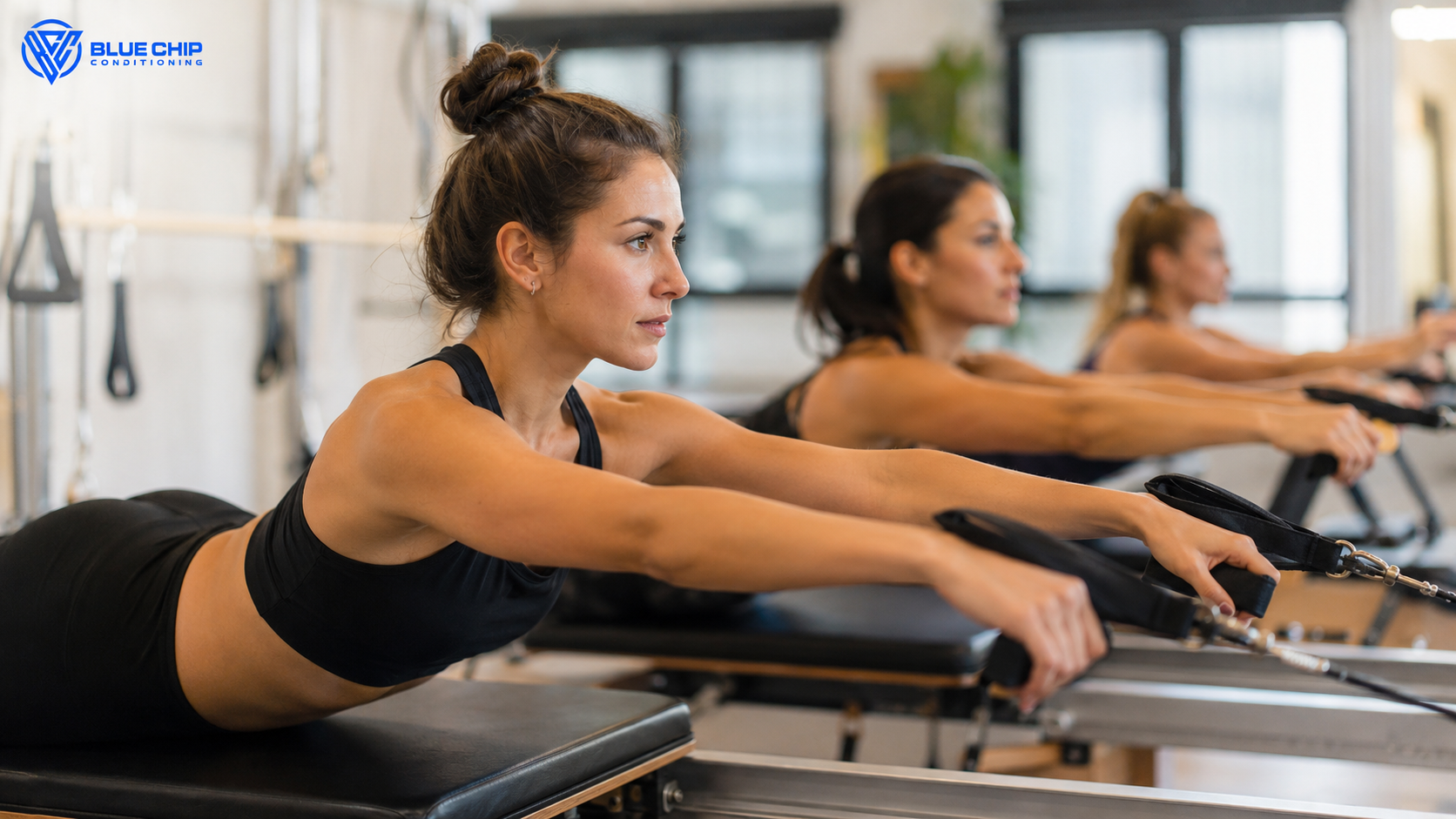
Pilates arm exercises favor higher repetitions with steady tempo. Because of that approach, you develop endurance and tone rather than sheer mass. If your goal is defined arms that look athletic in a tank top, this style fits perfectly. For a deeper foundation, our reformer Pilates sessions add spring resistance that takes the same principles even further.
8 Pilates Arm Exercises You Can Do at Home
You only need a mat, a little floor space, and optional light weights. Grab a pair of one to three pound dumbbells, or fill two water bottles if you are improvising. Then move through the list below at a slow, deliberate pace.
- Arm circles – small, controlled rotations that fire up the shoulders.
- Tricep press – extend the arms behind you to target the back of the upper arm.
- Boxing punches – controlled punches that build coordination and shoulder endurance.
- Serve the platter – open and close the forearms to train the rotator cuff.
- Bicep curls with a hold – curl, pause at the top, then lower slowly.
- Chest expansion – pull the arms back to open tight shoulders and counter slouching.
- Plank shoulder taps – a core-and-arm combo that demands real stability.
- Wall push-ups – a joint-friendly way to load the chest, arms, and shoulders.
Each of these Pilates arm exercises rewards quality over speed. Aim for 10 to 15 slow reps, and rest just enough to keep your form sharp.
A Simple 10-Minute Routine to Try Today
If you want structure, follow this short flow. It moves logically from warm-up to challenge, so your shoulders stay safe throughout.
- Warm up: Roll your shoulders and do 20 small arm circles in each direction.
- Activate: Perform 12 chest expansions to wake up the upper back.
- Build: Do 12 bicep curls with a one-second hold at the top.
- Target: Add 12 tricep presses, keeping your elbows still.
- Stabilize: Hold a plank and tap each shoulder 10 times.
- Cool down: Stretch the chest against a doorway for 30 seconds per side.
Do this routine three times a week, and you will likely notice steadier shoulders and better posture within a month. New to mat work? Our beginner Pilates guide breaks down the basics before you progress.
| Want hands-on coaching for your form? Explore our Pilates classes in Las Vegas and let a coach fine-tune every rep. |
Common Mistakes That Hold Your Progress Back
Even great moves lose their value with sloppy execution. After years on the studio floor, I see the same slip-ups again and again. Watch for these.
Rushing the Reps
Speed feels productive, yet it steals tension from the muscle. Slow down. A controlled three-count lift and lower will outwork a fast, jerky set every time.
Shrugging the Shoulders
When the weight feels heavy, the shoulders creep toward the ears. That habit strains the neck and skips the muscles you actually want to train. Keep the shoulder blades gently down and back instead.
Ignoring the Core
Your arms work best when your trunk is stable. Therefore, brace your midsection on every rep. A strong center turns ordinary Pilates arm exercises into full-body work.
How These Moves Improve Posture
Modern life pulls us forward. We hunch over phones, keyboards, and steering wheels for hours. Pilates arm exercises push back against that pattern by strengthening the muscles between your shoulder blades.
Picture two ropes running across your upper back. When those muscles are weak, the ropes go slack and your shoulders round. When they are strong, the ropes pull your shoulders into a tall, open line. Moves like chest expansion and the serve-the-platter drill train exactly those fibers.
The change is not only cosmetic, either. Better posture eases tension headaches, reduces neck strain, and helps you breathe more fully. In short, the upside reaches well beyond the mirror.
Which Muscles You Actually Train
It helps to know what you are working when you move. Pilates arm exercises mostly target the deltoids, biceps, and triceps, but they also recruit smaller helpers that ordinary gym lifts often skip.
- Deltoids: the rounded shoulder muscles that lift and rotate your arms.
- Biceps and triceps: the front and back of the upper arm that create that toned line.
- Rotator cuff: four small muscles that keep the shoulder joint safe and steady.
- Rhomboids and lower traps: the upper-back muscles that drive good posture.
Because the routine hits stabilizers and prime movers together, you build balanced strength. That balance protects your shoulders, which is exactly why so many physical therapists fold these moves into recovery plans.
Pair Your Reps With Smart Breathing
Breathing is the quiet engine behind every Pilates movement. When you exhale on the effort, your deep core switches on and your arms find a stronger base. Try it on a bicep curl. Inhale as you lower, exhale as you lift, and feel how much more controlled the rep becomes.
Hold your breath instead, and your shoulders tense while your form falls apart. So treat the breath as part of the exercise, not an afterthought. This single habit turns basic Pilates arm exercises into a calmer, more connected practice.
Beyond strength, steady breathing lowers stress and sharpens focus. Many clients tell me their ten-minute arm flow doubles as a mental reset after a long day.
Home Practice vs. Studio Coaching
Home practice is flexible and free, which makes it a smart starting point. Still, a trained eye catches the small errors you cannot feel on your own. That feedback is where most people make their biggest leaps.
If you live nearby, working with the best Pilates instructors in the city can shorten your learning curve dramatically. They adjust your alignment in real time, scale each move to your level, and keep you accountable week after week. Many of our members start at home, then book a few sessions to clean up their technique.
The best Pilates instructors also know how to progress you safely. Rather than piling on weight, they add tempo, range, or balance challenges. As a result, your arm work keeps improving without ever feeling stale or risky.
The Honest Pros and Cons
- Pro: Low impact and joint-friendly, so most people can start right away.
- Pro: Builds tone, posture, and stability at the same time.
- Con: Progress is gradual; you trade quick ego lifts for lasting control.
- Con: Form is everything, so self-taught beginners can drift into bad habits.
How to Fit Arm Work Into Your Week
You do not need a long, complicated plan. In fact, short and consistent beats long and sporadic almost every time. Here is a simple weekly layout that keeps your shoulders fresh.
- Monday: ten-minute arm flow plus your usual cardio.
- Wednesday: full mat session that includes chest expansion and tricep work.
- Friday: light arm circuit paired with stretching and breathing drills.
Notice the rest days between sessions. Those gaps let your muscles rebuild, which is when the real progress happens. Skip the urge to train arms every day; recovery is part of the work.
One client of mine, a nurse who spent long shifts hunched over charts, followed this exact schedule. After two months she told me her shoulders no longer ached at night, and her arms looked leaner than they had in years. Her secret was nothing fancy. She simply showed up three times a week and respected her form.
Simple Props That Add Variety
Once the basics feel easy, a few cheap props keep things interesting. None of them cost much, and each one changes how your muscles respond.
Resistance Bands
Bands give you smooth, constant tension. Pull one apart at chest height and you instantly feel the upper back light up. They also pack flat, so they travel well.
A Small Pilates Ball
Squeeze a soft ball between your palms during arm presses, and your chest and core join the party. It is a small tweak that makes a familiar move feel brand new.
Light Hand Weights
One to three pounds is plenty. Heavier weights tempt you to swing and rush, which undoes the control that makes this work effective. Stay light, stay slow, and let the reps do their job.
Final Thoughts
Pilates arm exercises prove that you do not need heavy weights to build arms that look strong and stand tall. With steady tempo, a stable core, and consistent practice, you can sculpt lean strength while undoing years of desk-bound slouching. Start with the home routine above, stay patient, and let the small daily wins add up.
| Ready to take it further with expert guidance? Book a session with Blue Chip Conditioning and train with some of the best Pilates instructors in Las Vegas. |
Frequently Asked Questions
Do Pilates arm exercises build muscle?
Yes. They build lean, toned muscle through high-rep, controlled movements. You gain strength and definition rather than bulk.
How often should I do them?
Three sessions a week is a solid target. That frequency gives your muscles time to recover while keeping your progress steady.
Can beginners start without weights?
Absolutely. Bodyweight versions and slow tempo create plenty of challenge. Add light weights only once your form feels secure.
Will these moves help my posture?
They will. By strengthening the upper back and shoulder stabilizers, they pull your shoulders back and help you stand taller.
Are Pilates classes in Las Vegas good for arm training?
Yes. Group and private Pilates classes in Las Vegas often include focused arm work, and a coach can tailor each move to your goals.
How long until I see results?
Most people feel stronger and stand straighter within three to four weeks of regular practice. Visible definition follows with continued effort.
Do I need a reformer machine?
No. A mat and light weights are enough to start. A reformer simply adds spring resistance for an extra challenge later on.