Introduction
If you’re an athlete coming back from injury, pilates workout balls might feel like the last thing you need.
You miss training hard.
You miss sweating.
You miss feeling strong and capable.
Instead, you’re dealing with tight hips, a stiff back, weak muscles, and that quiet fear of getting hurt again.
Your body doesn’t feel like it used to.
This is where pilates workout balls quietly change everything.
They don’t rush you.
They don’t overload you.
They help you rebuild control, strength, and trust in your body one steady movement at a time.
This article is written for athletes exactly like you.
The Hidden Problems Athletes Face Every Day After Injury
Injury doesn’t just affect one muscle.
It changes how your whole body moves.
Many injured athletes deal with:
- A weak core that no longer supports movement
- One side of the body working harder than the other
- Poor posture from protecting the injured area
- Tight hips, back, or shoulders
- Mental fatigue and fear of re-injury
You may look “fine” on the outside.
But inside, your body feels disconnected.
This is why rushing back to heavy training often leads to new injuries.
Your body needs control before power.
What Is Pilates Workout Balls and Why It Works
Pilates workout balls are small, lightweight balls used during Pilates exercises.
They are not for cardio.
They are not for speed.
They are for awareness.
When you use pilates workout balls, your body has to:
- Move slower
- Stay balanced
- Use deep muscles
- Control every inch of movement
This is the heart of Body control training.
Instead of forcing strength, you rebuild it from the inside out.
For injured athletes, this approach is safe, smart, and sustainable.
Ball Crunch: A Smarter Way to Build Core Strength After Injury
When athletes think about core training, they often picture fast sit-ups or hard floor crunches.
But after injury, those movements can feel uncomfortable or risky.
That’s where the Ball Crunch comes in.
It looks simple, but it teaches your body something far more important than burning abs: control.
What Is a Ball Crunch?
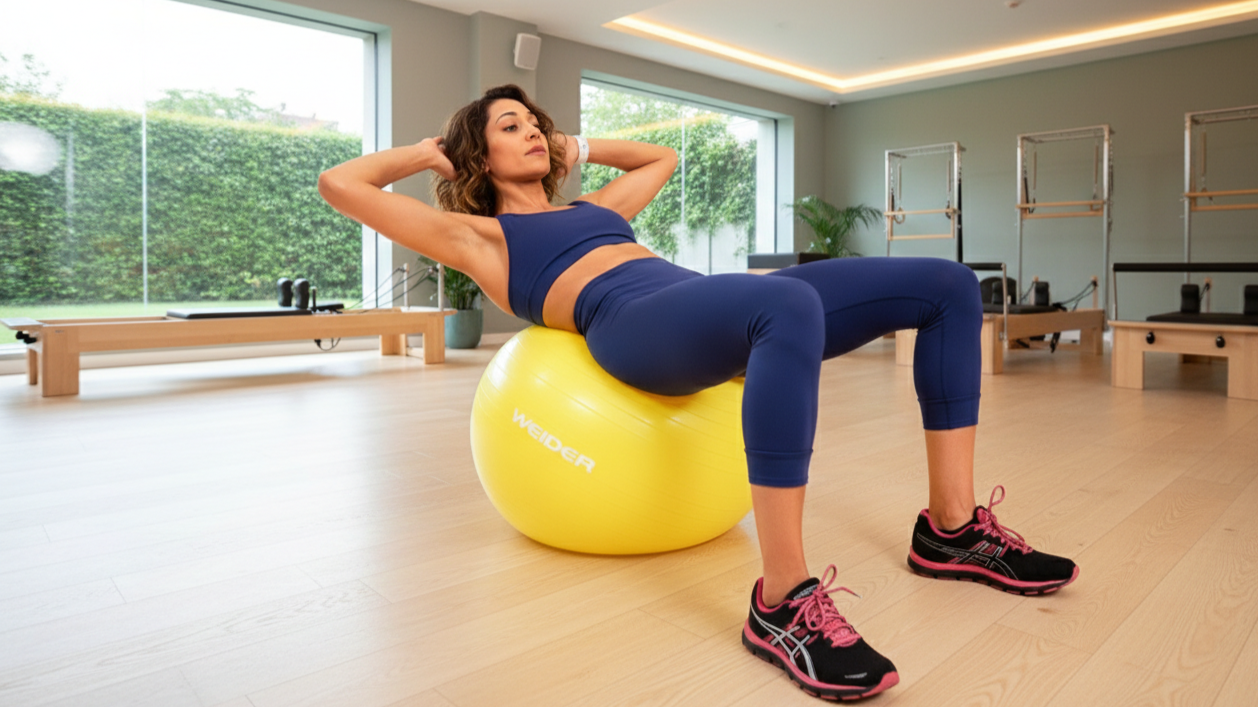
A Ball Crunch is a core exercise performed using a small Pilates ball placed under your lower or mid-back.
Instead of forcing the movement, the ball supports your spine and guides you through a slow, controlled crunch.
This turns a basic exercise into Body control training that protects your back and improves awareness.
You’re not jerking your body up.
You’re lifting with intention.
Why Ball Crunch Is Safer for Injured Athletes
After injury, your body often avoids certain muscles without you realizing it.
The Ball Crunch helps fix that.
Because the ball is unstable, your core has to engage evenly to stay balanced.
This reduces strain on the neck and lower back.
It’s a perfect example of Body control training because the focus stays on quality, not quantity.
Slow reps.
Steady breathing.
Full control.
How Ball Crunch Improves Athletic Recovery
1. Rebuilds Deep Core Strength
The Ball Crunch activates muscles that support your spine, not just surface abs.
This support is essential when returning to running, lifting, or sport-specific movements.
2. Improves Posture Without Stress
As you crunch over the ball, your spine moves naturally.
This helps undo stiffness caused by injury or protective movement patterns.
3. Trains the Mind-Body Connection
Every rep forces you to stay present.
That awareness is a key part of Body control training, especially when confidence in movement is low.
How to Perform a Ball Crunch Correctly
- Sit on the floor and place the ball behind your lower back
- Lean back until the ball supports your spine
- Cross arms over chest or place hands behind head lightly
- Exhale and slowly lift your upper body
- Inhale as you return with control
No rushing.
No pulling the neck.
Just smooth movement.
Why Ball Crunch Fits Perfectly Into Pilates-Based Recovery
The Ball Crunch blends strength, control, and safety.
It’s gentle enough for recovery, yet challenging enough to build real support for athletic movement.
When done correctly, it becomes more than an ab exercise it becomes a foundation builder.
And for athletes coming back from injury, that foundation matters more than anything.
How Pilates Workout Balls Specifically Help Injured Athletes
Pilates workout balls are powerful tools during recovery because they create challenge without stress.
Here’s how they help:
- Core stability – Small movements wake up deep core muscles
- Better posture – The body learns to stack itself correctly
- Joint safety – Less impact, more control
- Muscle balance – Weaker sides get attention
- Mental focus – Movement becomes intentional
This is core focused strength training done the right way.
You’re not chasing fatigue.
You’re rebuilding foundation.
Why Balance Matters More Than Strength During Recovery
Most injuries happen when the body loses control.
Not when it’s weak.
Pilates workout balls create gentle instability.
That instability forces your body to respond intelligently.
This turns each session into a Balance and core workout.
You’re teaching your body to:
- React quickly
- Stabilize joints
- Move efficiently
- Protect itself
That’s what real recovery looks like.
Real-Life Scenario: The Runner With a Knee Injury
A competitive runner comes in after knee pain stopped their training.
They try gym workouts first.
Heavy machines.
Fast movements.
Pain comes back.
We slow things down with pilates workout balls.
Week by week, they regain control in the hips and core.
The knee stops compensating.
The body moves as one unit again.
That’s Body control training in action.
Inner Thigh Squeeze: Small Movement, Big Support for Athletic Recovery
After injury, athletes often focus on the obvious areas knees, backs, shoulders.
But one important area is usually ignored: the inner thighs.
The Inner Thigh Squeeze may look simple, but it plays a powerful role in rebuilding stability and control, especially during recovery.
What Is the Inner Thigh Squeeze?
The Inner Thigh Squeeze is performed by placing a small Pilates ball or cushion between the thighs and gently squeezing it during controlled movements.
This action activates deep muscles that connect the legs, pelvis, and core.
It’s a key part of core focused strength training because it trains your body to move as one unit instead of isolated parts.
Why Inner Thigh Strength Matters After Injury
When inner thigh muscles are weak, the body loses alignment.
This can affect:
- Knee tracking
- Hip stability
- Pelvic control
- Lower back support
During the Inner Thigh Squeeze, these muscles switch back on in a safe, low-impact way.
That’s why it’s often used in core focused strength training programs designed for recovery.
How the Inner Thigh Squeeze Supports Athletic Movement
1. Improves Hip and Pelvic Stability
Strong inner thighs help stabilize the pelvis during walking, running, and lifting.
This reduces unnecessary strain on injured areas.
2. Enhances Core Engagement Naturally
The squeeze sends a signal to the deep core muscles to activate.
Without forcing effort, the body creates internal support—one of the main goals of core focused strength training.
3. Reduces Compensation Patterns
After injury, athletes often shift weight or movement to one side.
The Inner Thigh Squeeze encourages even muscle activation, helping restore balance.
How to Perform the Inner Thigh Squeeze Correctly
- Lie on your back or sit upright
- Place a small ball or cushion between your thighs
- Gently squeeze without tensing the legs
- Maintain steady breathing
- Hold for 5–10 seconds, then release slowly
The effort should feel controlled, not aggressive.
Why This Exercise Belongs in Pilates-Based Recovery
The Inner Thigh Squeeze builds strength quietly.
No impact.
No strain.
No rushing.
Yet it reinforces the deep connections that protect joints and improve movement quality.
For athletes rebuilding from injury, this small exercise can make a big difference—especially when paired with mindful, well-guided training.
Wall Squat With Ball: Controlled Strength for Safe Athletic Progress
After injury, squats can feel intimidating.
There’s fear of pain.
Fear of wrong form.
Fear of pushing too hard, too soon.
The Wall Squat with Ball removes that fear by adding support, feedback, and control making it one of the safest lower-body exercises for recovery-focused athletes.
What Is a Wall Squat With Ball?
A Wall Squat with Ball is performed by placing a Pilates ball between your lower back and the wall.
As you squat, the ball supports your spine and guides your movement.
This setup turns a traditional squat into a Balance and core workout that protects joints while strengthening key muscles.
Instead of dropping quickly, your body moves slowly and intentionally.
Why Wall Squats Are Safer After Injury
Injured athletes often lose proper squat mechanics.
They lean forward.
They shift weight unevenly.
They rely too much on one side.
The wall and ball correct these habits.
By keeping your spine aligned and your movement controlled, this exercise becomes a powerful Balance and core workout that reduces strain on knees, hips, and the lower back.
How Wall Squat With Ball Supports Athletic Recovery
1. Builds Lower-Body Strength Without Impact
The exercise strengthens quads, glutes, and hamstrings without jumping or heavy loading.
This is ideal when joints are still healing.
Because your back stays supported, your body can focus on clean movement and stability—key elements of a Balance and core workout.
2. Improves Core Engagement Naturally
As you squat, your core muscles activate to keep you steady against the wall.
This creates internal support without forcing effort.
The ball provides feedback, letting you feel when posture slips.
3. Restores Confidence in Movement
Many athletes hesitate with lower-body movements after injury.
Wall Squats rebuild trust.
Each controlled rep reminds your body that it can move safely again through a Balance and core workout approach.
How to Perform a Wall Squat With Ball Correctly
- Stand with your back against a wall
- Place a Pilates ball between your lower back and the wall
- Feet shoulder-width apart and slightly forward
- Slowly bend your knees, sliding down the wall
- Stop when thighs are near parallel
- Press through heels to return upright
Move slowly.
Breathe steadily.
Stay in control.
This steady pace reinforces the principles of a Balance and core workout without overloading the body.
Why This Exercise Fits Perfectly Into Pilates-Based Training
The Wall Squat with Ball blends strength, posture, and awareness.
It doesn’t rush progress.
It doesn’t punish weak areas.
It teaches the body how to move efficiently again.
For athletes rebuilding after injury, this exercise offers structure, safety, and confidence—making it a smart addition to any recovery-focused training plan.
A Realistic Weekly Plan for Busy Athletes
You don’t need daily sessions.
A smart plan looks like this:
- 2–3 sessions per week
- 45–60 minutes per session
- Focus on control, breathing, and form
After 4 weeks, most athletes notice:
- Less stiffness
- Better posture
- Stronger core
- More confidence in movement
This is core focused strength training that respects recovery.
Pilates vs Gym Training for Injured Athletes
Gym Training
- Heavy weights
- Fast movements
- Risk of poor form
- Easy to overload
Pilates Training
- Controlled movement
- Low impact
- Posture-focused
- Joint-friendly
With pilates workout balls, the focus stays on precision.
That’s safer during recovery.
Why Environment Matters During Recovery
Where you train matters.
A focused space like a pilates reformer studio las vegas allows:
- Fewer distractions
- Better coaching attention
- Safer movement progressions
Athletes heal better when they feel supported.
Bridge With Ball: Rebuilding Glute Strength and Spinal Support Safely
After injury, the hips and lower back often lose strength faster than we expect.
You may feel weak getting out of a chair.
Your lower back may tighten during simple movements.
Your glutes may feel “asleep.”
The Bridge with Ball is a simple but powerful exercise that helps bring these areas back online without stress or strain. It’s commonly taught in controlled environments like a pilates reformer studio las vegas, where recovery-focused movement matters.
What Is a Bridge With Ball?
A Bridge with Ball is performed by lying on your back with knees bent and feet flat on the floor.
A small Pilates ball is placed between the thighs or under the feet, depending on the variation.
As you lift your hips, the ball adds gentle challenge and feedback.
This forces the body to stay aligned and controlled.
Instead of pushing through the lower back, you learn to lift using your glutes and core together.
Why This Exercise Is Ideal After Injury
After injury, many athletes overuse their lower back and underuse their glutes.
The Bridge with Ball helps correct that pattern.
The ball encourages even muscle activation and prevents the hips from shifting or collapsing.
This makes it a safer option during recovery and a staple in many programs taught at a pilates reformer studio las vegas.
Slow movement builds trust in the body again.
Key Benefits of the Bridge With Ball
1. Activates Glutes Without Overloading the Spine
The supported position protects the lower back while strengthening the hips.
This is essential for athletes returning to running, lifting, or sport-specific movements.
2. Improves Pelvic and Core Stability
The ball challenges stability just enough to engage deep muscles.
This helps restore proper movement patterns that injuries often disrupt.
3. Reduces Lower Back Tension
When glutes work correctly, the lower back can relax.
Over time, this reduces stiffness and improves posture during daily movement.
How to Perform the Bridge With Ball Correctly
- Lie on your back with knees bent
- Place a small ball between your thighs
- Keep arms relaxed by your sides
- Exhale and lift hips slowly
- Hold for 2–3 seconds
- Lower down with control
The movement should feel smooth and steady, never forced.
Why This Exercise Fits Pilates-Based Recovery
The Bridge with Ball teaches the body how to support itself again.
It builds strength quietly and effectively.
No impact.
No rushing.
That’s why it’s often included in recovery-focused sessions at a pilates reformer studio las vegas, where precision and safety come first.
For athletes rebuilding from injury, this exercise helps lay the foundation for stronger, more confident movement.
Plank With Ball: Building True Core Strength Without Overloading the Body
After injury, planks can feel intimidating.
Your shoulders shake.
Your lower back tightens.
You’re never sure if you’re doing it right.
The Plank with Ball offers a smarter way to rebuild core strength one that focuses on control, not suffering. It’s a style of movement often used in recovery-based programs like reformer pilates las vegas, where form matters more than time.
What Is a Plank With Ball?
A Plank with Ball is a traditional plank made more effective by adding a small Pilates ball.
The ball may be placed under the hands, forearms, or feet depending on the level.
This small change increases awareness and forces your body to stabilize evenly.
Instead of holding tension, you learn to hold alignment.
That’s why variations like this are commonly taught in reformer pilates las vegas studios focused on safe progression.
Why Plank With Ball Is Better After Injury
After injury, the body often cheats during planks.
Hips sag.
Shoulders overwork.
The lower back takes over.
The ball exposes these issues immediately.
Because the surface is slightly unstable, your deep core muscles have to activate to keep you steady.
This makes the exercise challenging without being aggressive exactly what recovery requires.
This controlled approach is a major reason reformer pilates las vegas programs rely on ball-supported planks.
Key Benefits of the Plank With Ball
1. Strengthens the Deep Core Safely
The exercise targets muscles that protect the spine, not just surface abs.
This support is essential for athletes returning to sport.
2. Improves Shoulder and Hip Stability
Holding the plank with control trains joints to stay centered.
That stability reduces strain during pushing, lifting, and running.
3. Builds Confidence in Holding Positions
Many athletes fear static positions after injury.
The Plank with Ball rebuilds trust by making the body feel supported, not trapped.
How to Perform a Plank With Ball Correctly
- Place the ball under forearms or hands
- Step feet back into a straight plank
- Keep neck relaxed and gaze down
- Engage core gently
- Hold for 20–40 seconds with steady breathing
Stop before form breaks.
Quality always matters more than time an idea strongly emphasized in reformer pilates las vegas–style training.
Why This Exercise Fits Perfectly Into Recovery Training
The Plank with Ball teaches strength through stillness.
It doesn’t rush progress.
It doesn’t punish weak areas.
It helps the body feel organized again.
For athletes rebuilding after injury, that sense of control is just as important as strength itself.
Why Blue Chip Conditioning Is Different
At bluechip conditioning, injured athletes are not rushed.
You’ll find:
- Small class sizes
- Trainers who correct movement
- Clean, calm environment
- Beginner-friendly progressions
Recovery requires patience.
That’s built into the culture at bluechip conditioning.
Pilates Workout Balls and Reformer Training Together
When pilates workout balls are combined with reformer work, results improve.
Reformer training adds resistance.
The ball adds control.
This combination is common in reformer pilates las vegas programs focused on rehabilitation.
Athletes regain strength without sacrificing safety.
Real-Life Scenario: The Athlete Afraid to Move Again
After a shoulder injury, an athlete avoids overhead movement.
Fear replaces confidence.
Using pilates workout balls, they relearn shoulder stability slowly.
No pain.
No panic.
Confidence returns before strength.
That’s recovery done right.
Common Myths Injured Athletes Believe
“Pilates is too easy”
Easy movements done correctly are harder than heavy weights done wrong.
“I need to be flexible”
Flexibility improves with practice.
“It’s only for women”
Control-based training benefits all athletes.
“Gym training is faster”
Faster isn’t better during recovery.
Why Athletes Trust This Method
Pilates workout balls teach patience.
They reconnect the brain and body.
This is why many professional recovery programs include Body control training principles.
It’s not flashy.
It’s effective.
Where Athletes in Las Vegas Train Safely
Athletes searching for pilates reformer studio las vegas options often want guidance, not intensity.
Programs that integrate pilates workout balls support safer returns to sport.
This is why bluechip conditioning attracts athletes in recovery.
FAQ Section
1. Are Pilates workout balls good for athletes recovering from injury?
Yes, they are one of the safest tools for recovery.
Pilates workout balls allow athletes to rebuild strength without heavy pressure on joints.
They slow movements down, which helps your body relearn control and balance after injury.
This is especially helpful when muscles are weak or compensating for pain.
2. Can Pilates workout balls help prevent re-injury?
Yes, and this is one of their biggest benefits.
After an injury, your body often moves differently without you realizing it.
Pilates workout balls expose those weak links and help correct them early.
Better control means fewer sudden movements that cause re-injury.
3. How are Pilates workout balls different from gym stability balls?
Pilates workout balls are smaller and more precise.
They focus on deep muscle activation, posture, and control rather than large movements.
Gym stability balls often encourage big motions, which aren’t ideal during recovery.
For injured athletes, smaller tools create safer progress.
4. How often should injured athletes train with Pilates workout balls?
Most athletes benefit from 2 to 3 sessions per week.
This gives your body enough stimulus to improve without overloading healing tissues.
Consistency matters more than intensity.
Slow, regular practice leads to stronger results.
5. Can Pilates workout balls help with chronic back pain after injury?
Yes, especially when back pain comes from weak core support.
Pilates workout balls help activate deep muscles around the spine.
These muscles act like a natural brace for your back.
Over time, posture improves and pain often decreases.
6. Is Pilates with workout balls safe after surgery or physical therapy?
In many cases, yes but guidance is important.
Pilates workout balls are commonly used after physical therapy to bridge the gap back to full training.
They help transition from rehab exercises to functional movement.
Always work with a qualified instructor who understands injury recovery.
7. Will Pilates workout balls make athletes stronger or just more flexible?
They do both, but strength comes first.
Pilates workout balls build strength through control, not speed or weight.
You’ll feel stronger in movements like running, lifting, and changing direction.
Flexibility improves naturally as muscles learn to relax and work together.
8. How long does it take to see results from Pilates workout balls?
Most athletes notice changes within 3 to 4 weeks.
Early improvements include:
- Better balance
- Less stiffness
- Improved posture
- More confidence in movement
Strength continues to build with consistent practice.
9. Are Pilates workout balls only for beginners or low-level athletes?
No, they are used by athletes at all levels.
Even advanced athletes use Pilates workout balls to refine movement and prevent injuries.
The exercises become harder as control improves.
Difficulty comes from precision, not weight.
10. Can Pilates workout balls improve athletic performance after recovery?
Yes, they often enhance performance long-term.
Athletes move more efficiently when their core and stabilizing muscles are strong.
This means better power transfer, faster reaction time, and smoother movement.
Many athletes return stronger than before their injury.
Conclusion
Injury changes how you see your body.
Movements you never thought about suddenly feel risky.
Strength doesn’t feel reliable anymore.
Confidence takes a hit.
That’s why recovery needs more than hard workouts.
Pilates workout balls slow things down in the best way possible.
They help you rebuild control before power.
They teach your body to move safely again without fear, strain, or pressure.
This kind of training isn’t about rushing back.
It’s about coming back smarter, stronger, and more aware than before.
Your body has been protecting you since day one.
Now it deserves training that supports it just as carefully.
If you’re ready to move again with confidence, a single session at Blue Chip Conditioning can be a calm, safe place to start.