Endless crunches promise flat abs and rarely deliver. Pilates ab exercises take a smarter path. They train your core as a full system, deep muscles and all, so you build real stability instead of surface-level soreness. The payoff is a stronger, flatter midsection that actually supports your spine.
I spent years doing crunches before I understood this. My abs got tired, sure, but my back still ached and my posture stayed sloppy. Once I switched to a Pilates-based approach, everything clicked. This guide explains why that shift works and how you can make it yourself, step by step.
| Quick Answer Pilates ab exercises are controlled, low-impact movements that strengthen the entire core, including the deep transverse abdominis and the muscles around the spine. Unlike crunches, they emphasize stability, breathing, and control. The result is better posture, a flatter stomach, and a back that feels protected during everyday movement. |
Your Core Is Not Just a Six-Pack
Most people picture the front abs when they think core. That view is far too narrow. Your core wraps around your whole midsection like a natural corset, and it includes muscles you cannot even see.
Crunches mostly hit one of those muscles, the rectus abdominis. Meanwhile, the deeper layers stay weak. That imbalance is why so many crunch-heavy routines lead to nagging back pain. Pilates fixes the gap by training the whole unit together.
The Muscles That Matter
- Transverse abdominis: the deep layer that braces your spine like a built-in belt.
- Rectus abdominis: the front muscles responsible for that visible six-pack line.
- Obliques: the side muscles that handle twisting and side bending.
- Pelvic floor and multifidus: small stabilizers that keep your hips and lower back steady.
Strong, balanced versions of all four create true core strength. That is the foundation every good set of Pilates ab exercises is built on.
7 Pilates Ab Exercises That Actually Build Core Strength
These moves need nothing but a mat. Start slow, focus on control, and stop the moment your form breaks down. Quality always beats quantity here.
- The Hundred: a classic breathing-and-bracing drill that lights up the deep core.
- Single-leg stretch: alternating leg pulls that build control and coordination.
- Double-leg stretch: extend and gather to challenge the whole front of the core.
- Criss-cross: a slow bicycle motion that targets the obliques.
- Roll-up: a smooth spinal articulation that strengthens and lengthens at once.
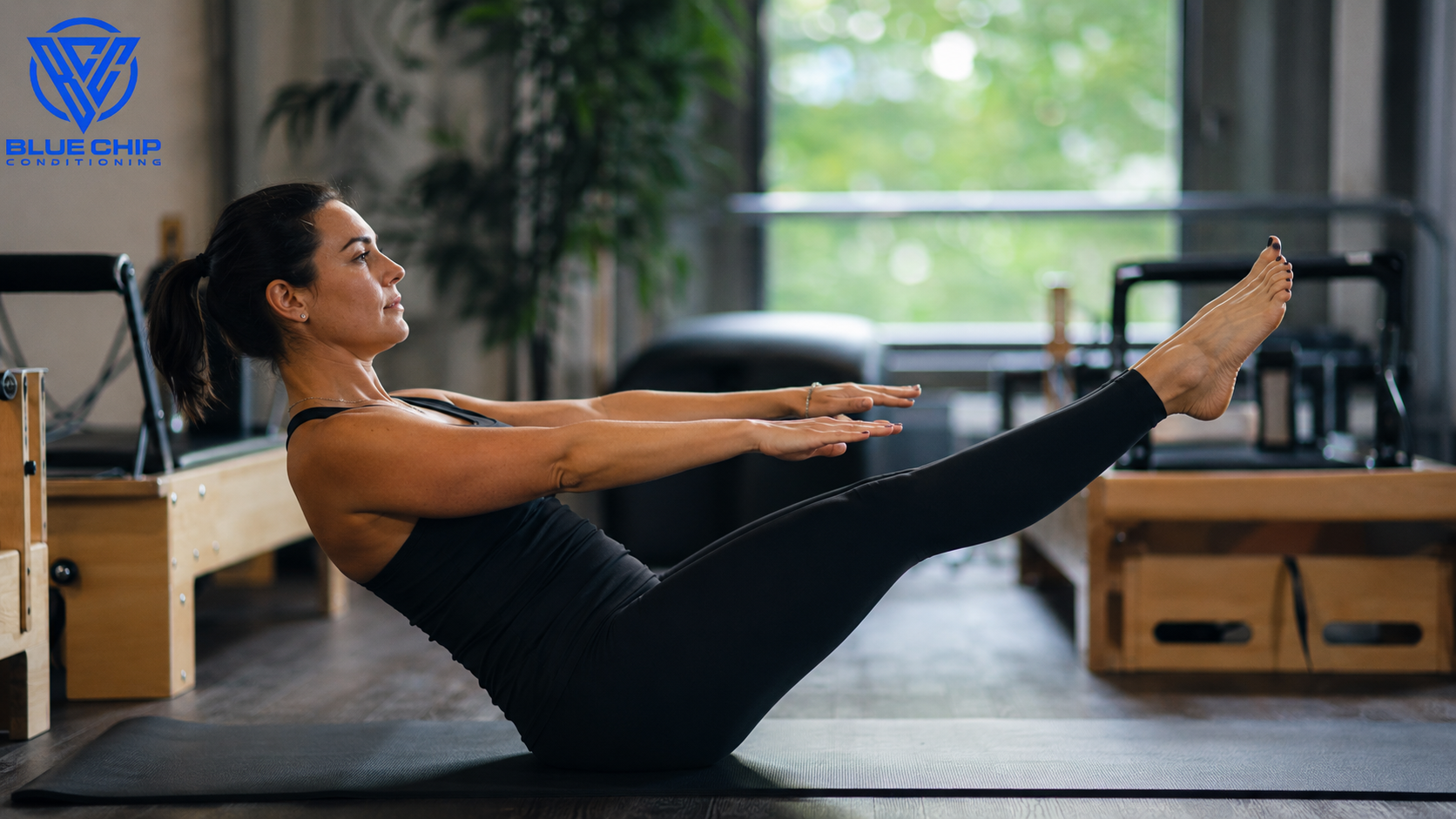
- Teaser: an advanced balance move that demands serious control.
- Plank with leg lift: a full-body hold that trains stability under load.
Run through three to five of these per session. Even five focused minutes of Pilates ab exercises beat twenty minutes of mindless crunches.
| Prefer guided practice? Our Las Vegas Pilates classes walk you through each of these moves with hands-on coaching. |
How This Differs From a Typical Gym Ab Day
Walk into most gyms and the ab routine looks the same: fast crunches, a few sit-ups, maybe a plank held until the arms shake. That style chases fatigue. Pilates ab exercises chase control instead, and the difference shows up in how your body feels later.
Speed and momentum let gravity do half the work in a crunch. Slow, deliberate Pilates ab exercises remove that shortcut. Your muscles stay under steady tension, so they work harder even though the movement looks gentler. That is the quiet trick behind the whole method.
There is also the breathing piece. Gym ab work rarely mentions it, yet breath is what switches on your deepest core layer. When you tie each rep to an exhale, you train the muscle that protects your spine, not just the one you see in the mirror.
Build Your Core in 4 Progressive Weeks
Jumping straight to advanced moves is a fast track to frustration. So follow this gradual plan instead. Each week adds a little challenge once the previous one feels solid.
- Week 1 — Connect: Practice the Hundred and basic bracing. Learn to find your deep core before adding movement.
- Week 2 — Coordinate: Add the single-leg and double-leg stretch. Keep your lower back glued to the mat.
- Week 3 — Challenge: Introduce the criss-cross and roll-up. Move slowly and breathe with each rep.
- Week 4 — Integrate: Attempt the teaser and plank variations. Combine everything into one flowing session.
By the end of the month, you will own a routine that scales with you for years. If you want a head start on the basics, our core strength tips for beginners cover the groundwork in plain language.
Form Cues That Change Everything
Small details separate effective Pilates ab exercises from a wasted effort. Keep these cues front of mind on every rep.
Zip Up Your Deep Core
Before you move, gently draw your belly button toward your spine. This activates the transverse abdominis and gives every move a stable base. Think of zipping up a tight pair of jeans, not sucking in your gut.
Exhale on the Effort
Breathe out as you contract, and your deep core engages automatically. Hold your breath instead, and you lose that natural support. Breathing is the rhythm that ties the whole practice together.
Press the Lower Back Down
During floor moves, keep your lower spine in contact with the mat. The moment it arches, your hip flexors take over and the abs check out. So move only as far as you can while staying flat.
Scale the Moves to Your Level
One reason Pilates ab exercises suit nearly everyone is that each move bends to your ability. You never have to choose between too easy and too hard. Instead, you adjust the lever.
Make It Easier
Bend your knees, keep your feet down, or shorten the range. For the Hundred, rest your head and lift only your arms. These small tweaks keep your form clean while you build the strength to progress.
Make It Harder
Straighten your legs, lower them closer to the floor, or slow the tempo even further. A longer lever and a slower count turn gentle Pilates ab exercises into a serious challenge, no extra equipment required.
Because the moves scale so smoothly, a beginner and a seasoned athlete can do the same exercise side by side, each working at the right intensity. That flexibility is what keeps the routine useful for years rather than weeks.
Mistakes That Quietly Stall Your Progress
Even committed people fall into these traps. Catch them early and your results speed up.
- Pulling on the neck: let your core lift you, not your hands.
- Rushing reps: speed removes the tension that builds strength.
- Skipping the breath: without exhaling on effort, the deep core stays asleep.
- Chasing soreness: a burning feeling is not the same as a stronger core.
Mat or Reformer for Your Abs?
Both tools work, and neither is wrong. Mat practice is accessible and free, so it is the perfect place to begin. You learn control with nothing but your bodyweight and gravity.
The reformer, however, adds adjustable spring resistance. That lets you load the core in ways the mat simply cannot match, and it offers support for tricky moves. Many members blend the two, building a base on the mat and then progressing on the machine. Our reformer Pilates program is a natural next step once your form feels dialed in.
A Quick Honest Comparison
Not sure which to pick? Use this quick rundown to decide where to start and when to level up.
- Mat — Pro: free, portable, and great for learning the fundamentals.
- Mat — Con: limited resistance options as you advance.
- Reformer — Pro: scalable resistance and helpful support for harder moves.
- Reformer — Con: needs equipment, so it usually means a studio visit.
Who Benefits Most From This Approach
Honestly, almost everyone. New parents rebuilding after pregnancy lean on the gentle, deep-core focus. Office workers undo hours of sitting. Athletes sharpen the stability that powers every sport. Older adults gain balance and confidence on their feet, which matters more with each passing year.
The method also adapts to injuries and limitations far better than high-impact training. Because the moves stay low to the ground and rely on control rather than force, people recovering from back trouble often find them safe and even soothing. Always clear new exercise with your doctor, of course, yet many physical therapists already use these patterns in rehab.
I once worked with a runner who kept getting sidelined by lower-back tightness. We added two short core sessions a week, nothing dramatic. Within six weeks his back settled, and his stride felt smoother than ever. The lesson stuck with me. A strong, controlled core fixes problems people often blame on the legs or the spine. He kept the habit long after the pain disappeared, simply because he liked how steady his whole body felt.
If you are searching for structure and a supportive room full of people chasing the same goal, group Pilates in Las Vegas can keep you consistent. Showing up gets easier when a coach and a community expect you.
Carry Your Core Strength Into Daily Life
The real test of core training is not the mat. It is the moment you lift a toddler, twist to grab a bag from the back seat, or stand through a long meeting. Pilates ab exercises prepare you for exactly those moments because they train movement, not just muscle.
Try this. Next time you pick something up off the floor, gently brace your deep core first, then exhale as you lift. That is the same pattern you practice on the mat, now working for you in real life. After a few weeks it becomes automatic, and your back stops absorbing the strain.
Consistency is the only catch. A single great session does little; a steady habit changes everything. If staying consistent on your own feels hard, a supportive studio helps. Practicing Pilates in Las Vegas alongside a coach gives you the structure and accountability that solo workouts often lack.
Final Thoughts
Pilates ab exercises reward patience and precision over speed and volume. Train the whole core, breathe with intention, and progress gradually, and you will build a midsection that looks toned and feels genuinely strong. Skip the endless crunches. Trade them for controlled, full-core work, and your back will thank you too. The best part is that these moves grow with you, so the routine you start today can still challenge you a year from now.
| Want expert eyes on your form? Book a class with Blue Chip Conditioning and experience smarter core training with the best Pilates in Las Vegas. |
Frequently Asked Questions
Are Pilates ab exercises better than crunches?
For most people, yes. They train the deep core and protect the spine, while crunches mostly work the surface muscles and can strain the back.
How often should I train my core?
Two to four short sessions a week is ideal. Your core recovers quickly, but it still needs rest days to grow stronger.
Can Pilates give me visible abs?
It can strengthen and tone the muscles, which helps define them. Visible abs also depend on lowering body fat through overall activity and nutrition.
Do I need equipment to start?
No. A mat is all you need for the moves in this guide. You can add a reformer later for extra resistance and variety.
Will core work help my back pain?
Often, yes. A strong deep core stabilizes the spine and can ease common, non-medical back strain. Many people notice less stiffness after a few weeks of steady practice. Still, check with a professional if pain persists or feels sharp.
Are Las Vegas Pilates classes good for beginners?
Very much so. Most Las Vegas Pilates classes offer beginner-friendly options, and a coach can scale every move to your level.
How long until I feel a difference?
Many people feel more stable within two to three weeks. Strength and definition build steadily after that with regular practice.