
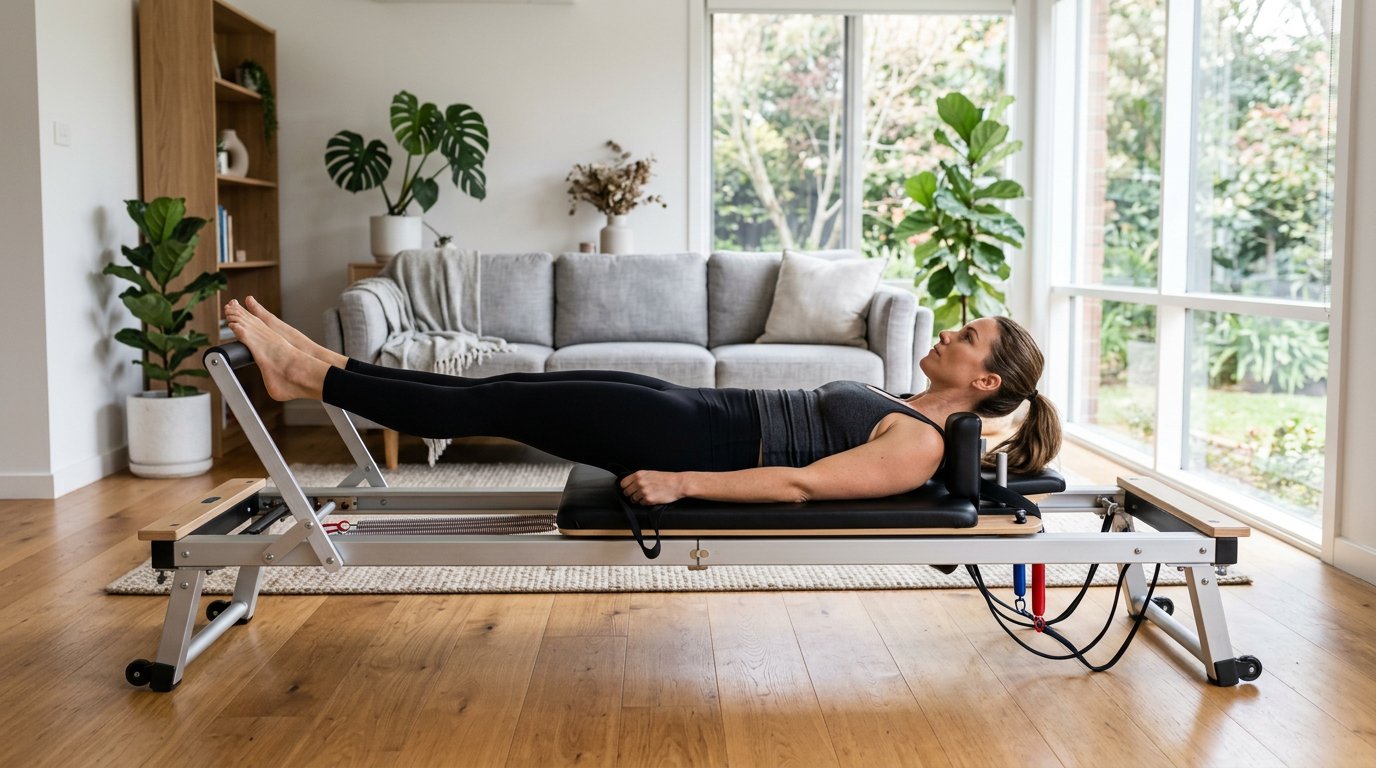
Thinking about skipping the studio drive and training on your own schedule instead? A portable pilates reformer promises studio-style training without ever leaving your living room. It folds away, costs far less than a full machine, and sounds like the perfect shortcut. But “portable” comes with real trade-offs. This guide breaks down exactly what you gain, what you lose, and whether it fits your specific goals, so you can decide with real information instead of a sales page.
Quick Answer: A portable pilates reformer works well as a supplement for people who already know proper form from studio classes. It’s a poor first purchase for complete beginners, since shorter carriage travel and lighter springs limit how much correction and progress you can get on your own.
What “Portable” Actually Means for a Reformer
Manufacturers cut weight and size in predictable places to make a machine foldable. Here’s what usually changes:
- Shorter carriage travel distance.
- Lighter, simpler spring systems.
- A lighter overall frame that folds for storage.
- Fewer accessory attachments compared to studio models.
Each change makes the equipment easier to store and move. Each change also limits what you can safely do once your skills grow.
The Real Pros of a Portable Pilates Reformer
To be fair, these machines solve genuine problems for the right person:
- Cost. A folding model runs a fraction of what studio-grade equipment costs.
- Storage. Most fold flat and slide under a bed or into a closet.
- Convenience. You can train on your own schedule without a commute.
- Consistency. Daily access removes the excuse of a busy week getting in the way.
For someone who already trains with an instructor, these benefits add real value between sessions.
The Real Cons of a Portable Pilates Reformer
The limitations matter more than marketing usually admits:
- Shorter carriage travel limits full-extension moves like long stretch or elephant, which need maximum range to work properly.
- Lighter spring resistance caps how much load advanced practitioners can eventually add.
- Lower frame stability raises safety concerns during larger or faster movements.
- No live correction means small form mistakes go unnoticed and can turn into habits.
None of this makes a folding machine unsafe for basic use. It simply caps how far your training can advance without a coach nearby.
Building a Pilates at Home Equipment Plan That Actually Works
A portable pilates reformer rarely works well on its own. Most successful home practices build a small pilates at home equipment plan around it, adding a mat, a light resistance band, and a stability ball for the days you want a shorter session.
This kind of pilates at home equipment setup keeps you moving daily, while the reformer itself stays reserved for longer, more focused practice sessions once or twice a week.
Who a Portable Pilates Reformer Actually Makes Sense For
This kind of machine fits a specific type of client best. Someone who already trains regularly in a studio and wants a low-stakes way to reinforce footwork and basic core work at home is the ideal candidate. Used this way, the equipment extends practice time without replacing the coaching that built your form in the first place.
If that description fits you, adding one to your routine can genuinely help you stay consistent between weekly classes.
Who Should Skip It Completely
If you’ve never used a reformer before, a folding model is the wrong place to start. Without an instructor watching, small alignment issues go uncorrected. A shifting hip during footwork or a collapsing shoulder during rowing can quietly turn into a habit that takes months to unlearn later.
Beginners get far more value starting in a guided Group Reformer Class, where an instructor can catch these issues in real time before they ever become automatic.
Is This the Best Pilates Reformer for Homes, or Just the Cheapest?
Search results often blur the line between the best pilates reformer for homes and simply the cheapest one available. Those aren’t always the same machine. The best pilates reformer for homes balances a stable frame, decent spring range, and honest weight capacity, even if it costs a bit more than the bargain options.
Buying the absolute cheapest option rarely counts as choosing the best pilates reformer for homes in any meaningful sense, since a wobbly frame or weak springs can undo the benefit of training at all.
Understanding Real Pilates Reformer Cost Before You Buy
Total pilates reformer cost goes well beyond the sticker price. Delivery fees, assembly time, and eventual accessory purchases all add up. A machine advertised at $400 can easily reach $500 once shipping and basic accessories get factored in.
Comparing pilates reformer cost against a studio membership only makes sense when you count everything, not just the initial purchase price.
Portable Reformer vs. Studio Membership: A Realistic Cost Comparison
Here’s how the numbers typically break down over a full year:
| Option | Approximate Year-One Cost | What You Actually Get |
| Portable pilates reformer | $300 to $800 (one-time) | Self-guided practice, no correction |
| Studio membership, 2x weekly | $1,500 to $3,000 | Certified coaching, professional equipment, community |
| Hybrid: portable plus occasional classes | $600 to $1,200 | Home reinforcement plus periodic in-person correction |
The upfront savings look appealing at first glance. That appeal fades once you factor in the plateau that comes from training without feedback, a cost that never shows up on a receipt but shows up clearly in your results.
Step-by-Step: How to Decide if It Fits Your Plan
Work through these five questions honestly before you buy:
- Have you already taken at least eight to ten guided classes with a certified instructor?
- Can you currently perform footwork, the hundred, and basic rowing with correct form?
- Do you have a dedicated space with enough clearance for the carriage to extend fully?
- Is your main goal reinforcement between classes, not replacing them entirely?
- Are you comfortable checking in with an instructor now and then to catch small form drift?
If you answered yes to most of these, a portable pilates reformer is a reasonable next step. If you answered no to two or more, start with classes first.
What to Look for in a Portable Pilates Reformer
Not every portable pilates reformer is built the same. Frame material, spring quality, and carriage length vary a lot between budget and mid-range options. Look for a weight capacity that comfortably exceeds your body weight, a carriage with smooth, tested glide, and a frame that locks securely during use rather than shifting mid-exercise.
Cheaper models often cut corners exactly where it matters most. A slightly higher price for a sturdier frame is almost always worth it once you’re training daily.
Making the Right Gear Choice From Day One
Equipment decisions go smoother once you already understand your own body and goals. Our guide on what to wear to Pilates covers the fitted clothing and grip socks that make any reformer session, home or studio, safer and more comfortable from the very first rep.
A Realistic Middle Ground: The Hybrid Approach
Most clients don’t need to choose one option forever. A common, sensible pattern looks like this: build your foundation in studio classes, add home equipment once your form is solid, then keep a weekly or biweekly class going for ongoing correction and progress.
This hybrid approach keeps your total pilates reformer cost reasonable, while still giving you the feedback that equipment alone can never provide. If you’re comparing numbers directly, our pricing page breaks down class packages so you can weigh a hybrid plan against buying gear alone.
Before you commit to buying anything, it’s worth trying the real thing first. Book a class and see whether in-studio training fits your goals better than training solo.
Maintenance and Longevity: What to Expect Over Time
Folding frames see more wear than studio machines, simply because they get assembled and disassembled repeatedly. Hinges loosen. Springs stretch slightly faster under regular home use. None of this happens overnight, but it happens faster than most buyers expect.
A little upkeep goes a long way. Wipe down the carriage rails after sweaty sessions, since salt and moisture speed up rust on cheaper frames. Check spring hooks every few weeks for early signs of stretching or bending. Tighten any loosening bolts before they become a safety issue rather than after.
Treat these small checks like you would any home fitness equipment. A few minutes of care each month adds real years to the machine’s usable life, and it keeps your workouts feeling as smooth on day 200 as they did on day one.
Common Regrets First-Time Buyers Report
Talk to enough people who’ve bought one, and the same complaints tend to come up:
- “I bought it too early.” Many wish they’d taken a few months of classes first, so they actually understood proper form before training alone.
- “I underestimated the space it needs.” Folded storage is easy, but the extended carriage during use often needs more room than buyers plan for.
- “I stopped using it after a few weeks.” Motivation fades fast without a coach or a class schedule holding you accountable.
- “I didn’t realize how limited the resistance was.” Once basic strength improves, lighter spring systems stop feeling challenging fairly quickly.
None of these regrets mean the purchase itself was wrong. They usually mean the timing or the expectations were off from the start.
A Quick Recap Before You Decide
Here’s the short version. Studios teach form. Home equipment reinforces it. Buying gear before learning proper technique usually backfires. Buying it afterward usually pays off.
Start with classes. Build real skill first. Add equipment once you know what good form actually feels like. That order rarely fails, even if it takes a little longer upfront.
The Bottom Line
A portable pilates reformer isn’t a bad purchase. It’s simply the wrong first purchase for most people. Treat it as a supplement for reinforcing what you already know, not a substitute for learning it in the first place.
Think of it this way. Classes teach the skill. Equipment protects the skill. Skip the first step, and the second one won’t help nearly as much as you’d hope.
Before you buy, try the real thing. Book a Group Reformer Class at Blue Chip Conditioning and see if in-studio training fits your goals better than training alone.
Frequently Asked Questions
Is a portable pilates reformer as good as a studio machine?
Not quite. Portable models trade carriage length and spring strength for lower cost and easier storage, which limits advanced or full-range work.
Can beginners use a portable pilates reformer safely?
Basic use is generally safe, but beginners miss the real-time correction that prevents form mistakes from becoming long-term habits.
What does the average pilates reformer cost for a home model?
Most reasonable models run between $300 and $800, depending on frame quality, spring system, and weight capacity.
Do portable reformers fold away completely?
Most fold flat for storage under a bed or in a closet, though some still need a few feet of clearance even when folded.
Is it better to buy equipment first or start with classes?
Starting with classes almost always pays off more. You’ll learn proper form before spending money on equipment you might use incorrectly.
How do I find the best pilates reformer for homes on a budget?
Prioritize frame stability and spring quality over flashy extras. A simple, sturdy model usually beats a feature-heavy one with a weak frame.
How long should I train in a studio before buying home equipment?
A few months of consistent classes, roughly eight to twelve sessions, gives most people enough of a form foundation to train safely at home.
What’s the biggest mistake people make when buying a portable pilates reformer?
Skipping instruction entirely and expecting the machine alone to teach proper form, which rarely works out well for complete beginners.
Will a portable model still feel challenging after a few months?
Not always. Many users outgrow the lighter spring range within a few months of steady training, which is exactly when a studio class or an upgraded machine starts to make more sense.