
Introduction
Types of Pilates can feel surprisingly personal. One person wants a gentle way to build strength. Another wants a smarter cross-training tool. Someone else needs support after an injury or wants a class that fits a packed schedule. The good news is that the right choice is usually obvious once you match the style to the goal.
That is the real value of Pilates styles: each style solves a slightly different problem. Blue Chip Conditioning in Las Vegas leans into private, semi-private, and group Pilates with a strong emphasis on athletic enhancement, rehabilitation, and personalized instruction, so this topic fits its audience especially well.
Quick Answer Section
Types of Pilates are different ways of practicing the same core method. The best match depends on whether you want mat-based control, machine-assisted support, traditional sequencing, modern modifications, or rehab-focused coaching. For many readers, the choice comes down to fitness level, injury history, and whether they prefer solo practice or studio guidance.
Key Takeaways
- Mat work is the simplest entry point and often the easiest to maintain at home.
- Reformer-based training adds spring resistance and more coaching options for alignment and progression.
- Contemporary Pilates often blends classical principles with modern exercise science and safer progressions.
- Clinical or rehab-oriented sessions are best when movement needs to be adapted carefully.
- The best choice is the one you can do consistently with good form and clear purpose.
What are the main options?
When people search for Types of Pilates, they usually want one thing: clarity. They want to know which style is safest, which one feels hardest, and which one fits their life. That is a smart question, because the answer changes based on body type, training history, and whether you are building confidence or chasing performance. The most common Types of Pilates are mat, reformer, classical, contemporary, and clinical styles.
Mat Pilates
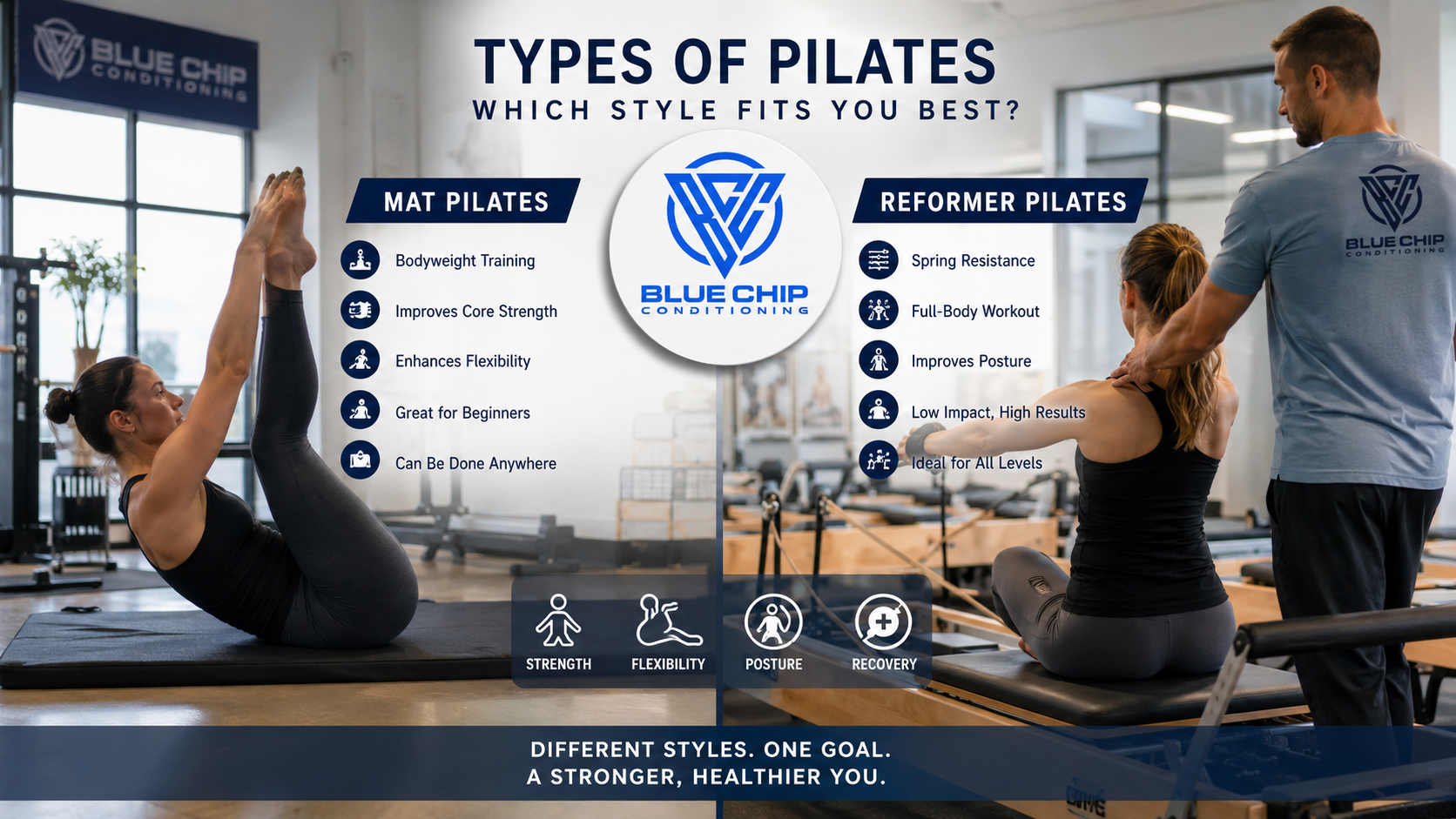
Mat Pilates is often the most approachable place to start. It uses bodyweight, breath control, and precise movement to build core strength, posture improvement, and control and alignment. For many beginners, it is the clearest way to learn the method before adding equipment. This is also why many instructors treat mat work as the foundation of the method.
Reformer Pilates
Reformer Pilates uses springs, straps, and a moving carriage to add resistance and support. It can feel smoother than people expect, but it still challenges the body in a serious way. For clients who want guided movement, stronger feedback, and more progression, reformer pilates las vegas is often a very good fit. That is one reason reformer pilates las vegas is such a strong local search phrase for studios like Blue Chip Conditioning.
Classical Pilates
Classical Pilates follows the original exercise order and principles more closely. It emphasizes precision, flow, and a consistent sequence, which many experienced students appreciate because it teaches discipline and body awareness. If you like structure and measurable progress, this style can feel very grounding.
Contemporary Pilates
Contemporary Pilates keeps the core ideas but often updates the movement selection, teaching style, or equipment use. Many modern studios use these adaptations to serve a wider range of bodies, especially people who need modifications, recovery support, or progressive coaching. This style is often the easiest to scale for mixed-level groups.
Clinical Pilates
Clinical Pilates is usually the most tailored option. It is often used in rehabilitation settings or under highly specific supervision because the exercises are adjusted to the person, not the other way around. That makes it especially useful when someone is managing pain, returning from injury, or rebuilding movement confidence. Blue Chip Conditioning’s service mix clearly leans into that personalized approach.
Comparison: which style fits which goal?
If you want a simple comparison, think of it this way. Mat work is best for learning control. Reformer work is best for feedback and resistance. Classical work is best for structure. Contemporary work is best for flexibility in programming. Clinical work is best for careful adaptation. That is the practical lens most people miss when they compare types of pilates too quickly.
For a busy adult looking for local Pilates classes, the decision usually comes down to convenience and coaching. If you want a class you can repeat weekly without overthinking, reformer-based group work is often the easiest path. If you want private attention, semi-private sessions may be a better entry point because the instructor can adjust the plan as you go. Blue Chip Conditioning offers exactly that kind of format, including private, semi-private, and group sessions.
Why the right style matters more than the “hardest” class
A common mistake is assuming the hardest option is automatically the best. It is not. The best style is the one that improves consistency, protects form, and keeps you engaged long enough to see results. Pilates is a low-impact, full-body workout that can improve strength, flexibility, and posture without needing to feel punishing every session.
That matters for athletes, too. Blue Chip Conditioning presents Pilates as part of athletic enhancement and rehabilitation, which matches what many sports-minded clients need: strong hips, better trunk control, cleaner movement, and recovery-friendly training. For that audience, reformer pilates las vegas is less about trendiness and more about useful, repeatable training.
A simple step-by-step way to choose your style
Here is an easy process.
- Decide your main goal. Do you want strength, flexibility training, injury recovery, posture improvement, or better performance?
- Match the style to the goal. Mat is excellent for foundations. Reformer is excellent for guided resistance. Clinical is best for careful adaptation.
- Think about how you learn. Some people need private instruction first. Others enjoy small group classes and build confidence quickly.
- Start with the least intimidating option. That usually leads to better consistency and fewer drop-offs.
- Review after three to five sessions. Your body will usually tell you whether the class feels supportive, too easy, or too advanced.
Real-life examples people relate to
A runner who wants better hip stability may do well with reformer sessions because the springs give feedback while still allowing controlled loading. A desk worker dealing with stiffness may prefer mat Pilates because it is easy to repeat at home and reinforces breathing and alignment. Someone returning from an old injury may benefit most from clinical work or a private session where the plan is adjusted carefully. These are exactly the kinds of situations where Types of Pilates stop being theory and start becoming practical.
Mistakes to avoid
The biggest mistake is choosing a class based only on popularity. Another mistake is assuming reformer training is only for advanced students. A third is skipping instructor guidance when your body needs modification. Many new clients also jump into harder classes before they have learned breath control, control and alignment, or the basic rhythm of the method. That usually makes the experience feel more confusing than it needs to be.
Myth vs fact
Myth: Pilates is only for flexible people.
Fact: Pilates is often used to build flexibility, control, and strength at the same time, which is why it works well for beginners and athletes alike.
Myth: You need to be advanced before trying the reformer.
Fact: Reformer classes can be adjusted for special populations and progression levels, which is one reason many studios use them for a wide range of clients.
Myth: All Types of Pilates feel the same.
Fact: The equipment, class structure, and coaching style can change the experience a lot, even when the core principles stay similar.
When to seek help
If you are coming back from injury, dealing with pain, or unsure how to modify movement, the safest path is to work with an instructor who can watch your form closely. That is where private or semi-private coaching can matter more than trying to “push through” a group class. Blue Chip Conditioning’s emphasis on personalized instruction and hands-on corrections fits that need well, especially when Types of Pilates have to be adapted to the person.
Expert insight for smarter results
In practice, the fastest progress usually comes from starting simpler than you think. Many clients want the most intense version on day one, but better results often come from learning breath, control, and alignment first. Once that foundation is solid, more advanced sessions feel productive instead of chaotic. That is why many studios use a staged approach across private, semi-private, and group formats, especially when introducing Types of Pilates to new clients.
For a studio audience in Las Vegas, that staged approach is especially valuable. Search behavior around pilates classes in las vegas and reformer pilates las vegas shows clear local intent: people want a place that feels credible, guided, and worth the visit. Blue Chip Conditioning’s messaging around athletic enhancement, rehabilitation, and individualized coaching aligns with that expectation.
FAQ
What is the best style for a beginner?
The best beginner option is usually the one that feels clear and manageable. Mat work is often the easiest starting point, while a beginner-friendly reformer class can offer more support and feedback. The best choice is the one you can repeat confidently.
Is reformer work harder than mat work?
Not always. Reformer work can feel more supported because of the springs, but it can also become more challenging as resistance changes. Mat work looks simple, yet it can be very demanding because your body provides the resistance.
Are pilates classes in las vegas good for athletes?
Yes, especially when the studio emphasizes coaching, alignment, and progressive programming. Athletic clients often benefit from stronger core control, better movement quality, and more balanced loading across the body.
Can Pilates help with posture?
Yes. Pilates is commonly used to build core strength, improve posture, and reinforce better movement patterns. That is one reason it works well for people who sit a lot or want to move with more ease.
Which option is best after an injury?
Clinical Pilates or a carefully supervised private session is usually the safest place to begin. The key is modification, not intensity. A qualified instructor can help you move with confidence while avoiding unnecessary strain.
Do all studios teach the same way?
No. Some focus on classical sequencing, while others use contemporary methods and a wider mix of apparatus. That is why choosing the right instructor matters almost as much as choosing the right style.
How often should I take classes?
A realistic starting point is two to three sessions per week if your schedule allows. Consistency matters more than doing a huge amount at once, especially in the early stage of learning.
Conclusion
Choosing among Types of Pilates gets much easier when you stop chasing the “best” style and start asking what your body actually needs. Some people need the simplicity of mat work. Others benefit from the feedback of reformer training or the care of a private session. The right answer is the one that helps you stay consistent, feel better, and move with confidence.
If you are looking for a supportive place to begin or progress, Blue Chip Conditioning in Las Vegas offers a personalized environment built around athletic enhancement, rehabilitation, and strong instruction. That makes it a practical fit for readers comparing types of pilates and looking for pilates classes in las vegas that feel purposeful, not generic. To learn more, visit the Blue Chip Conditioning website.