
Every serious competitor eventually hits the same wall. The lifts go up, the conditioning work gets harder, the hours in the gym increase and the on-field result stops improving. That plateau is rarely a work-rate problem. It is almost always a structural one, and it is exactly the gap that a properly built elite athlete development program is designed to close. Rather than adding more volume to a body that is already compensating, elite athlete development works on how force is produced, controlled and transferred through the kinetic chain.
At Blue Chip Conditioning in Las Vegas, that work is built on Pilates-based conditioning a method that has quietly become a staple in professional locker rooms because it addresses the qualities that barbell work alone cannot reach. This article explains what an elite athlete development program actually does, why it produces measurable gains in strength and speed, and how to judge whether a program is worth your training hours.
What Elite Athlete Development Actually Means
Before examining the training itself, it helps to define the term precisely, because elite athlete development is used to describe two very different things.
The phrase gets used loosely. Most facilities marketing elite athlete development are describing speed ladders, psychometric boxes and a strength template applied to everyone who walks in. That is general athletic training. It has value, but it is not individualized development.
Genuine elite athlete development begins with assessment rather than programming. Before a single set is prescribed, a coach needs to know how your hips rotate, whether your left side produces force like your right, where your thoracic spine has stopped moving, and how your body organizes itself under fatigue. The program is then written to those findings.
This distinction matters commercially as well as physically. A generic program can be sold to a hundred athletes. A real elite athlete development program can only be built for one, because the limiting factor is different in every body.
The Three Qualities Elite Athlete Development Targets First
Strength numbers are the easiest thing to measure and the least predictive of performance on their own. Elite athlete development therefore concentrates on three less obvious qualities that do most of the work.
- Force transfer. A powerful leg drive is wasted if energy leaks through an unstable pelvis or a rigid mid-back before it reaches the ball, bat or racquetball. Transfer efficiency, not raw output, determines what shows up in competition.
- Deceleration capacity. Most non-contact injuries happen while stopping or changing direction, not while accelerating. The ability to absorb force eccentrically is the single most underdeveloped quality in amateur athletes.
- Unilateral symmetry. Almost every athletic movement happens on one leg at a time. Bilateral training masks imbalances that a single-leg assessment exposes immediately.
Elite athlete development programs are built around these three qualities because improving them raises the ceiling on everything else. An athlete who transfers force efficiently gets faster without adding a kilogram to their squat.
Why Pilates-Based Conditioning Belongs in Elite Athlete Development
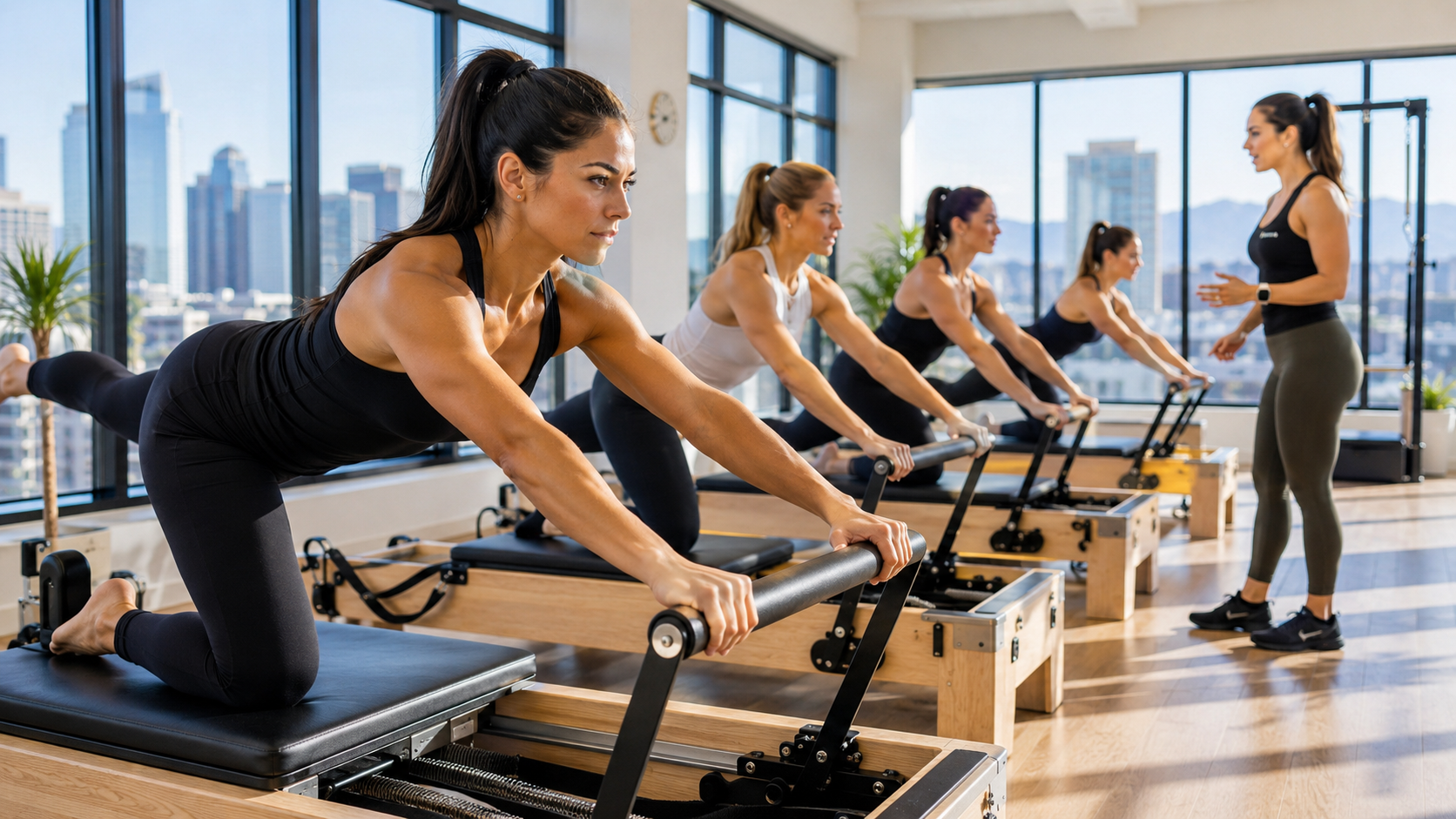
This is where our approach departs from a conventional performance gym. Within elite athlete development, reformer-based work is not a soft alternative to strength training it is a precision tool that solves problems weight training cannot.
Controlled Eccentric Loading
The spring resistance on a reformer loads muscle through the lengthening phase in a way that is smooth, adjustable and safe to repeat. That is the exact quality needed for deceleration training, and it can be trained at high volume without the joint stress of repeated psychometric landings.
Position Under Load
A reformer removes the need to stabilize against gravity in a standing position, which lets an athlete hold a demanding position while a coach corrects it. Faults that disappear the moment an athlete stands up under a bar remain visible and correctable on the equipment.
Breath and intro-abdominal Pressure
Bracing mechanics govern how much force actually reaches the ground. Pilates conditioning trains the relationship between breath, rib position and deep abdominal engagement directly, which is why so many athletes report their heavy lifts improving after a block of reformer work they never intended as strength training.
The practical outcomes athletes report most often:
- Faster change of direction without additional sprint volume
- Reduced lower-back load during heavy compound lifting
- Better shoulder position in overhead sports, particularly tennis and volleyball
- Fewer soft-tissue setbacks across a full competitive season
- More usable hip range, which shows up immediately in stride length
How a Structured Elite Athlete Development Program Is Built
A credible elite athlete development pathway follows a sequence. Skipping a stage is the most common reason athletes see no return on their investment.
Stage One: Assessment and Movement Screening
Range of motion, single-leg control, rotational capacity, breathing pattern and asymmetry are documented. Sport demands are mapped against what the body can currently produce. This produces a baseline you can measure against later.
Stage Two: Correction and Foundation
The limiting factors identified in assessment are addressed before load is added. This stage frustrates competitive athletes because it feels slow, but loading a dysfunctional pattern only makes the pattern stronger.
Stage Three: Loaded Development and Sport Transfer
Once positions are reliable, resistance increases and movements are shaped toward the demands of the sport rotational power for golf and tennis, unilateral drive for running sports, overhead stability for swimmers and volleyball players.
Stage Four: Maintenance Through the Season
In-season work protects what was built. Volume drops, precision stays. This is the phase most athletes abandon, and it is why gains made in the off-season so often disappear by mid-season.
Comparing Training Approaches Within Elite Athlete Development
| Approach | Primary Strength | Main Limitation | Best Used For |
| Traditional strength & conditioning | Maximal force production | Bilateral bias, limited eccentric control | Off-season strength blocks |
| Speed and agility training | Acceleration and footwork mechanics | Assumes underlying stability exists | Pre-season sharpening |
| Physical therapy | Resolving diagnosed injury | Ends at discharge, not performance | Acute injury recovery |
| Pilates-based conditioning | Force transfer, deceleration, symmetry | Not a substitute for maximal loading | Year-round, alongside strength work |
The strongest results come from combining approaches rather than choosing between them. Pilates conditioning is most valuable as the layer that makes the other work transfer, which is why our programs sit alongside an athlete’s existing strength routine rather than replacing it.
Choosing a Format: Private, Semi-Private or Small Group
Format affects the outcome of elite athlete development more than most athletes expect, because coaching attention is the variable that determines whether a correction actually happens.
- Private Pilates delivers the most precise work. One coach, one athlete, continuous hands-on correction and a program written entirely around your assessment. This is the format for in-season professionals and anyone working around an injury.
- Semi-private sessions pair two or three athletes with one coach. Programming stays individualized while the cost per session drops, which makes it sustainable across a long training block.
- Small group classes build consistency and conditioning volume. They are excellent for general athletic maintenance but cannot deliver the individualized correction that elite athlete development requires as its foundation.
- Pilates for dancers applies the same principles to a discipline where extreme range, turnout mechanics and repetitive single-leg loading create a very specific injury profile.
Sport-Specific Applications of Elite Athlete Development
The principles of elite athlete development stay constant; the application changes considerably by discipline.
Golf and tennis depend on separating hip rotation from thoracic rotation. Athletes who rotate through the lumbar spine instead lose club head or racquetball speed and accumulate lower-back damage. Rotational work on the reformer trains that separation directly.
Running and field sports are governed by single-leg force production and hip extension range. Elite athlete development for these athletes emphasizes unilateral loading and eccentric hamstring capacity.
Swimming and volleyball live overhead. Scapular control and thoracic extension determine both power and shoulder longevity, and both respond well to spring-loaded work.
Combat sports and basketball demand repeated deceleration and rapid direction change, making eccentric control the priority.
What Athletic Enhancement Looks Like in Practice
Our athletic enhancement programs are built for established professionals and aspiring competitors alike. Elite athlete development sessions are hands-on, correction-heavy and specific to your sport, your body and the gap between where you are and where you intend to be. Some clients are chasing another championship season; others are rebuilding after surgery and want to return without losing a step.
The best Pilates instructors working in this space share one habit: they change the program when the body changes. A plan written in January that is still being followed unmodified in April is not an elite athlete development program it is a template.
How to evaluate any program before you commit:
- Ask what the assessment process involves and how long it takes
- Ask how often the program is revised, and on what evidence
- Ask what the coach’s experience is with your specific sport
- Ask how in-season work differs from off-season work
- Ask what happens if you pick up an injury mid-block
Ready to Find Your Edge?
If you are training hard and still waiting for the result to show up in competition, the limiting factor is probably not effort. New clients can start with our $99 introductory package two semi-private sessions and two group classes, valued at $205 which includes a movement assessment and a clear picture of what is holding your performance back. Book your first session or call the studio at 702-848-2583 to talk through your sport and season timeline.
Measuring Whether Elite Athlete Development Is Working
Elite athlete development should produce evidence. Reassess every eight to twelve weeks against the same baseline measures: single-leg control, rotational range, asymmetry between sides, and sport-specific output such as sprint splits, vertical jump or serve velocity.
Subjective markers matter too. Athletes in a well-designed elite athlete development program typically report feeling looser in the morning, recovering faster between sessions, and moving more confidently in the positions that previously felt precarious. Those changes usually appear before the numbers move.
A program that cannot show you progress on either measure after three months is not working, and no amount of enthusiasm from a coach should persuade you otherwise.
Common Mistakes That Undermine Elite Athlete Development
- Training the strengths. Athletes gravitate toward what they are already good at. Elite athlete development happens in the qualities you avoid.
- Skipping the correction phase. Loading a compensation pattern reinforces it. The foundation stage is not optional.
- Abandoning the work in-season. Maintenance volume is small; the cost of dropping it is not.
- Treating reformer Pilates in Las Vegas as recovery only. Spring resistance is genuine resistance, and programmed properly it builds capacity rather than simply easing soreness.
- Chasing metrics that do not transfer. A heavier bilateral squat that does not improve single-leg drive has not made you a better athlete.
Conclusion
Elite athlete development is not more training it is better-targeted training. The athletes who break through plateaus are rarely the ones adding sessions; they are the ones who identified the specific quality holding them back and built a program around it. Force transfer, deceleration capacity and unilateral symmetry are where most of that opportunity sits, and they respond to precise, coached, individualized work far more than to additional volume.
Pilates-based conditioning earns its place in serious sports performance training because it trains those qualities directly, under control, and at a level of precision that free-weight work alone cannot match. Combined with your existing strength program, it is the layer that turns gym numbers into competitive results. If you are ready to find out what is actually limiting your performance, Blue Chip Conditioning in Las Vegas will assess it, program for it, and measure it with you.
Frequently Asked Questions
What is an elite athlete development program?
It is an individualized training program built from a movement assessment rather than a template, targeting the specific physical qualities limiting an athlete’s performance. It typically progresses through assessment, correction, loaded development and in-season maintenance.
How is elite athlete development different from regular personal training?
Personal training generally applies a standard program to an individual, while elite athlete development is written from assessment findings and revised as the body changes. The focus is competitive output rather than general fitness or aesthetics.
Can Pilates really improve strength and speed for competitive athletes?
Yes, primarily by improving how efficiently force transfers through the body rather than by increasing maximal force. Athletes commonly see gains in change-of-direction speed, hip range and heavy-lift stability within a single training block.
How long before an athlete sees measurable results?
Movement quality and control usually change within three to four weeks. Measurable performance markers such as sprint splits, jump height or serve velocity generally shift between weeks eight and twelve.
Is elite athlete development only for professional athletes?
No. The methodology applies to high school competitors, collegiate athletes, masters competitors and serious recreational athletes. What changes is the intensity and the sport-specific emphasis, not the underlying process.
How often should an athlete train in an elite athlete development program?
Two to three sessions per week is typical during an off-season block, dropping to one or two in-season for maintenance. Frequency is set around your competition calendar and your existing strength work.
Can I continue regular strength training alongside elite athlete development?
Yes, and you should. Pilates-based conditioning is designed to complement barbell and field work by improving the transfer of that strength, not to replace maximal loading.