When it comes to peak athletic performance, one-size-fits-all training simply does not work. The best Pilates instructors at Blue Chip Conditioning in Las Vegas take a very different approach. They study each athlete individually, identify the weak points, and then build a conditioning plan that matches the sport, the body, and the goal. This article breaks down exactly how that process works -and why it makes such a difference for elite performers.
What Makes a Conditioning Plan “Custom”?
A custom conditioning plan is not just a different workout. It is a complete system built around a specific person’s movement patterns, injury history, flexibility level, strength gaps, and performance targets.
Most generic fitness programs are written for the average person. But elite athletes are not average. A sprinter needs hip flexor mobility and explosive glute activation. A tennis player needs rotational core strength and shoulder stability. A dancer needs balance, extension, and full-body coordination.
The best Pilates instructors understand these differences. They do not just hand over a printed sheet and say “do these ten exercises.” They observe how you move. They ask questions. And then they design something that is built entirely for you.
At Blue Chip Conditioning, this is the standard -not the exception.
Step 1: The Initial Movement Assessment
Before a single exercise is assigned, a thorough movement assessment takes place. This is where the best Pilates instructors separate themselves from average trainers.
The assessment typically looks at:
- Posture and alignment -Does the athlete carry imbalances from years of sport-specific training?
- Core engagement -Can they activate deep stabilizers, or are they relying on surface muscles?
- Flexibility and range of motion -Where are the restrictions, and which joints are hypermobile?
- Breathing patterns -Breath is foundational in Pilates, and poor breathing mechanics affect everything.
- Injury history -Past injuries leave compensatory patterns that must be addressed before performance work begins.
This first session is really about listening. A skilled instructor hears what the body is saying, even when the athlete is not aware of it. At Blue Chip Conditioning, instructors bring backgrounds in dance, athletics, and physical rehabilitation -so they know how to read movement with a trained eye.
Step 2: Identifying the Athlete’s Performance Goals
Once the movement picture is clear, the next step is aligning it with what the athlete actually wants to achieve.
Goal-setting in elite athlete development is specific. “Get stronger” is not a goal. “Increase rotational power in my serve by reducing lumbar tension” is a goal. The best Pilates instructors help athletes define outcomes that are both measurable and meaningful.
Common performance goals that shape a custom plan include:
- Improving sprint speed by increasing hip extension strength
- Reducing lower back pain caused by anterior pelvic tilt
- Building single-leg stability for better balance in court sports
- Recovering post-surgery while maintaining cardiovascular conditioning
- Increasing overhead shoulder mobility for swimmers and pitchers
These goals become the compass for every exercise selection, progression, and session structure going forward.
Step 3: Building the Plan Around the Reformer
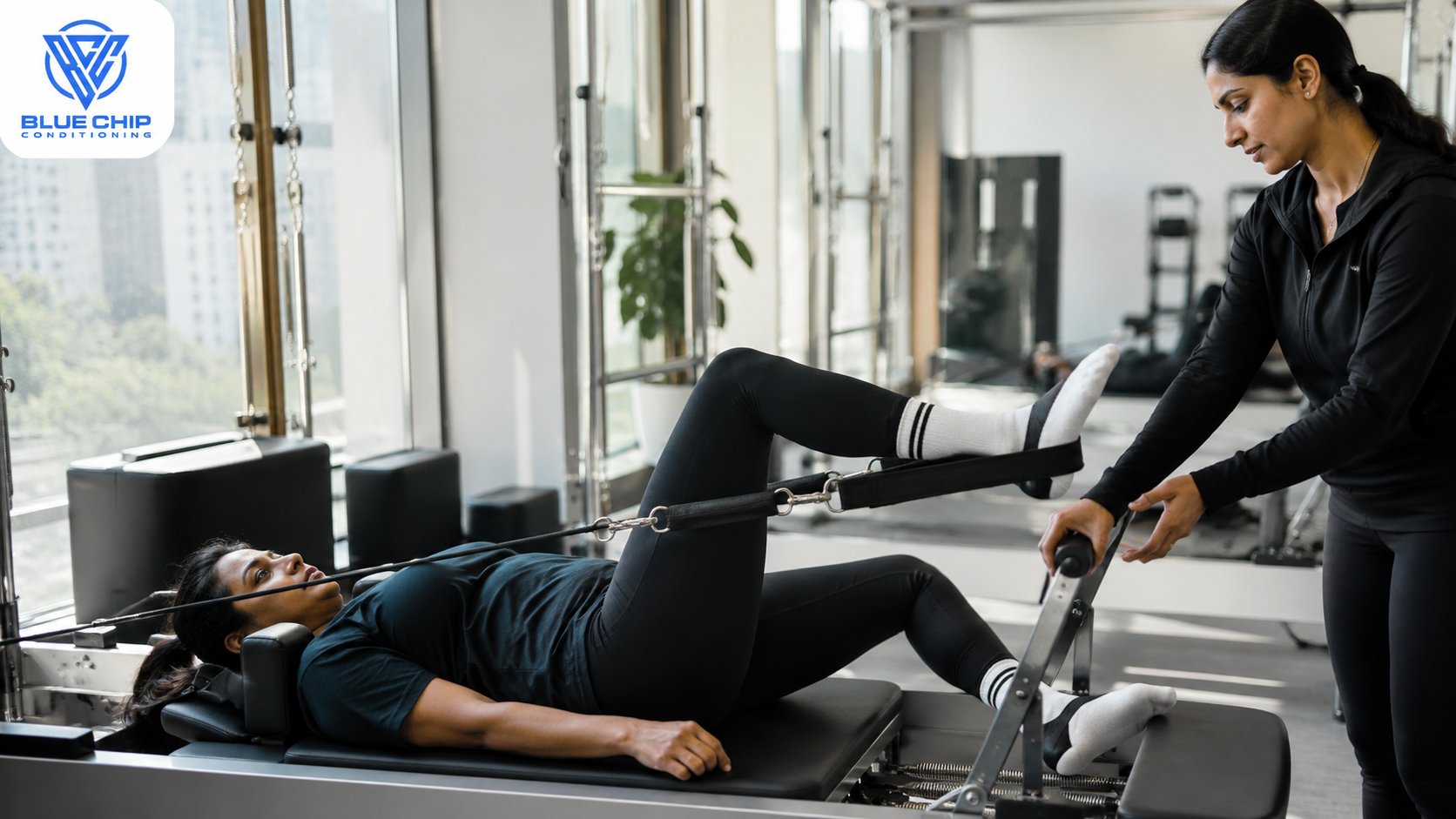
The Pilates reformer is the centerpiece of athletic conditioning at a serious Pilates Studio Las Vegas like Blue Chip Conditioning. It is a spring-resistance machine that allows precise loading of muscle groups in ways that dumbbells and barbells simply cannot replicate.
Here is why the reformer is so powerful for custom conditioning:
- Variable resistance -Springs can be adjusted to work with or against gravity, making the equipment adaptable to any strength level.
- Full-body integration -Almost every reformer exercise works multiple muscle groups simultaneously, which mirrors how athletes actually move.
- Decompression-friendly -Unlike heavy barbell work, the reformer does not compress the spine, making it ideal for athletes managing joint issues.
- Unilateral options -Single-leg and single-arm variations expose and correct left-right imbalances common in sport-specific athletes.
The best Pilates instructors know which spring settings, foot bar positions, and movement tempos are right for each client’s current capacity. They also know when to progress and when to pull back.
Step 4: Programming Progressions for Elite Athlete Development
A plan without progression is just a routine. What separates elite athlete development from regular fitness training is the intentional building of one capacity on top of another.
The best Pilates instructors at Blue Chip Conditioning follow a layered approach:
Phase 1 -Foundation
The first phase focuses on neuromuscular re-education. This means teaching the body to activate the right muscles in the right sequence. For many athletes, years of compensation patterns mean certain stabilizers are completely “asleep.” Before loading those muscles, they have to wake up.
Phase 2 -Strength and Stability
Once the foundation is solid, the plan moves into building functional strength. This is not bodybuilder-style hypertrophy. It is the ability to stabilize under load, transfer force efficiently, and maintain alignment under fatigue.
Phase 3 -Sport-Specific Power
The final phase maps the Pilates conditioning work directly to sport movements. A basketball player works explosive hip drive. A golfer drills rotational sequencing. A martial artist develops hip-to-shoulder coordination. The pilates reformer studio Las Vegas clients at Blue Chip use this phase to close the gap between training room gains and on-field performance.
What the Best Pilates Instructors Know About Injury Prevention
One of the most overlooked benefits of a custom conditioning plan is what it prevents. The best Pilates instructors think ahead. They do not just train for today’s game -they train for the entire season and beyond.
Research in sports science consistently shows that athletes with strong core stability, balanced muscle development, and good joint mobility suffer fewer non-contact injuries. Pilates addresses all three simultaneously.
At Blue Chip Conditioning, the instructors pay close attention to:
Key Injury Prevention Focus Areas:
- Hip alignment and glute activation to protect the knee joint
- Thoracic spine mobility to reduce shoulder impingement risk
- Deep core strength to protect the lumbar spine during explosive movements
- Ankle stability and proprioception to reduce sprain risk on uneven surfaces
- Scapular stability to support overhead athletes
These are not afterthoughts. They are built into every session from day one.
How Private Sessions vs. Semi-Private Sessions Change the Plan
The format of training directly affects how custom the plan can be. Blue Chip Conditioning offers private Pilates sessions for athletes who need one-on-one attention and completely individualized programming.
In a private session, the instructor’s entire focus is on one person. Corrections happen in real time. The plan can shift mid-session if the instructor notices something that needs adjustment. This is the highest level of customization available.
Semi-private sessions pair two or three clients together. This can still offer significant personalization, especially when the instructor groups people with similar goals or bodies. It is also more affordable, making consistent training sustainable over the long term.
For elite athletes in serious pursuit of competitive gains, private sessions during the initial phases of training -followed by semi-private maintenance work -is a common and effective approach.
The Role of the Instructor’s Background in Plan Quality
Not every Pilates instructor has the background to work with elite athletes. Conditioning plans for high-performance individuals require an understanding of biomechanics, periodization, and sport-specific movement that goes beyond basic Pilates certification.
This is why the team at Blue Chip Conditioning stands out. The instructors include former professional dancers who have spent their careers understanding movement at the highest level, certified trainers with backgrounds in rehabilitation and functional fitness, and master trainers certified in methods like the DK Body Balancing Method.
Founder Danielle Maas, for example, trained with the School of American Ballet and the American Ballet Theater -institutions that demand elite physical conditioning. That depth of experience shapes how she and her team approach every custom plan.
The services offered at Blue Chip Conditioning reflect this high standard. From dance conditioning to athletic enhancement to rehabilitation-based work, every offering is grounded in the same commitment to true personalization.
What Elite Athletes Say About Custom Pilates Conditioning
Athletes who have trained with the best Pilates instructors consistently report the same experiences:
- Faster recovery between training sessions
- Reduced pain in areas that used to be chronically sore
- Better body awareness during sport -knowing where their body is in space
- Improved breathing efficiency under exertion
- Stronger performance in areas they thought were genetic limitations
These results are not accidental. They are the product of an intelligent, progressive, customized plan delivered by an instructor who genuinely understands the body and the sport.
Why Pilates Studio Las Vegas Athletes Choose Blue Chip
Las Vegas is a city of performers, athletes, and high achievers. The demand for elite conditioning support is real. But not every studio in the city delivers at the level that competitive athletes require.
Blue Chip Conditioning has earned a reputation as the go-to Pilates studio for athletes in Las Vegas because of the quality of its instructors, the depth of its programming, and the results its clients see. With over 2,000 five-star reviews and a team of certified, experienced instructors, the studio continues to set the standard for what athletic Pilates conditioning can look like.
If you are an athlete -at any level -who wants a training system that is built entirely around your performance goals, Blue Chip Conditioning is the place to start.
Ready to train smarter? Book your first session today and experience what a truly custom conditioning plan can do for your performance.
Conclusion
The best Pilates instructors do more than lead a workout – they build a plan that matches the athlete’s body, sport, and performance goals. At Blue Chip Conditioning, every session is designed to improve movement, support injury prevention, and help athletes train with more control, strength, and confidence. This custom approach is what makes Pilates so valuable for elite performance and long-term progress.
If you are looking for a training method that supports your athletic goals in a smart and personalized way, Blue Chip Conditioning is a great place to start. With the right guidance, a custom Pilates conditioning plan can help you move better, recover faster, and perform at a higher level in your sport.
FAQs:
Q1. How do I know if a Pilates instructor is qualified to work with athletes?
Look for instructors with sports performance backgrounds, comprehensive certifications, and experience training athletes from your specific sport. At Blue Chip Conditioning, all instructors hold recognized certifications and many have professional performance backgrounds in dance and athletics.
Q2. How long does it take to see results from a custom Pilates conditioning plan?
Most athletes notice improved body awareness and reduced soreness within two to four weeks. Performance-specific gains -like stronger core activation or better joint mobility -typically become measurable within six to eight weeks of consistent training.
Q3. Can a custom Pilates plan work alongside my existing sport training?
Yes. Pilates conditioning is designed to complement, not replace, sport-specific training. It fills the gaps that conventional strength and conditioning programs leave behind, particularly in mobility, stabilization, and movement efficiency.
Q4. Do the best Pilates instructors work with beginners or only advanced athletes?
At Blue Chip Conditioning, instructors work with athletes across all levels -from those just starting out to professionals competing at high levels. The plan is built around where you are right now, not where you think you should be.
Q5. What is the difference between a reformer Pilates plan and a mat-based Pilates plan for athletes?
Reformer-based plans offer more resistance options and greater exercise variety, making them better suited for athletic conditioning. Mat work is valuable but limited in the loading it can provide. For elite athlete development, the reformer is usually the primary tool.
Q6. How often should an athlete train with a Pilates instructor?
Most athletes benefit from two to three sessions per week during an active training phase. During competition season, one to two sessions per week for maintenance is common. Your instructor will recommend a schedule based on your training load and recovery capacity.
Q7. Is private or semi-private Pilates better for elite performance goals?
Private sessions offer the most customization and real-time feedback, which is valuable when learning new movement patterns or working through injury history. Semi-private sessions work well for athletes who have a solid foundation and want continued progress in a more affordable format.