
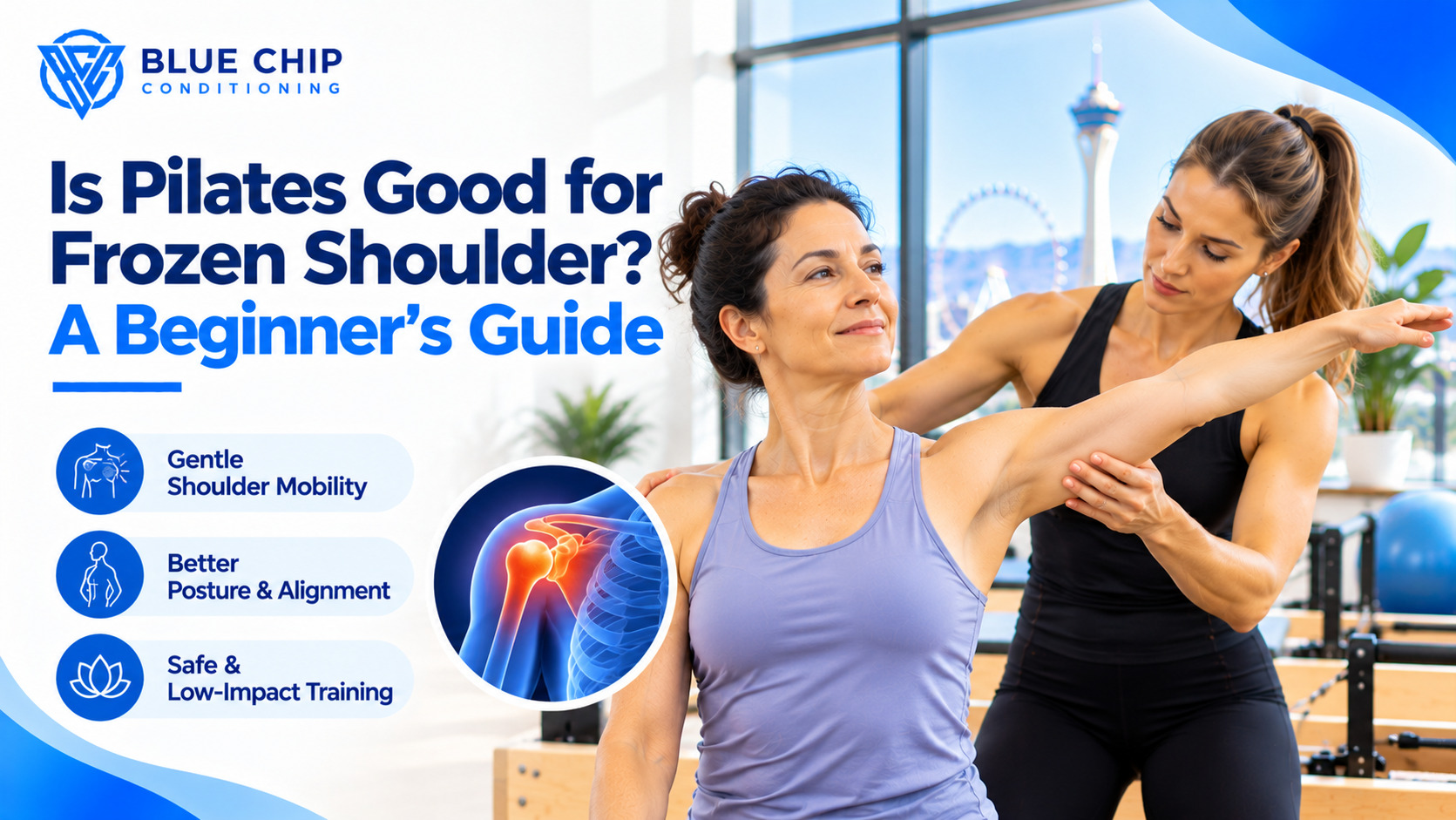
If you are living with a stiff, painful shoulder and wondering whether exercise will help or make things worse, understanding how Pilates helps frozen shoulder is a sensible place to begin. Pilates can be a useful, low-impact way to restore movement, strengthen the muscles around the joint and rebuild confidence, provided it matches the stage of the condition and your doctor or physical therapist approves it. This guide explains what frozen shoulder is, how Pilates helps frozen shoulder at each stage, which exercises are commonly used, what a first session looks like, which mistakes to avoid and how to start safely.
What Is Frozen Shoulder?
Frozen shoulder, known medically as adhesive capsulitis, develops when the connective tissue capsule around the shoulder joint thickens and tightens. The American Academy of Orthopaedic Surgeons describes it as a condition that develops gradually and can take a year or longer to resolve. It is most common between the ages of 40 and 60, affects women more often than men, and is more likely in people with diabetes or after the arm has been immobilized.
The condition typically moves through three phases:
- Freezing: Pain gradually increases and range of motion shrinks. Discomfort is often worse at night.
- Frozen: Pain may ease, but stiffness remains, and reaching overhead or behind the back becomes difficult.
- Thawing: Movement slowly returns as the capsule loosens, and strength can be rebuilt.
Aggressive stretching during the painful freezing phase can aggravate symptoms, while the thawing phase usually responds well to progressive shoulder mobility exercises and strengthening. Recognizing your phase is the first step in choosing the right exercise, because the right exercise at the wrong time can slow recovery.
How Pilates Helps Frozen Shoulder: The Core Principles
Pilates is a controlled, low-impact method built around breathing, alignment, core stability and precise movement. These principles are why it works well as a complement to formal frozen shoulder rehabilitation. Here is how Pilates helps frozen shoulder in practical terms.
Gentle, Pain-Free Range of Motion
Pilates works within a comfortable range instead of forcing the joint. Small, repeated movements encourage the capsule and surrounding tissues to move without provoking a flare-up. During the freezing stage, gentle Pilates exercises help you keep the movement you have without irritating the joint. This respect for comfort helps you progress without setbacks.
Better Shoulder Blade Mechanics
When the shoulder stiffens, the body compensates by hiking the shoulder blade toward the ear or arching the upper back. Pilates teaches scapular control, so the shoulder blade glides and rotates as it should. Retraining this pattern is a key part of how Pilates helps frozen shoulder, because it reduces strain on the neck and upper back while the joint recovers.
Breathing and Muscle Relaxation
Pain makes people brace. Pilates breathing encourages the neck and upper trapezius muscles to release, which is one reason Pilates for shoulder stiffness often feels more comfortable than general gym work. This quieter benefit is an often-overlooked part of how Pilates helps frozen shoulder.
Whole-Body Strength During a Long Recovery
Frozen shoulder affects posture and sleep. Pilates keeps the core, hips and spine strong while the shoulder recovers, which is part of how Pilates helps frozen shoulder beyond the joint itself. Staying active elsewhere also protects mood and energy during a recovery that can last many months.
How Pilates Helps Frozen Shoulder at Each Stage
Pilates can be appropriate throughout the condition, but goals and intensity shift. Get clearance from your physician or physical therapist first and share any restrictions with your instructor. The table summarizes how the focus changes from one phase to the next.
| Stage | Main Goal | Pilates Focus | What to Avoid |
| Freezing | Calm pain, maintain movement | Breathing, scapular setting, core work, very small arm movements | Forced stretching, heavy resistance, sharp pain |
| Frozen | Preserve and gradually improve range | Assisted range-of-motion work, light spring support, posture training | Loaded overhead work, fast or jerky movement |
| Thawing | Restore mobility and strength | Progressive shoulder flexibility exercises, rotator cuff strengthening | Jumping straight into heavy upper-body training |
The Freezing Stage
In this painful phase, Pilates is mostly about calm, not range. Sessions focus on breathing, posture, core strength and tiny pain-free arm movements, keeping the rest of the body active without irritating an inflamed capsule.
The Frozen Stage
Once pain settles but stiffness remains, the focus shifts toward assisted movement. Spring support on the reformer lets the arm move through a slightly larger range than it could alone, while scapular work prevents compensation.
The Thawing Stage
As the capsule loosens, sessions become more about strength. Light resistance for the rotator cuff and upper back helps the shoulder use its returning range with control, which matters for everyday tasks and sport.
This progression is central to how Pilates helps frozen shoulder over time: the method adapts to your body rather than asking your body to fit a fixed routine.
Gentle Pilates Exercises for Frozen Shoulder
These shoulder mobility exercises are common in early sessions. Treat them as examples to discuss with your provider, not a self-prescribed program.
Mat Pilates for Shoulder Mobility
Mat Pilates for shoulder mobility is a practical starting point because it needs no equipment and lets you control every inch of movement.
- Scapular setting: Lie on your back and gently draw the shoulder blades down and slightly together. Hold for one breath, then release.
- Supported arm floats: With knees bent, raise the arm toward the ceiling only as far as feels comfortable, using the other hand to assist.
- Side-lying chest opener: Lie on your side and slowly open the top arm behind you, stopping before pain.
- Thoracic rotation: Improving upper-back mobility reduces the demand on a stiff shoulder joint.
These shoulder mobility exercises should feel like mild effort or a gentle stretch, never sharp or lingering pain. Mat Pilates for shoulder mobility also builds the alignment habits you will rely on later.
Reformer Pilates Exercises for the Shoulder
The reformer adds adjustable spring support. Springs can assist the arm early on, then provide light resistance once the joint tolerates load. Common reformer Pilates exercises for the shoulder include arm circles in straps, supine arm presses toward the hips, low-load seated rowing and assisted overhead reaches using the footbar for support. An experienced instructor adjusts springs and strap height so these reformer Pilates exercises challenge the shoulder without straining it. Spring assistance offers support that bodyweight stretching cannot.
What to Expect in Your First Session
Beginners often worry that a class will push them too hard. A well-run first session should feel calm and educational, and it should show you how Pilates helps frozen shoulder without asking you to prove anything.
- Health history: Your instructor asks about your diagnosis, stage, pain levels and any restrictions from your therapist.
- Movement check: You will gently show how far the arm moves in a few directions, so the instructor knows your comfortable range.
- Foundations: Expect breathing, posture and scapular work before any loaded arm exercise.
- Feedback: You will be asked how each movement feels, and exercises will be adjusted on the spot.
Mild muscle fatigue the next day is normal. Increased shoulder pain that lingers is not, and it should be reported so the plan can be adjusted.
How Pilates Helps Frozen Shoulder Compared With Other Options
Pilates works best combined with other care. Physical therapy remains the primary treatment, and your doctor may also discuss medication, injections or, in persistent cases, procedures to release the capsule.
| Approach | Strengths | Limitations | Best Used For |
| Physical therapy | Clinical assessment, manual therapy, structured progression | Visits are limited | Primary frozen shoulder rehabilitation |
| Pilates (mat or reformer) | Controlled, low-impact, coached, whole-body | Not a medical treatment | Complementing therapy and continuing after discharge |
| Yoga | Flexibility and relaxation | Weight-bearing arm poses can be too demanding early | Later stages, with modifications |
| Home stretching alone | Convenient and free | Easy to overdo without feedback | Daily maintenance between sessions |
Compared with yoga or unsupervised stretching, Pilates offers more control over load, which explains how Pilates helps frozen shoulder where other methods can stall. Yoga still has a place later, and the studio’s comparison of Pilates and yoga explains where shoulder flexibility exercises from each method fit.
How to Start Pilates With a Frozen Shoulder
Knowing how Pilates helps frozen shoulder is only useful if you start safely. Confirm your diagnosis and stage with a medical professional, ask your physical therapist which movements to avoid, and share that information with your instructor.
Private or semi-private sessions are usually the safest entry point, because the instructor can adapt every exercise and watch for compensation. Many people train two or three times a week alongside their therapist’s home program, then progress to small groups as range returns. At Blue Chip Conditioning in Las Vegas, instructors adapt reformer and mat work to each client and stay within your healthcare provider’s guidance, with group classes capped at eight people so Pilates for shoulder stiffness stays coached and hands-on.
Why Guided Instruction Makes a Difference
Shoulders compensate easily, and that is the biggest obstacle when recovering from frozen shoulder. Without feedback, many people repeat arm movements while subtly shrugging or arching the back, which reinforces the original problem. Hands-on cues help you feel the difference between moving the arm and moving around it.
At Blue Chip Conditioning in Las Vegas, instructors emphasize hands-on corrections and tailor each session to the client’s goals and history. In semi-private sessions, an instructor can adjust springs, strap height and arm positions in real time, while group reformer classes let you keep training alongside others once your range returns. Posture plays a big part in shoulder comfort, so the studio’s guide to Pilates for Lower Back Pain From Sitting All Day is a useful companion read, and if you are new, it helps to know how to get real results from your first Pilates class before you book.
Frequently Asked Questions
Is Pilates good for frozen shoulder?
Yes. For most people, how Pilates helps frozen shoulder is as a complement to medical care. It improves range of motion gently, strengthens the muscles that support the shoulder blade and keeps the rest of the body active. It should be approved by your doctor or physical therapist and adapted to your current stage.
Can you explain how Pilates helps frozen shoulder in simple terms?
In simple terms, how Pilates helps frozen shoulder comes down to control. Slow, pain-free movement encourages the joint capsule to move, scapular training reduces compensation, and breathing relaxes guarded neck muscles. Over time, spring resistance on the reformer helps rebuild strength as mobility returns during the thawing phase.
Can Pilates make frozen shoulder worse?
It can if exercises are forced, loaded too early or performed through sharp pain. Problems usually come from aggressive stretching during the freezing phase or from compensating with the neck and upper back. Working with a qualified instructor and following your therapist’s guidance greatly reduces that risk.
Which is better for frozen shoulder, mat or reformer Pilates?
Both can help. Mat work is simple and easy to repeat at home, while the reformer offers spring assistance and adjustable resistance that make movement easier early and more challenging later. Many people begin with mat or assisted reformer work, then add gentle Pilates exercises with more load as the shoulder improves.
How often should I do Pilates for frozen shoulder?
Two to three supervised sessions per week, combined with your therapist’s daily home exercises, is a common routine, and the same rhythm suits Pilates for shoulder stiffness at any stage. Short, frequent practice tends to work better than occasional long sessions, because the goal is steady, comfortable movement rather than pushing the joint hard.
How long before I notice a difference?
Many people notice better posture and less upper-back tension within a few weeks, while shoulder range improves more slowly. Patience is part of how Pilates helps frozen shoulder, because the condition can take a year or more to resolve. Measure progress over months, adding shoulder flexibility exercises as the thawing phase begins.
Should I stop physical therapy if I start Pilates?
No. Pilates works best alongside physical therapy, not as a replacement. Your therapist diagnoses, monitors and guides treatment, while Pilates adds coached movement between appointments. Many people continue Pilates after discharge to maintain mobility and strength once formal frozen shoulder rehabilitation ends.
Conclusion
Frozen shoulder is frustrating, but it does not have to mean months of inactivity. Knowing how Pilates helps frozen shoulder lets you approach recovery with patience and a plan: gentle, pain-free movement early, assisted mobility work as stiffness peaks, and progressive strengthening once the joint begins to thaw. The key takeaway is that how Pilates helps frozen shoulder depends on matching the exercise to the stage and keeping your physician or physical therapist involved throughout.
If you are in Las Vegas and want coached, low-impact support for a stiff shoulder, start with a private session so an instructor can learn your history and restrictions before building a plan around how Pilates helps frozen shoulder at your stage. Book your first session with Blue Chip Conditioning or call (702) 848-2583 to talk through the best starting point.