
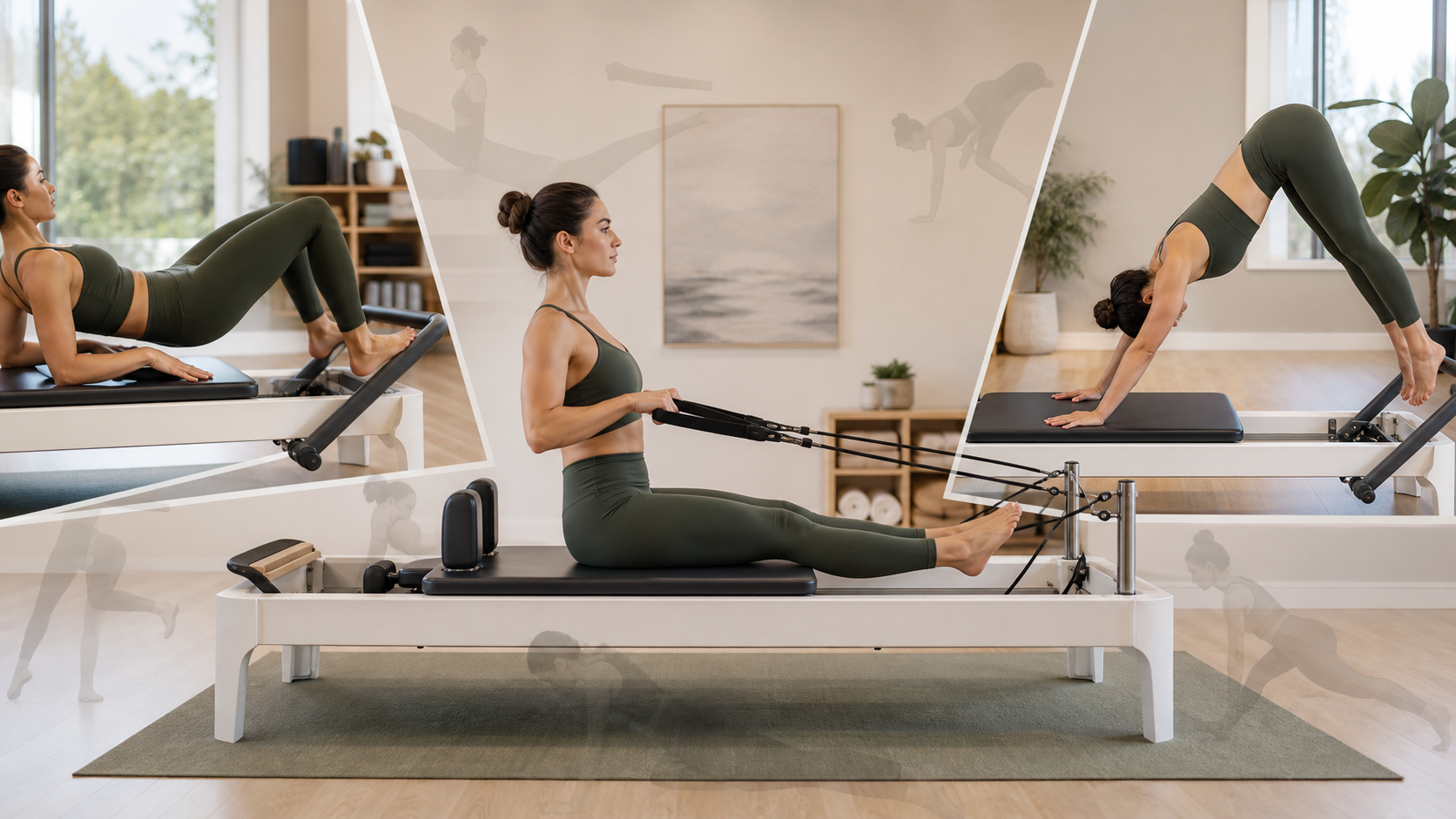
Want a workout that trains your legs, core, and arms in one session, without ever touching a dumbbell? These pilates reformer exercises use spring resistance and body control instead of heavy weights. They build strength through your entire range of motion, not just the easy middle part of a movement. Below are 12 moves that, together, cover the whole body in under an hour.
Quick Answer: The most effective pilates reformer exercises for full-body strength are footwork, the hundred, coordination, rowing, long stretch, and elephant. Each one targets a different area, and together they train legs, core, and upper body in a single balanced session.
Why the Reformer Trains Muscles Mat Work Can’t Reach
Mat Pilates relies only on gravity and your own body weight. A reformer adds spring resistance that pushes and pulls in multiple directions. That extra force keeps your stabilizer muscles working through the whole movement, not just the hardest point of a rep. As a result, a slow-paced class built around these moves can feel far more demanding than it looks.
The 12 Reformer Exercises, Grouped by Focus Area
Here’s the full list before we break each one down:
- Footwork
- Leg circles
- Single-leg press
- The hundred
- Coordination
- Short spine
- Rowing series
- Arm circles
- Long stretch
- Elephant
- Knee stretches
- Running
These twelve pilates reformer exercises form the backbone of most well-built classes. Instructors mix and match them based on class level and available time.
Lower Body: Footwork, Leg Circles, and Single-Leg Press
Footwork
Feet rest on the footbar while the carriage presses out and pulls back in under control. This move builds foundational leg strength and teaches carriage control before anything harder gets added. Almost every beginner class opens with some version of this exercise.
Leg Circles
With straps around your feet, your legs draw slow, controlled circles in the air. This isolates hip mobility while your core works hard to keep your torso still and steady.
Single-Leg Press
One leg extends the carriage while the other stays completely still. This move exposes side-to-side imbalances that most people never notice during regular training. Two-legged exercises tend to hide weaker sides.
Core: The Hundred, Coordination, and Short Spine
The Hundred
This classic breathing-and-pulsing exercise fires up your deep core early in any session. It’s simple to learn, yet genuinely hard to hold with perfect form for the full count. Most instructors treat it as a benchmark for how a client’s core strength is progressing.
Coordination
Your arms and legs move in sync while your torso stays locked in place. This trains core control under motion, which carries over directly into daily movement and sport.
Short Spine
An advanced sequence that combines spinal movement with hamstring flexibility and deep core strength all at once. Instructors usually save this one for clients who’ve built a solid foundation through simpler pilates reformer exercises first.
Upper Body: Rowing Series and Arm Circles
Rowing Series
Seated on the carriage, you pull the straps toward your body in a controlled rowing motion. This targets your back and shoulders in a way that mat work simply can’t replicate. It’s one of the more satisfying pilates arm exercises on this list. You can feel your posture improve within a single set.
Arm Circles
Small, controlled circles using strap resistance build shoulder stability and visible definition over time. Because the movement is slow, there’s nowhere to hide weak form. Many instructors pair this with rowing to round out a complete set of pilates arm exercises before moving on to full-body work.
Full-Body Integration: Long Stretch and Elephant
Long Stretch
A plank-style hold on the moving carriage that demands full-body tension from your shoulders down to your ankles. It’s one of the most complete strength tests on this list. It also doubles as one of the more effective pilates ab exercises, once your shoulders and core learn to work together.
Elephant
A pike-style position that builds hamstring flexibility alongside deep core and shoulder strength. Many clients find this one humbling the first time they try it.
Knee Stretches
A kneeling exercise that bridges beginner and intermediate difficulty, blending core and shoulder work into one flowing movement.
Running
A footwork variation using small, quick pulses that raises your heart rate while keeping the movement fully controlled. It’s a favorite finisher in many classes.
How Instructors Modify These for Beginners vs. Advanced Clients
Every exercise on this list scales with spring tension and range of motion. Beginners typically use heavier springs, which means more support and less resistance, along with a shorter carriage travel distance. Advanced clients reduce spring tension and extend their range of motion to raise the difficulty of the same pilates reformer exercises.
A certified instructor adjusts all of this in real time. That’s one of the clearest advantages of a guided class over solo practice. Nobody has to guess which setting fits their current level.
Choosing the Right Pilates Reformer Exercises for Your Goal
Not every client needs the same routine. If your main goal is core strength, lean toward the hundred, coordination, and long stretch. If posture is your focus, rowing and arm circles deserve extra attention. you’re chasing full-body conditioning, running and elephant tie everything together near the end of class.
A good instructor builds a personal pilates reformer routine around your specific goal. They avoid running the same fixed sequence for every client, every single week.
A Sample 45-Minute Sequence Combining All 12
Here’s how a typical class often flows from start to finish:
- Warm up with footwork and leg circles to wake up the legs and core together.
- Move into the hundred and coordination for a focused core section.
- Add rowing and arm circles to balance out the upper body.
- Finish strong with long stretch, elephant, and running as a full-body combination.
- Cool down with a short stretch sequence to release tension before you leave the carriage.
The order matters just as much as the exercises themselves. Building from simple to complex keeps your form intact even as fatigue sets in near the end.
Common Mistakes to Avoid With These Exercises
A few small errors show up again and again, even among people who’ve trained for months:
- Rushing footwork instead of controlling the carriage on the way back in
- Letting the shoulders creep up toward the ears during rowing or arm circles
- Holding the breath during the hundred instead of pulsing it with the movement
- Overextending the spine during short spine before the hips are properly warmed up
Catching these early makes a real difference. That’s exactly why hands-on correction matters so much more than following a video alone. This is especially true for anyone still learning these pilates reformer exercises for the first time.
Building Core Strength Beyond the Reformer
If the core-focused exercises above interest you, check out our deeper guide on Pilates ab exercises. It breaks down progressions you can use both on and off the carriage. It pairs well with the core work in this list, especially the hundred, coordination, and long stretch. Many clients treat those three moves as their own mini set of pilates ab exercises before moving into the rest of class.
Strengthening Arms Alongside Your Reformer Routine
Upper-body moves like rowing and arm circles build a strong base, but they’re only part of the picture. For a fuller breakdown of shoulder and arm training, take a look at how Pilates arm exercises build lean strength and better posture. Together, these exercises round out a complete upper-body routine that pairs naturally with the pilates reformer exercises covered above.
Building Your Own Pilates Reformer Routine at Home
Once you’ve learned proper form for these movements, you can build a simple pilates reformer routine to reinforce what you practice in class. Start with footwork and the hundred, add rowing once your upper body feels steady, and finish with a short stretch. Keep the routine short and consistent rather than long and inconsistent, since regular practice beats occasional marathon sessions almost every time.
A basic home pilates reformer routine works best as a supplement to real classes, not a full replacement for them. Nothing replaces an instructor catching a small form break before it becomes a habit.
Ready to feel these moves for yourself, guided by someone who can correct your form on the spot? Book a class and let a certified instructor walk you through the full sequence safely.
Quick Reference: What Each Exercise Targets
Use this table to scan the full list of pilates reformer exercises at a glance.
| Exercise | Main Focus | Difficulty |
| Footwork | Legs, carriage control | Beginner |
| Leg circles | Hips, core stability | Beginner |
| Single-leg press | Leg balance, symmetry | Beginner |
| The hundred | Deep core, breath | Beginner |
| Coordination | Core control | Intermediate |
| Short spine | Spine, hamstrings | Advanced |
| Rowing series | Back, shoulders | Beginner |
| Arm circles | Shoulder stability | Beginner |
| Long stretch | Full-body tension | Advanced |
| Elephant | Hamstrings, core | Intermediate |
| Knee stretches | Core, shoulders | Beginner |
| Running | Legs, cardio | Intermediate |
This kind of breakdown is exactly what a good instructor keeps in mind. They plan your weekly pilates reformer exercises around it, even if they never show you the table itself.
Why Order and Pacing Matter as Much as the Moves
Two classes can use the exact same pilates reformer exercises and still feel completely different. Pacing changes everything. A rushed class skips the small pauses that let your body reset between moves. A well-paced class builds intensity gradually, so your last few exercises still get your full effort instead of leftover energy.
This is one more reason solo practice rarely matches a guided class. An instructor reads the room. They slow things down when form starts slipping, and they speed things up when everyone looks ready for more.
Quick Recap Before You Start
Let’s keep this simple. Twelve exercises. Three body areas. One goal: real, balanced strength.
First, start with footwork. Then, add core work once your legs feel warm. After that, save long stretch and elephant for last, since both demand the most control. Rest when you need to. Meanwhile, keep breathing steady through every rep, because holding your breath only makes each move harder than it needs to be. In short, form always beats speed.
That’s the whole plan in a nutshell. Everything else in this guide simply fills in the details.
The Takeaway
These 12 pilates reformer exercises cover your entire body in one balanced, efficient session. Lower body, core, and upper body all get real, focused attention, without a single dumbbell in sight. The exercises themselves matter, but how they’re sequenced and corrected matters just as much as the movements.
Ready to feel this sequence guided by a certified instructor? Book a Group Reformer Class and experience the full routine safely, from footwork to your final stretch.
Frequently Asked Questions
What are the best pilates reformer exercises for beginners?
Footwork, leg circles, and the hundred are the most beginner-friendly starting points, since they build foundational control before harder moves get introduced.
How many reformer exercises should a typical class include?
Most 45 to 50-minute classes include 10 to 15 exercises, moving from simple warm-up moves toward more demanding full-body work.
Can these exercises help build visible muscle tone?
Yes. Long-lever, high-rep resistance work like this tends to build lean, defined muscle rather than bulk, especially with consistent weekly practice.
Do I need advance experience before trying short spine or elephant?
Not necessarily, but most instructors introduce these later, once basic footwork and core control feel steady and confident.
How is a reformer routine different from a mat Pilates routine?
A reformer adds adjustable spring resistance in multiple directions. That challenges your stabilizer muscles through the whole movement, not just at the toughest point.
Can I practice these moves safely without an instructor?
Some basic exercises are reasonably safe to try alone, once you know proper form. Still, a full pilates reformer routine benefits greatly from real-time correction and spotting.
Which exercise on this list is the hardest for most beginners?
Long stretch and elephant tend to challenge beginners the most, since both demand full-body tension and control at the same time.
How often should I do a full reformer routine each week?
Two to three sessions a week is a common, sustainable target for building visible strength without overtraining or burning out.