
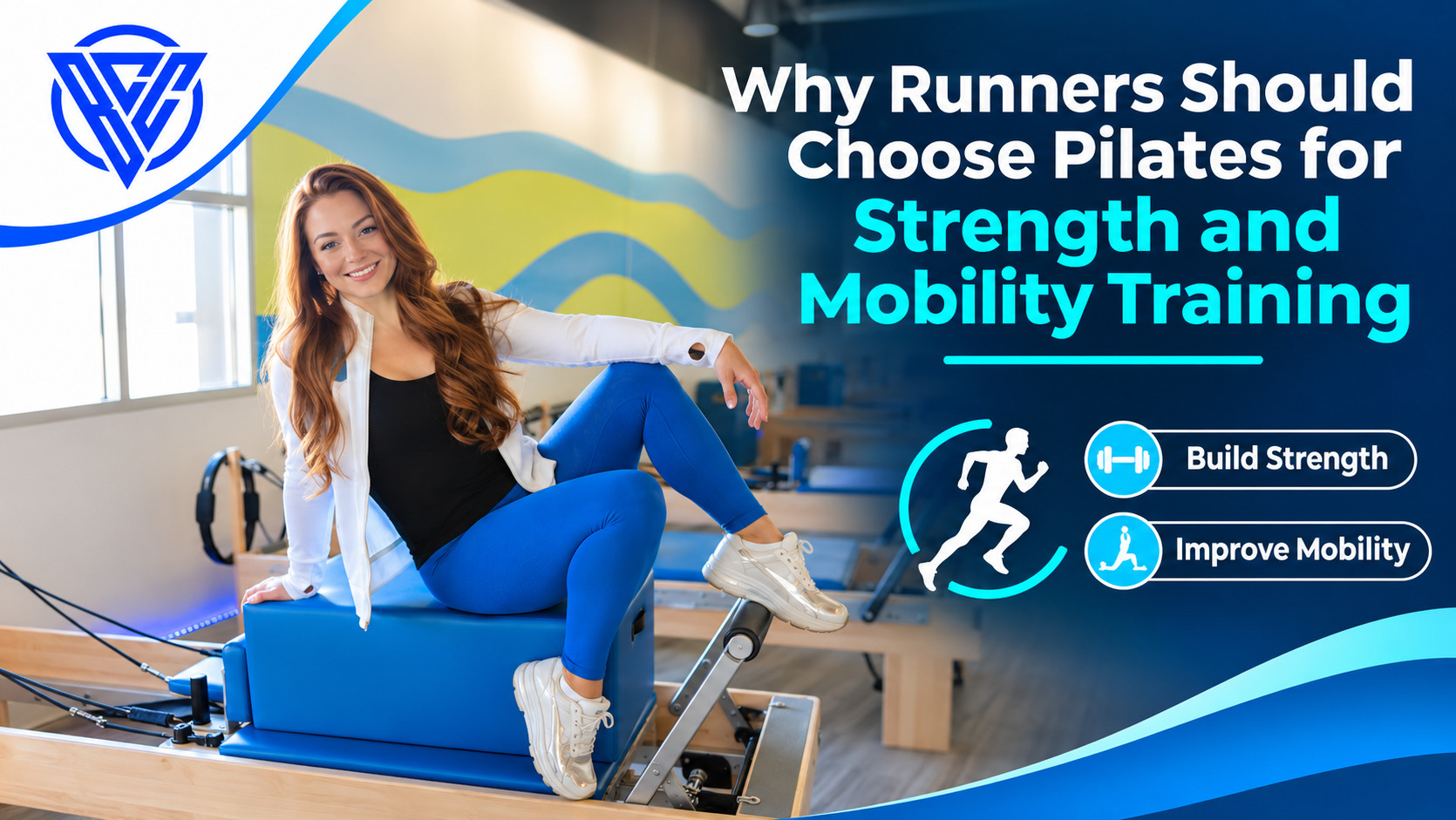
Pilates for runners addresses what mileage alone rarely does: the core control, hip stability and mobility that keep your stride efficient as fatigue builds. This article explains how Pilates complements running, which areas it targets, how it fits around a training week and what to look for in a program, so you can add it for the right reasons without expecting miracles.
Why Pilates for Runners Works
Running is repetitive. You move forward, mostly in one plane, thousands of times per session, and the same muscles absorb the load each time. Strength and mobility work that challenges the body differently can balance that pattern, and this is where Pilates for runners earns its place.
Pilates trains the trunk, hips and deep stabilizing muscles through slow, controlled movement. Instead of building brute force, it develops the ability to hold a stable pelvis, rotate through the spine under control and keep the ribcage and hips aligned when you are tired. The U.S. Department of Health and Human Services’ Physical Activity Guidelines recommend muscle-strengthening activity on two or more days a week, and Pilates is one practical way for runners to meet that recommendation without adding impact.
What Pilates Does Not Replace
Pilates for runners complements running; it does not replace your mileage, speed work or heavier strength training. It works best as a supporting layer that improves how well your body handles the training you already do.
Best Pilates for Runners: What to Look For
The best Pilates for runners is not a generic class. It is a program built around the demands of running: single-leg strength, hip and core stability, posture and efficient movement over long distances. When you evaluate options, look for instructors who ask about your running volume, race calendar and injury history before they choose exercises.
Reformer-based work is particularly useful because adjustable springs let an instructor add resistance or support exactly where you need it. Single-leg work on the carriage, for example, reveals side-to-side differences that are easy to miss when you only run. The best Pilates for runners also changes across the season, which we cover below. A general-fitness class can still help, but Pilates for runners works best when the exercise selection reflects how runners actually load their bodies.
Pilates for Running Performance
Better performance usually comes from moving efficiently, not just working harder. Pilates for running performance focuses on the qualities that support efficient movement: a stable trunk, mobile hips, controlled foot and ankle mechanics and the body awareness to notice when form begins to slip late in a run.
It is worth being realistic. No Pilates program guarantees a faster time, because performance depends on training load, recovery, sleep, nutrition and many other factors. What Pilates for running performance can reasonably offer is better control and coordination, which gives you a stronger foundation to train on. Semi-private sessions suit many runners because the workout is individualized while an instructor watches your form.
Pilates for Stronger Legs
Runners often assume their legs are already strong. Yet running works the legs in a narrow range, and the glutes, inner thighs and deep hip muscles can lag behind. Pilates for stronger legs uses spring resistance to work these areas through a full range of motion, often one leg at a time.
On the reformer, footwork, lunges and side-lying leg work challenge the legs while the trunk stabilizes the pelvis. The pace is slow, so muscles stay under tension longer than they do in a typical stride. Group reformer classes can be a good entry point, and Pilates for stronger legs is easiest to learn in a small class where the instructor can correct your alignment.
Core Strengthening for Runners
A runner’s core does more than hold the stomach in. It keeps the pelvis level, limits excess rotation and helps transfer force between the legs and upper body. Core strengthening for runners therefore focuses on endurance and control rather than maximum effort, which is why Pilates for runners emphasizes control over intensity.
Many core strengthening for runners exercises ask you to keep the trunk still while the arms and legs move, which mirrors what the body does during a long run. Good coaching matters: poor alignment can shift the work to the wrong muscles.
Where Pilates Focuses for Runners
- Pelvic stability: keeping the pelvis level while one leg supports your weight on the carriage or mat.
- Hip strength and mobility: working the glutes and deep hip muscles through a controlled range.
- Trunk endurance: holding good posture over many repetitions, which is relevant late in a long run.
- Rotational control: limiting unnecessary twisting through the torso as your arms and legs swing.
- Foot and ankle awareness: footwork exercises that train the lower leg to push and control through the footbar.
Pilates for Running Injury Prevention
No exercise program can promise to prevent injury, and runners should be wary of anyone who says otherwise. What Pilates for running injury prevention can do is support injury-aware training: strengthening under-used muscles, improving mobility and building awareness of how you move, so that you notice and address problems earlier.
If you are currently injured, see a physician or physical therapist first. Pilates is exercise, not medical treatment, and a return to training should follow their guidance. Share any restrictions with your instructor so every movement can be adapted. For runners, Pilates for running injury prevention is most useful as a long-term habit rather than a short-term fix.
Pilates for Flexibility and Mobility
Flexibility and mobility are related but not identical. Flexibility is how far a muscle can lengthen, while mobility is how well a joint moves through its range under control. Runners often need mobility more than extreme flexibility, particularly in the hips, spine and ankles.
Pilates for flexibility and mobility combines controlled breathing with movements that lengthen and strengthen at once. Spring resistance lets you work through a full range of motion with support, which many runners find more productive than passive stretching. The breathing emphasis in Pilates for runners is also worth practicing, since controlled breathing is a core part of the method. Some studios also offer mat and stretch classes, which can be an easy way to continue Pilates for flexibility and mobility on lighter training days.
Reformer or Mat: Which Suits Pilates for Runners?
Both formats follow the same principles. The difference is equipment and how each challenges the body.
| Factor | Reformer Pilates | Mat Pilates |
| Resistance | Adjustable springs add resistance or support | Body weight only |
| Single-leg and balance work | Carriage adds a stability challenge | Relies on body control and floor position |
| Learning curve | Equipment takes a few sessions to learn | Easier to practice anywhere |
| Best suited for | Strength, mobility and detailed coaching | Core foundations and flexible home practice |
Many runners combine both, using reformer sessions for strength and mat work for mobility between runs.
Fitting Pilates Into a Running Week
Timing matters when you add Pilates for runners to a busy schedule. A hard Pilates session the day before a key workout can leave you fatigued, while the same session on an easier day can complement your training.
Practical Scheduling Tips
- Off-season or base phase: train more often to address imbalances and build a foundation of strength and mobility.
- Build phase: shift toward single-leg strength and trunk control that mirror running demands.
- Peak and race weeks: keep sessions lighter and focused on mobility so you stay fresh.
- Frequency: many athletes add Pilates one to three times per week alongside their strength and conditioning.
- Recovery days: use gentle mat or stretch sessions rather than intense strength work.
Common Mistakes in Pilates for Runners
A frequent error is treating Pilates as another hard workout. Heavy sessions the day before a long run or race can leave your legs tired, so match the intensity to your training phase. Another mistake is rushing to advanced exercises before you can control your pelvis and trunk, which reduces the benefit of Pilates for runners. Runners also tend to focus only on the legs, yet the core, hips and upper back deserve equal attention because posture late in a run depends on them. Finally, some runners expect quick changes. Pilates for runners is a long-term investment, and its value shows in how you move across months of training, not after a single class.
Advantages and Disadvantages of Pilates for Runners
Advantages
- Low impact: adds strength and mobility without extra pounding on the joints.
- Targets neglected areas: stabilizers, hips and trunk that running does not train directly.
- Adaptable: springs and modifications fit beginners, recreational runners and competitive athletes.
- Builds body awareness: helps you notice form changes and asymmetries.
Disadvantages
- Not a substitute for running or heavy strength training: it supports your plan rather than replacing it.
- Takes consistency: benefits build gradually over weeks, not days.
- Cost and scheduling: studio sessions add expense and time to an already full training week.
- Quality varies: results depend on coaching that understands running.
Frequently Asked Questions
Is Pilates good for runners?
Yes. Pilates builds core control, hip stability and mobility, which support efficient movement during running. It is low impact, so it adds strength work without extra pounding. It complements, rather than replaces, running and strength training, and results depend on consistency.
How often should runners do Pilates?
Many runners do Pilates one to three times per week alongside their regular training. Beginners often start with one or two sessions and increase gradually. Reduce intensity during peak training and race weeks so you stay fresh for key workouts.
Is reformer or mat Pilates better for runners?
Neither is universally better. Reformer sessions add adjustable spring resistance, which is useful for single-leg strength and detailed coaching. Mat Pilates is easier to practice anywhere and suits core and mobility work. Many runners combine both formats.
Can Pilates help prevent running injuries?
Pilates cannot guarantee injury prevention, but it can support injury-aware training by strengthening under-used muscles and improving mobility and body awareness. If you are injured, get guidance from a physician or physical therapist first, and tell your instructor about any restrictions.
Should I do Pilates before or after a run?
Many runners schedule Pilates on easier days or separate it from hard workouts by several hours. Doing intense strength work right before a key run can cause fatigue. Gentle mobility-focused sessions can be done more flexibly, depending on how your body feels.
Will Pilates make me run faster?
Pilates alone does not guarantee faster times. Performance depends on training load, recovery and other factors. Pilates can improve trunk stability, hip mobility and body control, giving you a stronger foundation that supports efficient running over time.
What should I look for in a Pilates program for runners?
Look for instructors who ask about your running volume, race schedule and injury history, then design sport-specific work. Single-leg strength, hip and core stability, small class sizes and hands-on corrections are strong signs. A trial session helps you judge the coaching.
Conclusion
Running builds endurance, but it can leave gaps in strength, stability and mobility. A well-designed approach to Pilates for runners fills those gaps through controlled work on the core, hips and legs, always alongside your training rather than in place of it. The value comes from consistent, well-coached sessions timed sensibly around your running week.
If you are considering Pilates for your own training, share your running volume, goals and any injury history with an instructor before you begin. Blue Chip Conditioning offers sport-specific reformer programs for runners at its Las Vegas studio; explore the athlete programs and session options on the website, or call (702) 848-2583 to book a free 30-minute demo.