
Pilates for men was a punchline in most weight rooms. Today it is the fastest-growing demographic in boutique fitness, and the men signing up are not casual exercisers they are lifters, cyclists, golfers and desk-bound professionals whose hips stopped cooperating. This article explains what is driving that adoption, what a reformer delivers that a barbell cannot, and how to structure your first eight weeks so the investment actually pays off.
Why Pilates for Men Became a Serious Category
The shift did not come from marketing. Pilates for men grew because it solved three practical problems conventional training handles poorly.
The first is mobility. A man who has squatted and pressed for a decade usually has strong prime movers and stiff joints. Hip internal rotation, thoracic extension and shoulder flexion narrow year after year, and the narrower they get, the worse his lifts look.
The second reason Pilates for men caught on is injury history. Lower back tightness, cranky shoulders and a knee that objects to stairs send men looking for loading that does not aggravate what already hurts.
The third is time. A well-run reformer session trains strength, control, mobility and breathing in fifty minutes. For someone with a job and a family, consolidation matters more than variety, and Pilates for men delivers it.
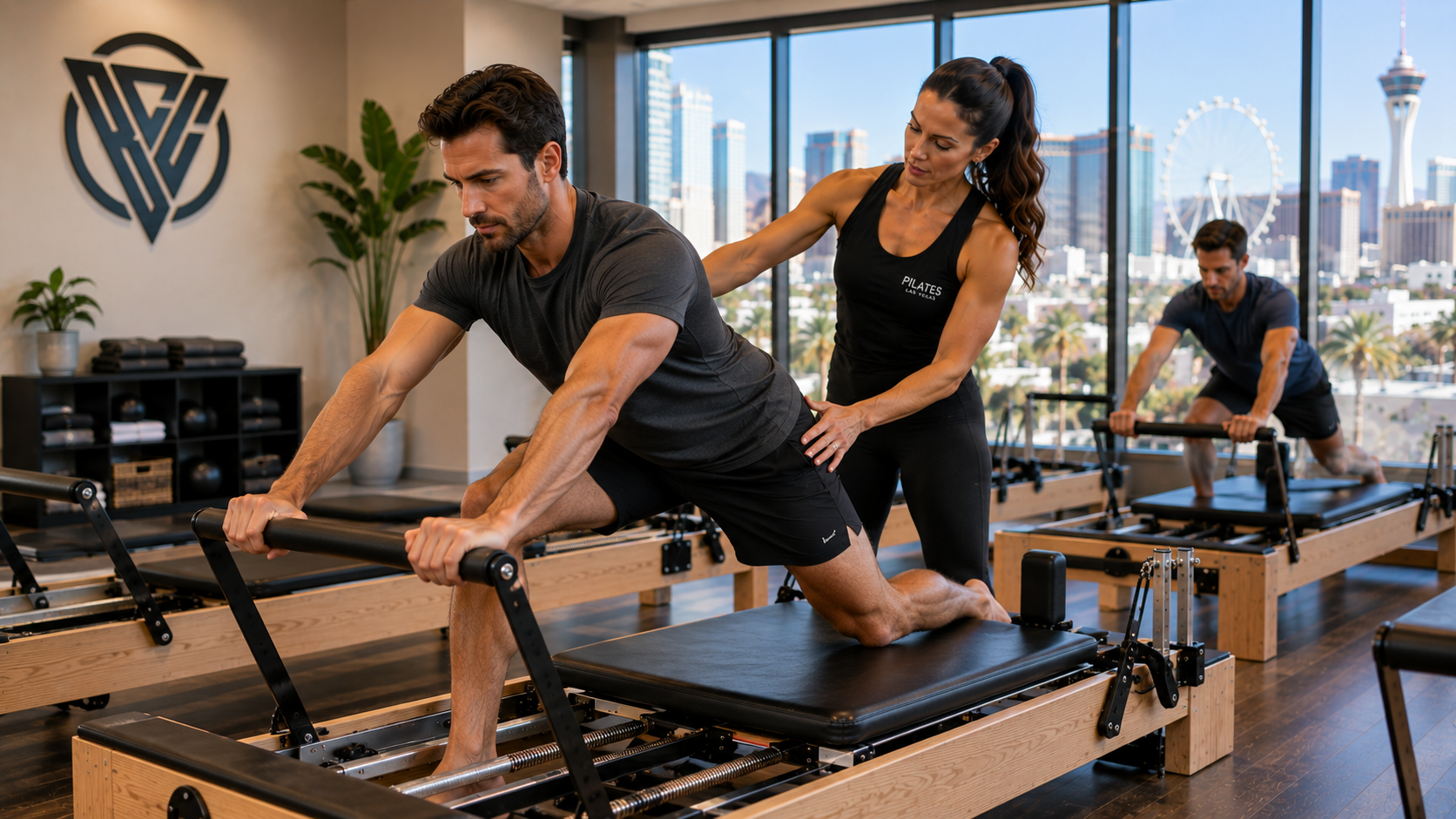
Instructors here see the same first-session pattern almost every time. A strong man gets on the reformer, moves the carriage easily with his quads and last, and then cannot hold a stable pelvis through a single controlled leg extension. Strength is not the limiter. Control is.
What Pilates for Men Trains That Lifting Misses
Barbell training is excellent at what it does: producing force in a fixed, largely sagittal plane. It is less good at three things that matter enormously after thirty-five.
Rotation and anti-rotation. Almost every sport and most daily tasks involve twisting or resisting a twist. Men reformer Pilates loads rotation directly through straps and springs, in ranges a cable machine rarely reaches. This is where Pilates for men separates itself from accessory gym work, and it is a distinction the coaching literature published by the National Strength and Conditioning Association has made for years.
Eccentric control at end range. The reformer’s spring returns the carriage whether you are ready or not, which forces you to control the lengthening phase. That control is what protects hamstrings, groins and shoulders.
Unilateral honesty. Men reformer pilates exposes what a barbell hides, because a barbell lets the strong side compensate. A single-strap or single-foot reformer exercise does not. The first time most men train one leg at a time on a reformer, they discover a difference of fifteen to twenty percent between sides.
Research indexed on PubMed and summarised by the National Institutes of Health has repeatedly linked unilateral strength asymmetry to elevated injury risk in athletic populations, which is one reason strength coaches now test it routinely.
Reformer Work Versus the Weight Room
Pilates for men is not a replacement for lifting. It is the complement most training programmes are missing. The table below shows how the two compare across the qualities men typically care about.
| Training Quality | Barbell / Weight Room | Reformer Pilates |
| Maximal strength | Excellent | Limited |
| Hypertrophy potential | Excellent | Moderate |
| Rotational and anti-rotational load | Limited | Excellent |
| Eccentric control | Moderate | Excellent |
| Hip and thoracic mobility under load | Limited | Excellent |
| Joint stress per session | Moderate to high | Low |
| Unilateral imbalance exposure | Poor | Excellent |
| Ideal weekly frequency alongside lifting | 3–4 sessions | 1–2 sessions |
The honest reading of that table is that a man lifting three times a week and adding one or two reformer sessions covers far more of the athletic spectrum than a man lifting five times a week. Comparative work of this kind appears regularly in the Journal of Bodywork and Movement Therapies.
Pilates for Men Is Adopted Fastest by Lifters
Pilates for lifters has become its own category for a reason, and it is the entry point into Pilates for men for most experienced trainees. The men who commit fastest are usually the ones with the most training history, because they can feel the difference immediately.
A lifter already understands tempo, progressive load and positional cues. Put him on a reformer and he does not need the concepts explained he needs the application. That is why a lifter’s second session usually looks dramatically better than his first, while a complete beginner’s improvement is slower and steadier.
Lifters also tend to start in private Pilates sessions rather than group classes, because a coach who can see a barbell pattern can correct a reformer pattern in half the time. Once the pattern holds, most move into the group timetable.
What Changes Between Week Two and Week Eight
Week two is uncomfortable in an unfamiliar way. Clients report soreness in the deep hip rotators, the adductors and the lower abdominals muscles that were present but under-recruited.
By week eight the reports change. Squat depth improves without a mobility warm-up. Overhead position feels less forced. Lower back stiffness after long drives fades. Those are the changes that keep men booking, because Pilates for lifters produces results visible in the training they already care about.
A Realistic First Eight Weeks
Male pilates beginners consistently make the same three mistakes: they choose springs that are too heavy, they rush the tempo, and they train through positions they cannot yet hold. Here is an eight-week structure for Pilates for men that avoids all three.
- Weeks 1–2: Two sessions per week. Moderate spring load. Focus entirely on pelvic and rib position. Expect to feel unstable that is the point.
- Weeks 3–4: Two sessions per week. Introduce unilateral footwork and single-arm strap work. Note which side is weaker and stop pretending it isn’t.
- Weeks 5–6: Two to three sessions. Increase spring load on pressing and pushing patterns. Add controlled rotation.
- Weeks 7–8: Two to three sessions. Load the patterns you now control, extend eccentric tempo to three or four seconds, and reassess your weaker side.
Male pilates beginners who follow that progression generally reach useful competence in eight weeks, particularly when our certified Pilates instructors set the spring load in the first fortnight. Those who chase heavy springs in week one usually stall, because they recruit the same dominant muscles they already over-use. Before committing to eight weeks, it is worth checking Pilates pricing and packages so the schedule and the budget are decided at the same time.
Mobility for Men Is a Strength Problem, Not a Stretching Problem
Most men treat tightness as something to stretch away. It rarely works, because passive stretching increases tolerance to a stretch without building strength in the new range. We cover the evidence behind this at length in our guide to flexibility training Pilates.
Mobility for men improves fastest when the joint is loaded at the end of its range, which is precisely how Pilates for men is programmed. The reformer does this by design: straps hold your limb in a lengthened position while a spring demands active resistance. You are not stretching a hamstring; you are training it long.
That mechanism is why clients often gain range they had lost for years within a handful of sessions, and more importantly keep it. Range that is strong is range your nervous system will let you use.
Mobility for men also has a compounding effect. Better hip internal rotation makes a golf swing rotate rather than shear. Better thoracic extension makes an overhead press an actual overhead press instead of a lumbar arch.
What to Expect in Your First Class
Men who have never taken a reformer class usually worry about two things: that they will be the only man in the room, and that they will be bad at it.
The first concern is already outdated. The second is accurate and irrelevant. Everyone is clumsy on a reformer initially, including athletes with two decades of training.
What actually matters is instruction quality, not natural aptitude. In a large class, cueing is general. In a semi-private setting, spring load and modifications are prescribed for you. Men with an injury history or a specific performance goal almost always progress faster in private Pilates sessions or semi-private work before moving into group classes.
Our instructors are certified through DK Body Balancing and Balanced Body, and the team includes professional performers and conditioning specialists. You can review our certified Pilates instructors before you book, then match a name to a time slot on our Pilates class schedule.
Try It Before You Judge It
The fastest way to find out whether Pilates for men belongs in your programme is a single session under proper instruction. Blue Chip Conditioning offers a free 30-minute demo, a $20 first group class, and a $99 new client special that includes two semi-private sessions and two group classes — enough to feel the difference rather than read about it.
Compare Pilates pricing and packages, view our Pilates class schedule, or call (702) 848-2583 to get on the books this week. If you would rather start one-to-one, ask about private Pilates sessions when you call.
Conclusion
The growth in male membership is not a trend story. It is what happens when a group of experienced trainees finds a tool that addresses the qualities their existing programme neglects. Pilates for men solves rotation, eccentric control and unilateral honesty better than almost anything else available, and it does so at a joint cost low enough to run alongside heavy training year-round.
Blue Chip Conditioning has built its programming around exactly that use case. Founded in 2020 by Danielle Maas and based at 6275 S Rainbow Blvd in Las Vegas, the studio offers group reformer classes, semi-private coaching, private sessions and elite athlete development training with our certified Pilates instructors qualified to work with lifters, athletes and men returning from injury. If you have been training hard and moving worse, Blue Chip Conditioning is where that trade stops being necessary.
This article is educational and is not medical advice. Consult a qualified healthcare provider before beginning a new exercise programme, particularly with an existing injury. General exercise guidance for adults is published by the American College of Sports Medicine.
Frequently Asked Questions
Is Pilates actually effective for men, or is it mainly for women?
Pilates for men is effective and always has been Joseph Pilates developed the method training boxers and male athletes. The reformer loads rotation, unilateral control and end-range strength, all of which are common weak points in men who lift. The demographic skew was cultural, not physiological.
Will Pilates for men build muscle?
It builds strength and lean mass modestly, but it is not a hypertrophy programme. Treat it as a complement to resistance training rather than a replacement. Most men see the biggest returns in control, mobility and injury resilience, which then allow heavier and more consistent lifting.
How many sessions a week should a man who lifts do?
One to two reformer sessions per week alongside three or four lifting days is the range most men find sustainable. That frequency is enough to change mobility and control without adding meaningful recovery cost to your lifting. Check our Pilates class schedule for times that fit around your training days.
Do I need to be flexible to start?
No. Stiffness is the reason to start, not a reason to wait. The reformer’s straps and carriage let you train within the range you currently control, and that range expands as strength develops at the end of it. Instructors routinely start men who cannot reach past their knees.
What should male Pilates beginners wear to a first class?
Fitted athletic wear and grip socks. Loose shorts and baggy shirts make it hard for an instructor to see your pelvis and rib position, which is exactly what they need to see. Grip socks are required on the reformer for safety.
Is reformer Pilates safe with a lower back or shoulder issue?
Often yes, with appropriate modification, but tell your instructor before the session begins. Spring load, range and body position can all be adjusted around a specific issue. Most clients in this situation begin in private Pilates sessions, where every variable is prescribed rather than generalised. If you are under active treatment, clear it with your physician or physical therapist first.
How soon will I notice a difference?
Most men notice improved positional awareness within two to three sessions and meaningful mobility or control change by week six to eight. Changes usually show up first in something outside the studio: squat depth, overhead position, or how your back feels after sitting.
What does it cost to get started?
The demo is free and the first group class is $20. Full Pilates pricing and packages are listed on the site, including the $99 new client special and ongoing membership options.