
Choosing where to train is a bigger decision than most people realize. Two studios can advertise the same class names, charge similar rates and look identical in photographs, yet produce completely different outcomes for the client walking through the door. The difference is rarely the equipment. It is the standard of instruction, the size of the class and whether anybody is paying attention to how you actually move. That is worth remembering when you start comparing options for a Pilates studio Las Vegas has plenty of.
Reformer work has moved firmly into the mainstream over the last decade, and for good reason. Demand for Pilates in Las Vegas has risen alongside it, which means more choice for clients and more variation in quality. It builds genuine strength, it improves how the body organism itself under load, and it does both without the joint cost of heavy lifting. But the method only delivers when it is taught properly. This guide covers what strong reformer training looks like, what results are realistic, and how to judge a studio before handing over money for a package.
What Separates a Serious Studio from a Fitness Trend
Equipment Depth
A well-equipped Pilates studio Las Vegas clients stay loyal to will offer more than a row of identical reformers. The classical apparatus includes the Cadillac or tower, the Wunda chair, the ladder barrel and the spine corrector. Each unlocks positions and loading angles the reformer cannot reach on its own.
For general fitness, reformers alone can carry a client a long way, and a straightforward Pilates reformer studio Las Vegas residents can walk into will serve that goal well. For rehabilitation or athletic work, the wider toolkit becomes essential. A shoulder that needs loaded overhead work in a supported position, or a spine that needs traction before extension work, requires apparatus most boutique studios do not own.
Instruction Standard
Certification varies enormously. Comprehensive programmer involve several hundred hours across all apparatus, supervised teaching and formal examination. Weekend certifications also exist, producing instructors who can run a class but often cannot modify safely when something unexpected appears.
Ask directly. Any credible Pilates studio Las Vegas has to offer will answer questions about instructor training without hesitation, and most publish their team’s backgrounds. Ours are listed on our instructor page for exactly that reason.
Class Size and Attention
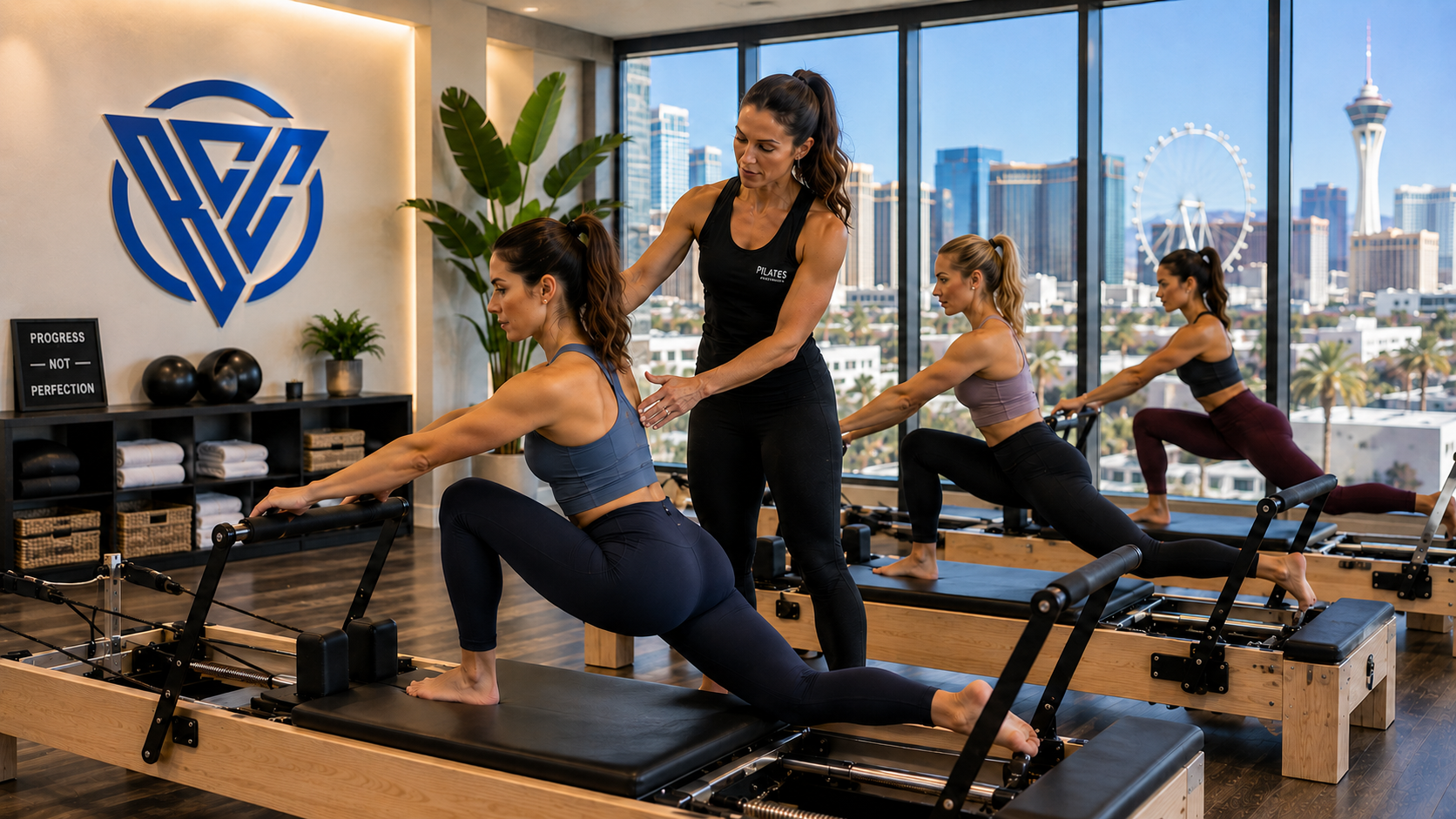
Class size is the single most reliable indicator of quality, and the first thing to check at any Pilates studio Las Vegas advertises as boutique or personalize. In a class of six to eight, an instructor can watch every client, correct spring settings and place hands where they are needed. In a class of twenty, they are running a choreography session with a microphone. Both can be enjoyable. Only one changes how you move.
How Reformer Training Builds Strength
Strength on the reformer arrives with control attached, which is what makes it useful outside the studio.
Every repetition demands eccentric management. The carriage does not return on its own, and letting it snap back is immediately visible. Eccentric strength is what allows the body to decelerate, absorb landing forces and change direction without injury — and it is the quality most often missing in people who train hard yet keep getting hurt.
The spring system also allows loading to be matched precisely to current capacity. Rather than jumping from a five-kilogram dumbbell to a ten, tension can be adjusted in small steps or shifted by changing body position relative to the springs. Progress becomes continuous instead of stepped, which suits both beginners and advanced clients. It is also why a serious Pilates studio Las Vegas athletes train at can run a professional and a post-surgical client on the same apparatus in the same hour.
Regions that respond consistently to structured reformer work include:
- Deep abdominal and pelvic floor musculature, which supports the lumbar spine far more effectively than crunch-based training
- Gluteus medius and the posterior chain, chronically underused in anyone who sits for a living
- Scapular stabilisers, addressing the rounded-shoulder pattern that follows years at a keyboard
- Single-leg strength, exposing left-right differences that bilateral machines happily disguise
- Hip and thoracic mobility under load, which is where range becomes usable rather than decorative
A dedicated Pilates reformer studio Las Vegas trainees can rely on will programmer these areas deliberately across a training block rather than hoping they get covered by accident.
How It Translates to Performance
Clients rarely arrive asking for improved preconception. They arrive because a golf swing has lost its rotation, a knee complains on descents, or a twelve-hour shift ends with a burning neck.
The carryover is consistent and explainable. Better pelvic and rib cage control means force produced by the limbs travels where it is aimed instead of leaking sideways. Restored hip extension lengthens stride. Improved thoracic rotation returns yardage to a golf drive. For competitive athletes, this is the foundation our elite athlete development programming is built on, and it is why so many professional teams now employ apparatus-based conditioning alongside their strength work.
The same principles apply to a sixty-year-old who wants to keep hiking. The scale changes. The mechanics do not. This breadth is precisely why a good Pilates studio Las Vegas families use tends to have members spanning four decades of age in the same class.
Reformer Work Compared With Other Training Options
Understanding what each approach does well makes it easier to combine them intelligently rather than treating them as competitors.
| Factor | Reformer Pilates | Traditional Gym Training | Mat Pilates |
| Primary quality built | Controlled strength and stability | Maximal force production | Endurance and body awareness |
| Joint impact | Low | Moderate to high | Low |
| Load adjustment | Continuous, via springs | Fixed plate increments | Body weight only |
| Imbalance detection | Immediate and obvious | Often masked | Moderate |
| Suitability during injury | High, with clearance | Limited | Variable |
| Instructor attention required | High | Low to moderate | Moderate |
| Typical session cost | Mid to high | Low | Low |
Most committed clients end up using two of the three, and any honest Pilates studio Las Vegas offers will tell you as much rather than claiming the reformer replaces everything else. Reformer sessions build the foundation, mat work fills gaps at home, and gym training adds load once movement quality is sound.
What a Well-Run Pilates Studio Las Vegas Programme Includes
Beyond equipment and credentials, the thing that separates studios is whether anyone is planning your training or simply running classes. A structured programmer at a Pilates studio Las Vegas clients stay with for years generally includes four components.
- An initial movement assessment covering posture, range of motion, injury history and asymmetry, documented rather than remembered.
- Progressive programming that changes every four to six weeks instead of repeating the same sequence indefinitely.
- Ongoing communication between instructors, so a client seen by three different teachers still receives consistent cueing and appropriate progressions.
- Periodic reassessment against the original findings, which is the only honest way to demonstrate progress.
Very few group-only operations do all four. Studios built around athletic and rehabilitation work almost always do, because their clients arrive with specific problems that generic programming will not solve. It is a fair question to ask on your first visit, and the answer tells you a great deal about how a Pilates reformer studio Las Vegas markets to serious trainees actually operates behind the branding.
Choosing Between Class Formats
Any established Pilates studio Las Vegas locals recommend will offer more than one format, because clients arrive with genuinely different needs.
- Private sessions are the right starting point for complex injury histories, post-surgical clients and athletes with specific performance targets. Programming is built entirely around the individual.
- Semi-private sessions suit two or three people with comparable goals. Our semi-private training keeps the attention high and the cost lower than a full private.
- Group reformer classes deliver structure, energy and value once fundamentals are established, provided the class cap is sensible.
- Specialist programming covers dancers, athletes and rehabilitation clients whose requirements sit outside a general schedule.
Many clients rotate between formats over a year, using a private session periodically to review technique while group work fills out the week. Popular Pilates classes in Las Vegas book out several days ahead, so it is worth checking how far in advance a studio releases its schedule.
What Realistic Progress Looks Like
Expectations set honestly at the start prevent disappointment later. The following reflects what we typically observe in clients training twice weekly.
| Timeframe | What Usually Changes | What Clients Notice |
| Weeks 1–3 | Motor learning and equipment familiarity | Muscles they did not know existed |
| Weeks 4–6 | Range of motion and postural control | Standing taller, less morning stiffness |
| Weeks 7–12 | Measurable strength and endurance gains | Everyday tasks feel easier |
| Months 4–6 | Structural change and sport carryover | Improved performance, fewer flare-ups |
| Beyond 6 months | Consolidation and advanced progressions | Training becomes maintenance plus goals |
Anyone promising dramatic transformation inside a fortnight is selling something, and a reputable Pilates studio Las Vegas clients trust will never make that claim. Real adaptation follows a timeline, and a good studio will tell you that before you buy a package.
Questions Worth Asking Before You Commit
- What certification do your instructors hold, and how many hours did it involve?
- What is the maximum class size, and is it enforced?
- Do instructors provide hands-on correction, and do you ask permission first?
- How do you handle injuries, pregnancy and post-surgical clients?
- Is there an assessment before I join group classes?
- What is the full pricing structure, including cancellation terms?
- Can I observe or trial a class before purchasing a package?
A studio that answers these openly is a studio that has thought about them. Hesitation on any of the first three is worth noting. Every Pilates studio Las Vegas markets to newcomers should be able to explain its safety and modification policy in plain language.
Cost, Value and Commitment
Reformer training costs more per session than a gym membership, and it should — the equipment is expensive, class sizes are small and instructors are highly trained. The relevant question is not price per session but cost per unit of progress. Two well-coached sessions weekly will outperform five unsupervised gym visits for most people chasing strength, mobility and pain reduction. Judged that way, a well-run Pilates studio Las Vegas charges premium rates for often represents better value than a cheap membership that goes unused.
Introductory offers are the sensible way to test a studio before committing. Our rates and new-client options are published on the pricing page. If you are still weighing whether the method suits you at all, our overview of why Pilates in Las Vegas has grown so quickly covers the broader picture.
Conclusion
The reformer is a remarkable tool, but a tool is only as good as the person teaching you to use it. The strongest results come from qualified instruction, small classes, apparatus depth and programming that respects where a client actually is rather than where a generic template assumes they should be.
If you are comparing options for a Pilates studio Las Vegas can offer, judge on those four things rather than on décor or social media presence. Ask about certification. Ask about class caps. Book a single session before a package and pay attention to whether anyone corrects your alignment. Blue Chip Conditioning has been working this way with athletes, dancers and everyday clients on South Rainbow Boulevard for years, and we are happy to answer any of the questions above before you commit to anything. Come in, try a session, and judge the difference for yourself. Pilates in Las Vegas is no longer a niche pursuit, and choosing well at the outset saves both money and months.
Frequently Asked Questions
Are Pilates classes in Las Vegas suitable for older adults?
Yes, and they are among the safest strength options available. Low-impact spring resistance supports bone density, balance and joint health without the loading risks of heavy free weights.
What should I look for in a Pilates studio?
Prioritise comprehensively certified instructors, small class caps, a full range of apparatus and a proper intake assessment. These four factors influence results far more than facilities or pricing.
How much do Pilates classes in Las Vegas typically cost?
Group reformer sessions generally range from around twenty-five to forty dollars, with private sessions higher. Most studios offer introductory packages that reduce the per-session cost significantly.
Is reformer Pilates suitable for complete beginners?
Yes. Spring resistance can be lowered to make every exercise accessible, and beginner-appropriate sessions teach the equipment safely before any meaningful load is added.
How many times a week should I train?
Two sessions weekly is the practical minimum for steady progress. Three suits clients with specific strength, rehabilitation or athletic goals, provided recovery is managed.
Can I train with a back or knee injury?
Usually yes, with clearance from your medical provider. Precise load control is why the method is widely used alongside physical therapy during rehabilitation.
What is the difference between reformer and mat classes?
Reformer classes use spring resistance and a moving carriage, allowing greater load and support. Mat classes rely on body weight and suit home practice or supplementary training.