
Choosing between reformer or mat pilates is the first real decision most people face when they begin the method, and the honest answer is that neither format is universally better they are two expressions of the same system with different strengths. This article explains how each one works, what the spring-loaded carriage actually changes about an exercise, which format suits which starting point, and why most people eventually use both.
Anyone weighing reformer or mat pilates is really asking a narrower question: which tool suits my starting point. Framed that way, reformer or mat pilates becomes a decision you can actually make. Both formats share the same principles breath, concentration, control, centring, precision and flow. What differs is the source of resistance, the amount of feedback you receive, and how much guidance is built into the equipment.
The Same Method, Two Different Tools
The reformer or mat pilates decision becomes far simpler once you understand what each tool provides. Mat work is the original foundation of the method, using body weight, gravity and floor contact to challenge the deep stabilising muscles. The classical repertoire published in Return to Life Through Contrology in 1945 contains thirty-four floor exercises. Nothing supports you, so your own control is the only thing regulating the movement, which is the first thing to understand about reformer or mat pilates as a pairing.
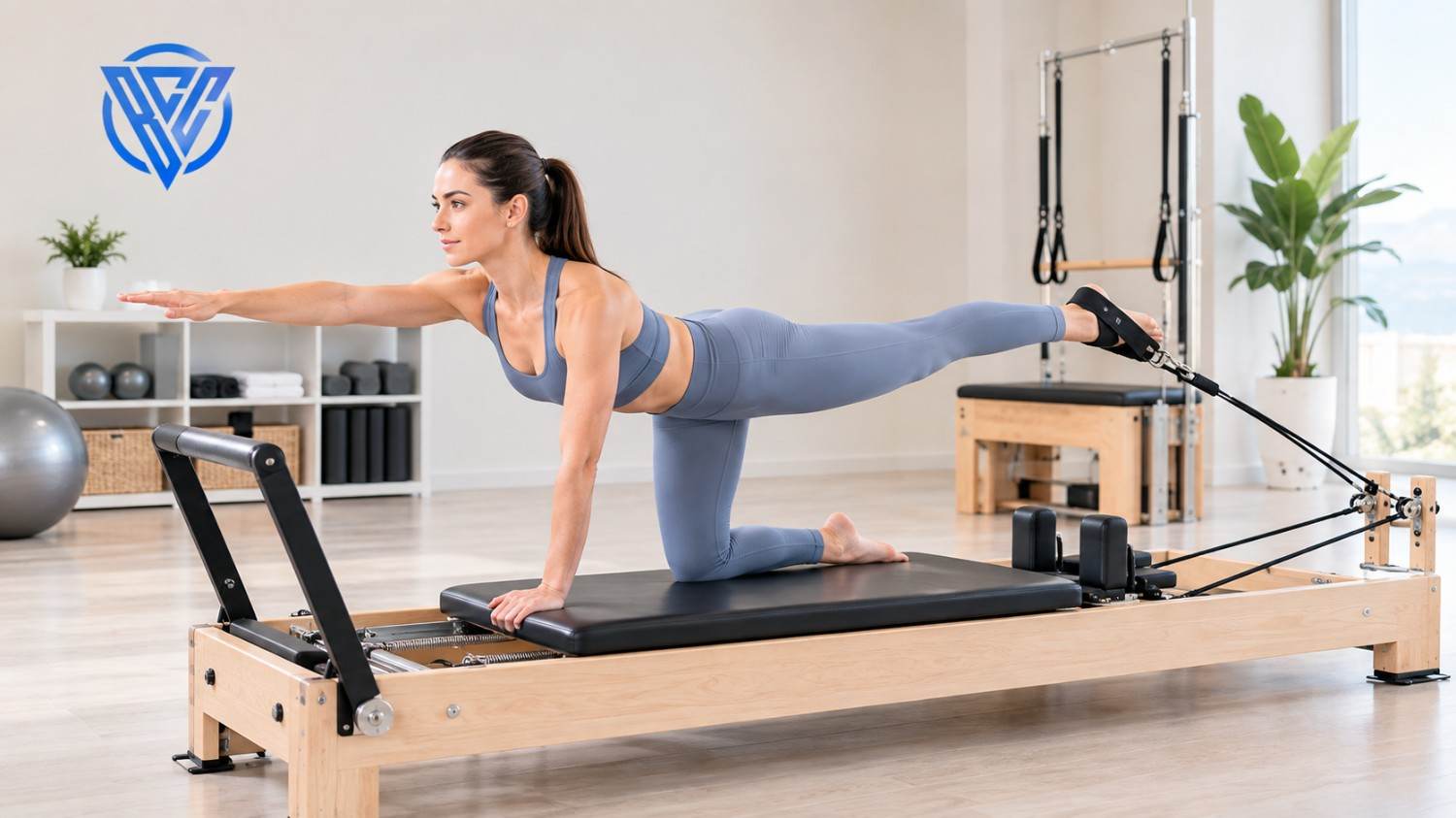
The reformer is a carriage sliding along rails against adjustable spring tension, fitted with a footbar, shoulder rests and long straps. It does two things a mat cannot: it adds resistance, and critically for newcomers it can add assistance. Understanding the difference between reformer and mat really comes down to that dual capability.
Why springs change the exercise
A heavier spring resists a leg press but supports a roll-up. An exercise inaccessible on the floor can therefore be performed correctly on the reformer, then progressively loaded as strength develops. This is the practical difference between reformer and mat training for anyone starting from a low base, and it is the difference between reformer and mat work that beginners feel most immediately.
Why the mat is not the easy option
It is a common misconception that mat work is a beginner’s version. Advanced mat repertoire is genuinely demanding precisely because nothing helps you, and a well-taught mat class exposes weaknesses the reformer’s structure can partly compensate for.
Reformer or Mat Pilates: The Practical Comparison
| Factor | Reformer Pilates | Mat Pilates |
| Resistance source | Adjustable springs and body weight | Body weight and gravity |
| Feedback | High the carriage reveals instability | Moderate depends on cueing |
| Assistance available | Yes, springs can support movement | No |
| Class size | Usually smaller, limited by machines | Can be larger |
| Typical cost per class | Higher | Lower |
| Practise at home | Not realistically | Yes, with minimal equipment |
| Best suited for | Rehabilitation, alignment, progression | Foundational control and consistency |
Neither column wins outright. When comparing reformer or mat pilates side by side, the right choice depends entirely on why you are starting.
When the Reformer Is the Better Starting Point
There is no universal rule for choosing reformer or mat pilates, but several circumstances point clearly toward the equipment. Reformer pilates for beginners is often the more forgiving entry, which surprises people who expect the machine to be intimidating.
- You are new to structured movement entirely. Reformer pilates for beginners is deliberately scalable, and spring settings can be lowered until a movement becomes achievable.
- You are returning from injury or working alongside physical therapy. Spring assistance lets you load a joint gradually and precisely.
- You struggle to feel your core engage. The moving carriage gives immediate, honest feedback — lose stability and the carriage tells you.
- You have limited mobility. The footbar and straps position you in ranges you could not reach unsupported.
- You need external structure to stay consistent. Booking reformer pilates classes creates accountability that home practice rarely does.
Regular reformer pilates classes also make progression visible, because spring settings give you a concrete record of what has changed. Most studios structure reformer pilates classes by level so beginners are not placed alongside advanced practitioners.
When Mat Work Makes More Sense First
The reformer or mat pilates question tilts toward the floor in several common situations. Mat pilates for beginners has real advantages, particularly around cost and frequency.
- You want to practise more often than an equipment budget allows. Mat work needs almost nothing and supplements studio sessions well.
- You want to internalise the principles. Without springs you learn to generate stability yourself, which transfers directly onto the reformer later.
- You travel frequently. A mat repertoire goes with you, which is why mat pilates for beginners suits unpredictable schedules.
- You prefer a larger, less equipment-focused environment. Some people simply feel more comfortable starting on the floor, and reformer or mat pilates is never a permanent commitment either way.
Well-taught mat pilates for beginners is a complete practice in its own right, not a warm-up for the machine.
Is Reformer Better Than Mat?
Asking is reformer better than mat work assumes one is a superior version of the other. It is more useful to ask which tool solves your current problem, and that reframing makes the comparison genuinely decidable.
In a direct reformer vs mat pilates comparison, the reformer excels at precision, progression and assisted range of motion. It is the better tool when you need loading control, when managing an injury, or when you need immediate feedback about what your body is doing. The mat excels at self-generated control, accessibility and frequency, making it the better tool when the goal is consistency and deep foundational strength.
So is reformer better than mat for everyone? No. Framing reformer vs mat pilates as a rivalry tends to slow beginners down more than it helps them, and a well-designed programme uses both in rotation rather than treating reformer vs mat pilates as an either-or choice.
Mat Pilates vs Reformer Over Your First Few Months
Whichever side of the decision you land on, the early trajectory looks broadly similar. Progress in reformer or mat pilates is gradual and largely neurological at first, because you are learning to recruit muscles you have not consciously used before.
- Weeks one to three: unfamiliar terminology, heavy cueing and considerable focus on breath. Expect to feel deep abdominals and hip stabilisers you did not know you had.
- Weeks four to eight: sequences start to feel familiar and you stop thinking about the equipment. This is usually when posture changes become noticeable.
- Months two to four: repertoire expands and the same exercise feels different because your control has improved, not because the exercise changed.
- Throughout: consistency matters far more than intensity. Two well-executed sessions weekly outperform one hard session taken occasionally.
Comparing mat pilates vs reformer progress over this period is less useful than simply attending. In practice, mat pilates vs reformer becomes a false choice once you are established, and most long-term practitioners alternate between the two across the week.
Common Mistakes When Choosing a Format
Beginners comparing reformer or mat pilates tend to make the same handful of avoidable errors.
- Choosing on price alone. The cheaper format is not cheaper if it does not address why you started.
- Assuming the machine requires existing fitness. A well-run beginner reformer class is designed for people with none, and reformer pilates for beginners assumes no prior training.
- Judging the method on a single session. A single reformer class tells you about the instructor and the room, not the method.
- Ignoring instructor quality. A skilled teacher on a mat serves you better than a poor teacher on excellent equipment.
- Booking an advanced reformer class too early, which usually produces frustration rather than progress.
When Choosing Reformer or Mat Pilates
When deciding between reformer or mat Pilates, avoid these common mistakes:
- Do not choose only based on price. The cheapest option is not necessarily the best choice if it does not match your goals or needs.
- Do not assume reformer Pilates is only for fit or experienced people. Beginners can start safely with appropriate spring settings and instructor guidance.
- Do not start with an advanced class. Choose a beginner-level session first so you can learn the basic movements, terminology and techniques properly.
- Do not ignore instructor quality. Good instruction is more important than simply choosing a studio with expensive equipment.
- Do not push through pain. Muscle effort is normal, but sharp or unusual pain should not be ignored. Stop the movement and speak with your instructor or healthcare professional.
- Do not judge Pilates after one class. Your first session may feel unfamiliar. Give yourself time to learn the movements and develop control.
- Do not treat reformer and mat Pilates as competing methods. Both formats have different advantages and can complement each other as your practice develops.
Conclusion
The reformer or mat pilates question resolves once you stop looking for a winner and start matching the tool to your goal. If you need assistance, precision and structured progression, begin on the equipment. If you need frequency, accessibility and a deeper feel for self-generated control, begin on the floor. Whichever you choose, the underlying Pilates method is identical, and results come from consistency rather than from the format you picked in week one.
If you are weighing reformer or mat pilates in Las Vegas, the most useful next step is to try a properly taught beginner session and judge from experience rather than description. Review the schedule at Blue Chip Conditioning, or book a private session if you would prefer a full assessment before joining a group.
Frequently Asked Questions
Should a complete beginner start with reformer or mat pilates?
Either works, but the reformer is often the easier entry because spring assistance supports movements you cannot yet perform unaided. Beginners managing injuries or mobility limitations generally benefit most from starting on the equipment with close instruction.
What is the main difference between the two formats?
The reformer adds adjustable spring resistance and assistance through a sliding carriage, while mat work relies entirely on body weight and gravity. Both follow the same principles and much of the same repertoire, adapted to the tool being used.
Is reformer pilates harder than mat pilates?
Not inherently. The reformer can make exercises easier through assistance or considerably harder through resistance. Advanced mat work is difficult because nothing supports you, so difficulty depends on repertoire and instructor rather than format.
Can I do both?
Yes, and most experienced practitioners do. Mat work develops self-generated control and can be practised frequently at low cost, while equipment sessions refine alignment and allow progressive loading. The two complement each other well.
How often should beginners attend?
Two sessions per week is a realistic and effective starting point. That frequency allows motor learning to consolidate between sessions without overwhelming a body adapting to unfamiliar movement patterns.
Do I need to be fit or flexible before starting?
No. Both formats build strength and mobility rather than assume it. Instructors adjust spring settings, range and repertoire to your current capacity, which is precisely why the method is widely used in rehabilitation.
Which format is better for back pain?
The equipment is often preferred initially because spring support allows controlled, low-load spinal movement. Any programme for back pain should be guided by a qualified instructor and coordinated with your healthcare provider first.