
Ask ten people why they started reformer Pilates in Las Vegas and you will get ten different answers. A back that never quite recovered from a desk job. A knee that objects to running. A dance career that demands more control every year. The method attracts people from very different starting points, and it keeps them because results arrive without the body being punished to produce them.
What surprises most newcomers is how demanding it is. There is a lingering assumption that Pilates is gentle stretching for people who find the gym intimidating. Anyone who has held a plank on a moving carriage with the springs set light knows otherwise. The growth of Pilates in Las Vegas over the past few years has been driven largely by people who arrived sceptical and stayed because the work was harder and more useful than they expected. Reformer work builds real strength, restores range of motion that years of sitting quietly removed, and translates both into better performance in whatever the client actually does outside the studio.
What Makes Reformer Training Different
The Spring System
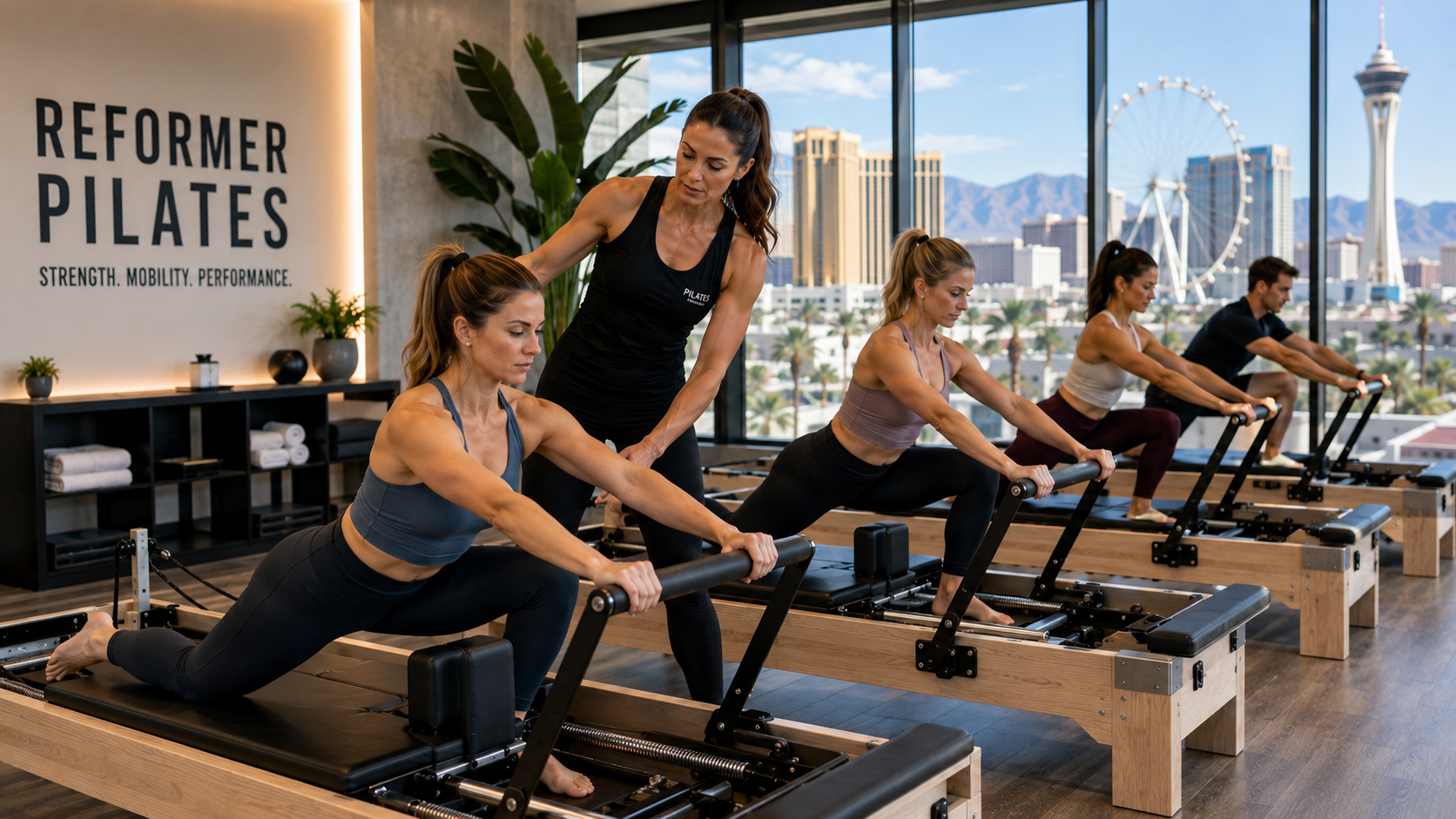
The reformer is a sliding carriage attached to a frame by adjustable springs, with a footbar, straps and a headrest. That sounds simple, and mechanically it is. The consequences are not, and they explain why almost every serious provider of Pilates in Las Vegas now builds its schedule around the apparatus rather than the mat.
Because resistance comes from springs rather than gravity, load can be adjusted in fine increments and applied from angles a barbell cannot reach. The carriage moves, so the body must stabilise continuously instead of bracing once and grinding through a repetition. Springs also assist as well as resist, meaning the same exercise can be made accessible for a beginner or considerably harder for an advanced client.
Why It Works Across Every Level
This adjustability is the reason a professional athlete and a sixty-five-year-old recovering from hip surgery can use the same apparatus productively. Reformer Pilates in Las Vegas has grown quickly for exactly this reason: it scales. Very few training methods can genuinely say that.
Strength: Building Capacity Without Wrecking Recovery
Strength gained on the reformer behaves differently from strength gained under a barbell. It arrives with control attached.
Every repetition demands eccentric management the carriage does not come back on its own, and letting it slam is both obvious and instantly corrected. Eccentric strength is what allows a body to decelerate, absorb landings and change direction safely. It is also the quality most commonly missing in people who train hard but keep getting injured. It is one of the clearest reasons runners and racquet-sport players take up Pilates in Las Vegas after a second or third recurring strain.
The other advantage is recovery cost. Heavy compound lifting is effective but taxing. Reformer sessions produce meaningful strength adaptation while leaving the nervous system in reasonable shape, which is why many clients train three or four times weekly without feeling wrecked. For anyone balancing training with shift work or a physical job, that matters more than any number on a chart.
Areas that respond quickly to consistent reformer work include:
- Deep abdominal and pelvic floor musculature, which supports the lumbar spine far more effectively than surface-level ab work
- Glutes and posterior chain, particularly the gluteus medius, which is chronically weak in people who sit for a living
- Scapular stabilisers, addressing the rounded-shoulder pattern that follows years at a keyboard
- Single-leg strength and control, exposing and correcting left-right imbalances that bilateral machines hide
Mobility: Range You Can Actually Use
Flexibility and mobility are not the same thing. Flexibility is passive range; mobility is range a person can control under load, and only the second protects joints during activity.
Reformer work develops mobility rather than flexibility because range is always trained with resistance and intent. A hip opens against spring tension while the trunk stays stable. The thoracic spine rotates while the pelvis is held still. Range gained this way tends to stay, because the nervous system has learned to own it rather than simply tolerate it. Clients who practise Pilates in Las Vegas through the summer months often report that heat-related stiffness bothers them noticeably less by the end of a training block.
For desk-based professionals and this city has plenty, alongside hospitality staff who spend entire shifts standing the priority areas are hip flexors, thoracic extension, ankle dorsiflexion and shoulder rotation. Improvement there changes how a day feels, not just how a workout feels.
Performance: Where It Shows Up Outside the Studio
Clients rarely arrive asking for better proprioception. They arrive wanting to golf without a stiff back, hike Red Rock without their knees complaining, or finish a twelve-hour shift without a burning neck.
The performance carryover is consistent. Golfers gain rotation and hold their posture deeper into a round. Runners find their stride opens up once hip extension improves. Combat sport athletes discover their base is steadier. For competitors with specific targets, our elite athlete development programming takes these principles further and builds them into a periodised plan.
None of this is mysterious. Better control of the pelvis and rib cage means force generated by the limbs actually goes where it is aimed instead of leaking sideways. That principle holds whether someone is chasing a personal best or simply wants to carry groceries without their lower back objecting, and it is the reason Pilates in Las Vegas appeals to such a broad range of clients.
Reformer vs. Mat: An Honest Comparison
Both have value. They are not interchangeable, and the right choice depends on what someone needs.
| Factor | Reformer Pilates | Mat Pilates |
| Resistance source | Adjustable springs | Body weight only |
| Progression range | Very wide — beginner to elite | Narrower without added props |
| Support for injuries | High; load can be reduced precisely | Limited; some positions unavailable |
| Feedback on form | Immediate, via carriage movement | Depends on instructor observation |
| Strength development | Substantial | Moderate |
| Cost per session | Higher (equipment and class size) | Lower |
| Best suited to | Rehab, athletes, strength goals | Home practice, general conditioning |
Most clients who take Las Vegas Pilates classes seriously end up doing both, using the mat as supplementary work between studio sessions. If you are choosing where to start with Pilates in Las Vegas, the reformer generally gives faster, clearer progress because the feedback is immediate.
What Actually Happens in Your First Session
Nervousness before a first class is normal and unnecessary. A well-run introduction follows a predictable shape:
- A short intake conversation covering injuries, surgeries, goals and current activity levels
- Equipment orientation spring settings, safety chains, how to get on and off the carriage properly
- Footwork sequences to establish alignment and warm the lower body
- Core and upper body work at a level matched to the individual, not the room
- Hands-on cueing throughout, because verbal instruction alone rarely fixes a movement pattern
- A closing stretch sequence and a short discussion of what to expect over the following days
Most people leave feeling worked but not exhausted, with the soreness arriving the next day in muscles they did not know they had.
Building a Realistic Schedule
Consistency beats intensity. The table below reflects what we typically see across clients at different frequencies over a twelve-week period.
| Weekly Frequency | Typical Focus | What Clients Usually Report by Week 12 |
| 1 session | Maintenance and technique | Better body awareness, modest strength change |
| 2 sessions | Balanced progression | Clear postural change, reduced everyday stiffness |
| 3 sessions | Accelerated development | Visible strength gains, improved sport performance |
| 4+ sessions | Athlete or rehab focus | Substantial capacity change, requires careful planning |
Anyone committing to Pilates in Las Vegas for the long term should plan around sustainability rather than intensity. Two sessions a week is the sweet spot for most people. It is frequent enough to build genuine adaptation and realistic enough to sustain around work and family commitments. Group formats keep this affordable, and our group reformer classes are capped deliberately so instructors can still correct individuals rather than shout at a crowd.
Choosing Where to Train
Not every provider of Pilates in Las Vegas operates to the same standard, and studios differ more than their websites suggest. Before committing to a package, check instructor certification, class caps, whether hands-on correction is offered, and how injuries and modifications are handled.
Location matters more than people expect, because a studio that is inconvenient is a studio that gets skipped. For anyone searching for Pilates Las Vegas NV options close to home, our facility sits on South Rainbow Boulevard with easy access from the southwest valley the full address and directions are on our contact page.
Pilates Las Vegas NV clients can reach in under twenty minutes will always beat a better studio on the far side of the valley. Parking, class timing and proximity to your commute sound like trivial considerations until they are the reason you have skipped three weeks. It is also worth being clear about pricing before you start. Introductory offers are useful for testing whether a studio suits you, and our current Las Vegas Pilates classes and package options are published openly rather than hidden behind a consultation call.
Private, Semi-Private or Group?
Las Vegas Pilates classes generally come in three formats, and each suits a different type of client.
- Private sessions suit complex injury histories, specific athletic goals, or anyone who wants programming built entirely around them.
- Semi-private sessions work well for two or three people with similar needs and offer close attention at a lower cost, through our semi-private training format.
- Group classes deliver energy, structure and value, and are ideal once fundamentals are established.
Many clients combine formats: a monthly private session to review technique, with group classes filling out the week.
Why the Method Fits This City
Las Vegas presents a specific set of physical demands. Hospitality and casino staff stand for long shifts on hard floors. Dancers and performers work punishing schedules with little margin for injury. Office workers deal with the same seated postures found anywhere, compounded by long drives across the valley. Add a climate that encourages indoor training for a good part of the year, and the popularity of Pilates in Las Vegas starts to look less like a trend and more like a sensible response to local conditions.
There is also a strong performance culture here. Between professional franchises, touring productions and a serious amateur sport scene, the city holds an unusual concentration of people whose bodies are part of their livelihood clients who need training that raises output without adding injury risk.
Conclusion
Reformer training earns its reputation because it delivers on three fronts at once. It builds usable strength, restores mobility that most adults have quietly lost, and turns both into performance that shows up in everyday life. The demand for Pilates in Las Vegas has grown because people who try it properly, with qualified instruction and consistent attendance, tend to stay.
If you have been curious but hesitant, the honest advice is to book a beginner-appropriate session rather than reading more about it. Reading about Pilates in Las Vegas will only take you so far; the method makes sense the moment you feel a spring load under your own feet. Bring your history, your goals and your questions. A good instructor will meet you exactly where you are and build from there. Pilates Las Vegas NV clients find lasting is rarely the studio with the flashiest marketing it is the one where someone knows their name and their left hip. Come and see whether ours is that studio for you.
Frequently Asked Questions
Is reformer Pilates suitable for complete beginners?
Yes. Spring resistance can be reduced to make exercises accessible at any starting level. Most studios, including ours, run beginner-appropriate sessions where instructors teach the equipment before adding load.
How is reformer Pilates different from going to the gym?
The gym trains mainly maximal force through fixed loads. Reformer training develops control, stability and range alongside strength, with far lower joint impact and immediate feedback on movement quality.
How many sessions per week do I need to see results?
Two sessions weekly is the practical minimum for meaningful change. Most clients notice improved posture and reduced stiffness within four to six weeks at that frequency.
Can I do Pilates with a back or knee injury?
Often yes, with medical clearance. Load and range can be adjusted precisely, which is why the method is widely used in rehabilitation settings alongside physical therapy.
Will reformer Pilates help me lose weight?
It builds lean muscle and improves movement quality, which supports body composition change. Sustained weight loss still depends primarily on nutrition and overall activity levels.
What should I bring to my first class?
Fitted workout clothing, grip socks and water. Avoid loose garments and jewellery, and arrive ten minutes early to complete an intake form and meet your instructor.
Is Pilates in Las Vegas suitable for older adults?
Very much so. The low-impact nature of spring resistance makes it one of the safest ways for older clients to build strength, protect bone density and maintain balance.