
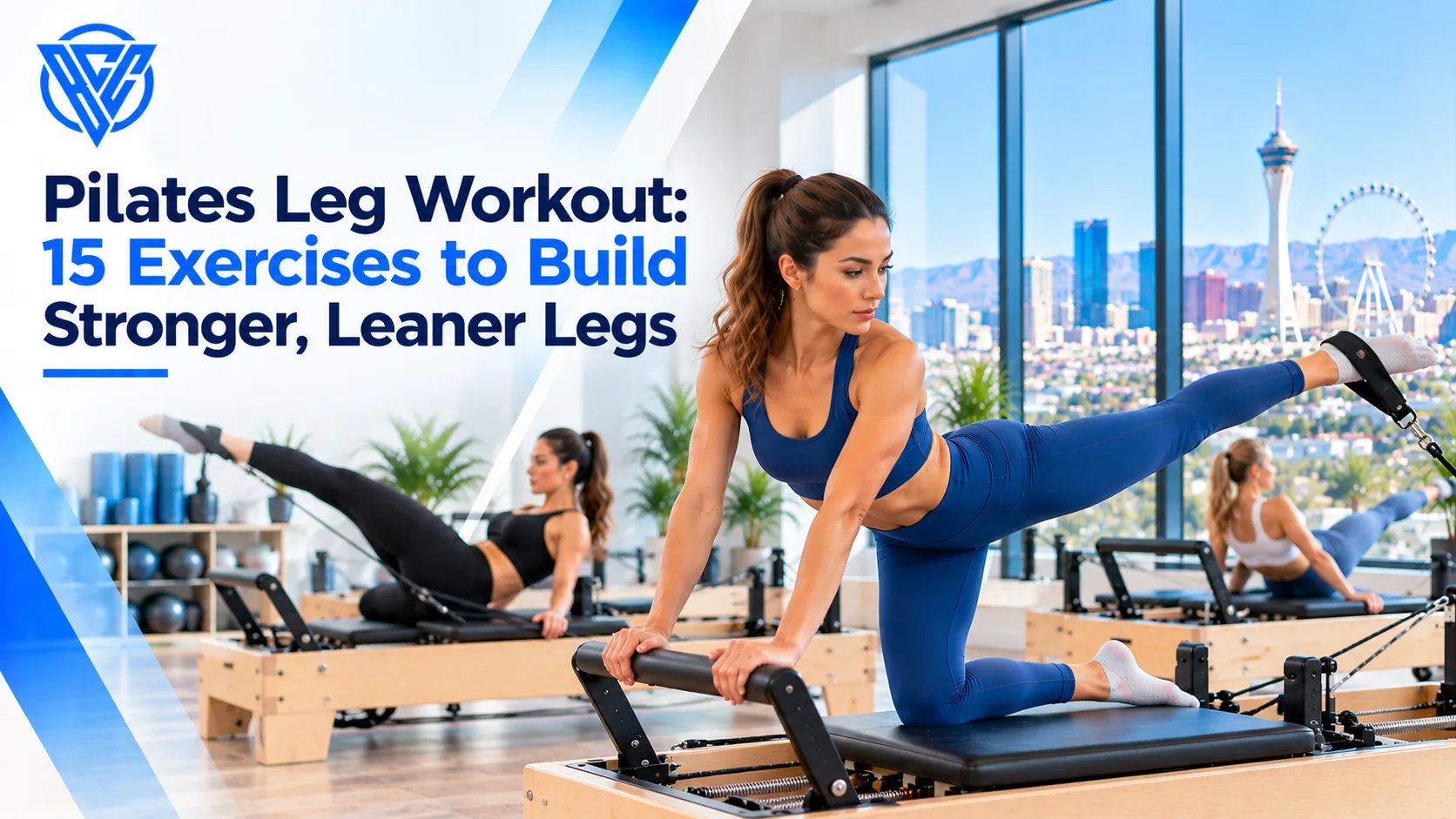
A pilates leg workout strengthens your hips, thighs, calves, and glutes through slow, controlled, low-impact movement that spares your knees and lower back. Below are 15 mat and reformer exercises, a 3-day weekly plan, exact rep and tempo targets, and the mistakes to avoid — everything you need to build leaner, more capable legs.
Why This Pilates Leg Workout Builds Better Legs
Most lower-body routines chase soreness. A smart pilates leg workout chases control instead. The method is built on slow, deliberate movement, precise alignment, and continuous core engagement, so your legs learn to stabilize, decelerate, and hold position — the way they work in daily life and sport — rather than simply lifting the heaviest load you can. The goal of any pilates leg workout is better movement, not just bigger muscles. Lower each repetition over about 3 seconds and pause for 1 second under tension, and a bodyweight move becomes demanding without any extra load.
That tempo reaches muscles ordinary training tends to skip. Deep hip stabilizers, the inner-thigh adductors, and the smaller glute muscles rarely get direct work from squats and lunges alone. Targeted pilates leg exercises address them head-on, which is why people describe strong pilates legs as looking long and defined rather than bulky.
There is also a joint-health advantage. Because the movements are low-impact, you can train 3 times a week without the knee and lower-back strain that comes from repetitive pounding. For anyone rehabbing an injury, returning to exercise, or wanting to train hard without breaking down, that mix of strength and protection is hard to beat. It is also why the method has become a staple for dancers and athletes who need durable legs across a 30-plus-week competitive season.
What a single session gives you
- Low impact, high output: controlled resistance challenges muscles without jarring your joints.
- Balanced strength: inner thighs, outer hips, hamstrings, and glutes develop evenly, closing weak links.
- Core integration: every movement is anchored by your deep abdominals, so leg strength transfers to real tasks.
- Mobility with stability: you gain range of motion and the control to actually use it safely.
What Low-Impact Leg Training Actually Does for Your Joints
Running loads each knee with roughly 2 to 3 times your bodyweight on every stride, and a heavy back squat can push that higher still. Spring-based and bodyweight resistance removes almost all of that peak force while keeping the muscles under steady tension through a full range, which is exactly the stimulus that drives strength and definition. Pilates itself was developed in the early 20th century as a system of controlled conditioning; you can read the background on the Wikipedia entry for Pilates. The practical takeaway is simple: you can build a pilates leg workout around 2 to 3 hard leg sessions per week, roughly 90 to 135 minutes of total work, with a fraction of the impact a running or jumping program would put through the same joints.
Before You Start: A 5-Minute Warm-Up
Never start a pilates leg workout cold. Spend 5 minutes raising tissue temperature and switching on the muscles you are about to train:
- Marching in place — 60 seconds, driving the knee to hip height.
- Hip circles — 10 slow circles in each direction per leg.
- Glute bridges — 15 reps with a 2-second squeeze at the top.
- Bodyweight calf raises — 20 reps, lowering slowly to prime the ankles.
The 15-Exercise Sequence
This pilates leg workout is organized from foundational mat moves to reformer-based progressions. Start with the mat block to build control, then add spring resistance as you get stronger. The first group needs no equipment; the second uses a reformer, the machine at the center of most studio group classes. Throughout, keep your spine long, your pelvis stable, and your breathing steady — these cues are what separate the method from ordinary leg training.
Mat Exercises (1–8)
This mat pilates leg workout can be done in a space about 2 meters square, which makes it ideal for home training between studio sessions. Aim for 10 to 15 reps per side unless noted.
- Side-lying leg lifts — Stack your hips and raise the top leg with control to target the outer hip and glute medius. 12 reps per side.
- Inner-thigh lifts — Cross the top leg forward and lift the bottom leg 15 to 20 cm to fire the adductors. 12 reps per side.
- Clamshells — Open the top knee with heels together to build the glutes that stabilize the knee. 15 reps per side.
- Single-leg circles — Draw 8 controlled circles with one extended leg while keeping the pelvis still, then reverse.
- Bridging — Peel the spine off the mat one vertebra at a time and hold the top for 2 seconds, a staple of effective pilates lower body exercises. 12 reps.
- Single-leg bridge — The same move on one leg, which exposes and corrects left-to-right imbalances. 10 reps per side.
- Standing footwork (relevé) — Rise onto the balls of the feet and lower over 3 seconds to strengthen calves and ankles. 15 reps.
- Leg pull front — From a plank, lift one leg 10 to 15 cm while holding a stable trunk. 8 reps per side.
Insert your own studio photo or diagram of the side-lying leg lift here, showing stacked hips and a neutral spine (suggested filename: pilates-leg-workout-side-lying-leg-lift.png).
Reformer Exercises (9–15)
On the machine, spring resistance loads the legs smoothly through a full range. Start most movements on 2 to 3 springs and adjust from there. These reformer Pilates leg exercises are where many people see the fastest change in strength and shape.
- Reformer footwork — Press the carriage out and in across 4 foot positions, 10 reps each, to work the whole leg chain.
- Single-leg press — Isolate one leg for 10 reps to balance strength side to side.
- Running on the reformer — Alternating heel lifts under spring load, 20 total, for calves and coordination.
- Reformer lunges — Deep, supported lunges, 8 per side, that build quads and glutes with control.
- Hamstring curls — Curl the carriage in a kneeling setup, 12 reps, to target the back of the legs.
- Side splits — Control the carriage outward for 10 reps to challenge the inner thighs through range.
- Jump board — Low-impact plyometrics, 2 sets of 15, that build power without landing stress.
Run through this full pilates leg workout 2 to 3 times a week, using 8 to 12 slow repetitions per exercise. Quality reps are the entire point — a slow, controlled set at a 3-1-3 tempo will always outperform a fast, sloppy one.
Mat vs Reformer: Choosing the Right Tools
Both halves of this pilates leg workout have a place. A mat pilates leg workout builds the control and body awareness that make everything else safer, while reformer Pilates leg exercises add adjustable resistance that speeds up strength gains. Most people progress fastest by combining the two rather than picking one. If you are newer to training, begin with 2 weeks of a mat pilates leg workout before adding the machine; if you already train, the springs make each repetition count for more. Neither tool replaces the other — they stack.
| Factor | Mat Pilates | Reformer Pilates |
| Equipment needed | Mat only | Reformer machine |
| Resistance source | Body weight | Adjustable springs |
| Best for | Control, core, home training | Progressive strength and range |
| Learning curve | Gentle, self-guided | Easier with instructor guidance |
| Impact on joints | Very low | Very low |
| Ideal setting | Home or studio | Studio or semi-private session |
Building Your Weekly Routine
Consistency beats intensity. Two to three focused leg sessions a week, each 30 to 45 minutes and spaced with at least 1 rest day, is enough to build noticeable strength and definition in your pilates legs over 6 to 8 weeks. Remember that a balanced pilates leg workout trains both legs equally, so imbalances don’t creep in.
A simple weekly template:
- Day 1 — Mat focus: exercises 1–8, 2 rounds, emphasizing control.
- Day 2 — Reformer focus: reformer Pilates leg exercises 9–15 at a moderate 2-to-3-spring load.
- Day 3 — Mixed or mobility: a lighter blend plus 10 minutes of stretching, or a studio class.
Who Benefits Most From This Routine
This pilates leg workout suits a wide range of people because the load is self-scaling: you control tempo, range, and spring tension. Beginners use it to build a foundation of control before adding heavy load. Runners and cyclists use it to balance the hips and prevent the overuse injuries that come from thousands of repetitive strides or pedal strokes each week. Dancers and athletes use it to refine alignment and single-leg strength that carries directly into their sport. And anyone rehabbing a knee, hip, or back issue gets measurable, low-impact progress without the pounding that sets recovery back. In practice, most of these groups can start the same mat block and simply dial the difficulty up or down to keep building leaner, stronger pilates legs.
When to Skip This Workout
This routine is low-impact, but it is not right for everyone on every day. Do not start or continue if any of the following apply:
- You are in acute pain. Sharp or pinching pain in a joint means stop — soreness is fine, pain is a signal.
- You are early post-surgery or post-injury. Wait until a doctor or physiotherapist clears you, which is often 6 weeks or more for knee and hip procedures.
- You have uncontrolled high blood pressure or are in late pregnancy without specific clearance, since some bridging and inversion-style positions may not be appropriate.
- You cannot hold neutral spine yet. If your lower back arches on every rep, scale back to the warm-up drills until you can brace properly.
When in doubt, work through the first 2 sessions with a qualified instructor rather than guessing on your own.
Common Mistakes to Avoid
Even a good pilates leg workout can stall when technique slips. Watch for these:
- Rushing the reps: speed removes the tension that drives results, so hold the 3-1-3 tempo.
- Losing the core: if your lower back arches, re-engage your abdominals before continuing.
- Skipping one side: always match reps left and right to within 1 or 2 repetitions.
- Chasing soreness: fatigue is not the goal; clean, controlled range is.
- Neglecting progression: add 2 reps, a little range, or 1 spring every 1 to 2 weeks so the work keeps challenging you.
If you are unsure about form, 2 or 3 guided sessions with an instructor will correct habits faster than 6 months of solo practice.
Frequently Asked Questions
Does a Pilates leg workout actually build muscle? Yes. Loading the legs through a full range under controlled tension builds lean muscle. You won’t bulk up fast, but you will gain visible strength, definition, and stability within 4 weeks of regular training.
Can I do Pilates leg exercises every day? You can do light pilates leg exercise daily because they are low-impact, but strength-focused sessions need recovery. Keep hard leg days to 2 or 3 a week, with a rest day between them, so muscles adapt and grow stronger.
Is mat or reformer better for legs? Neither is strictly better. Mat work builds control and can be done anywhere, while reformer Pilates leg exercises add adjustable resistance for faster gains. Combining both delivers the most complete lower-body results.
Will Pilates make my legs bigger or leaner? It tends to create leaner, more defined pilates legs rather than bulk, because the emphasis is on control, length, and balanced development rather than heavy loading.
How long until I see results? Most people notice better strength and control within 3 to 4 weeks. Visible changes in tone from steady pilates lower body exercises usually appear around the 6-to-8-week mark with consistent effort.
Do I need equipment to start? No. Begin with the mat block using just a 2-meter space and a mat, then add reformer work later. The mat sequence builds the core control that makes every reformer exercise safer.
Are these exercises safe for bad knees? Generally yes, because the method is low-impact and emphasizes alignment. With a knee injury, start with gentle pilates lower body exercises and work with a qualified instructor who can modify movements for your body.
Looking for more detail on each movement? Read our full guide to the 10 best Pilates leg exercises for toned thighs and glutes for step-by-step form cues and progressions.
Conclusion
Stronger, leaner legs come from consistency and control, not punishment. A well-structured pilates leg workout trains every part of the lower body — hips, thighs, hamstrings, calves, and glutes — while protecting the joints you rely on. Start with the mat sequence to build a foundation, progress to reformer work as your control improves, and keep every repetition slow and deliberate. Done 2 or 3 times a week, these pilates lower body exercises will reshape how your legs look, move, and feel within 8 weeks.
If you’d like expert eyes on your form, Blue Chip Conditioning offers group, semi-private, and private sessions in Las Vegas, where instructors tailor every mat pilates leg workout and reformer progression to your goals. Book your first class and feel the difference a guided approach makes.