
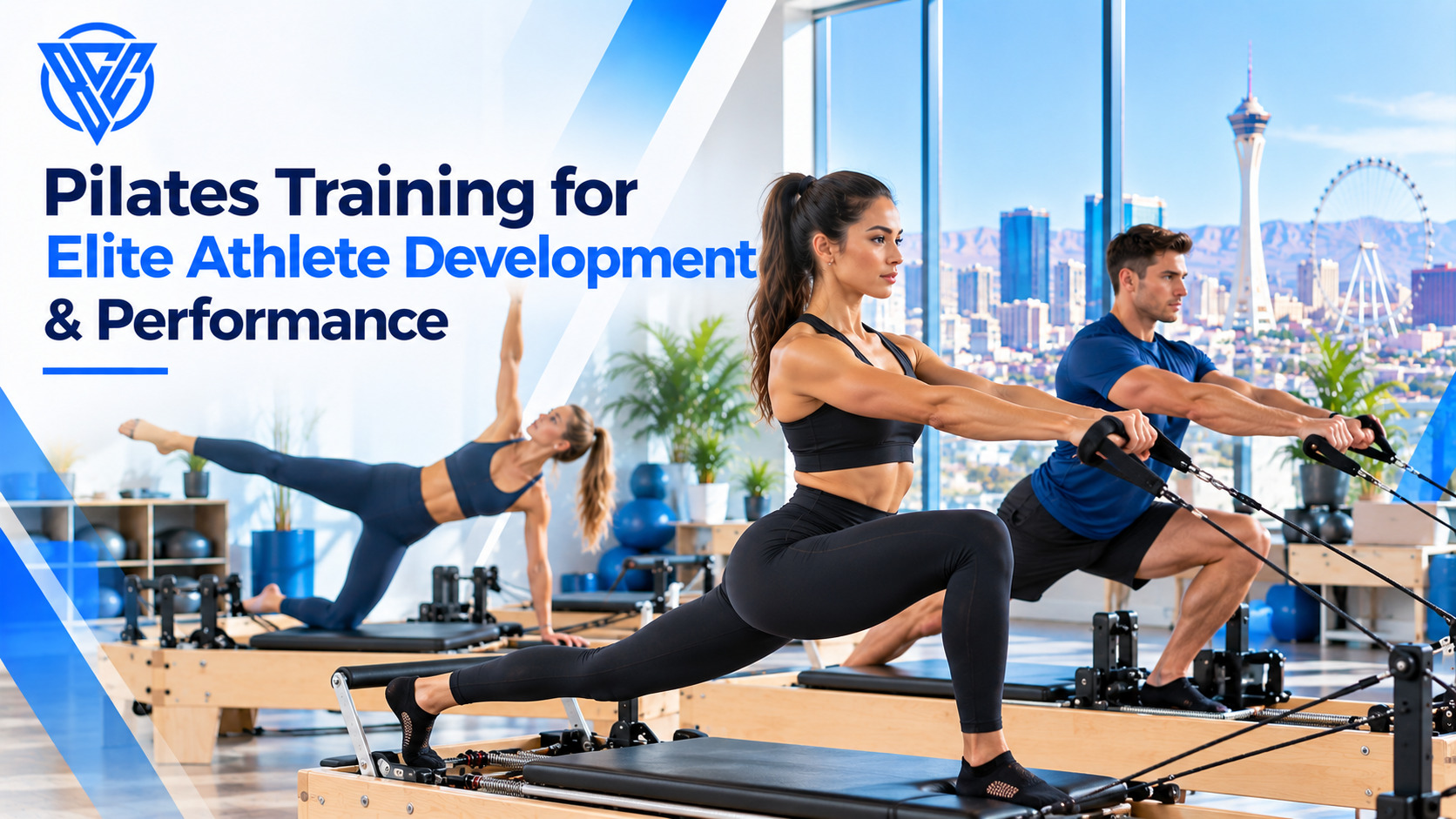
Elite athlete development depends on more than speed, strength and sport-specific skill. It also requires a body that can control force, move efficiently through its full range and stay resilient across a long season. This guide explains how Pilates supports that process, from core strength and mobility to balance and coordination, and how to combine it with an existing strength and conditioning program.
Athletes across many sports now use Pilates alongside traditional training. The appeal is precision: the method targets specific muscles and movement patterns that heavy lifting and conditioning drills can overlook.
How Pilates Supports Elite Athlete Development
Traditional training builds capacity: strength, power and endurance. Pilates, a low-impact method built on control, alignment, breathing and precision, refines how that capacity is used. Within an elite athlete development program, Pilates usually plays three roles:
- Performance: Improving how force travels through the body so power generated in the legs and hips reaches the arms, bat, racket or club more efficiently.
- Resilience: Addressing muscular imbalances and mobility restrictions that can contribute to overuse strain.
- Recovery and maintenance: Providing low-impact training that keeps athletes active during lighter weeks, in-season periods or alongside physical therapy.
Because sessions can be fully individualized, Pilates for athletes can be adapted to a sprinter, a tennis player, a golfer, a fighter or a dancer. The exercises may look similar, but the programming reflects each sport’s demands.
Building Core Strength and Stability With Pilates
The core is far more than the abdominal muscles you can see. It includes deep stabilizers such as the transverse abdominis, multifidus, pelvic floor and diaphragm, along with the glutes and hip muscles that stabilize the pelvis. Together, they protect the spine and transfer force between the lower and upper body.
Athletic core training through Pilates focuses on control during movement rather than isolated crunches. That distinction matters, because athletes rarely need their core to flex repeatedly; they need it to resist unwanted motion while the limbs produce force.
What Pilates Adds to Core Work
- Anti-rotation and anti-extension control that keeps the spine stable during throwing, swinging and cutting
- Breath coordinated with bracing, so athletes can stabilize without holding their breath under effort
- Single-side work that exposes and corrects left-to-right differences
- Spring resistance on the reformer that loads muscles through both the lifting and lowering phases
Well-structured athletic core training carries over to landing, sprinting and change of direction. That is why core stability sits at the center of almost every elite athlete development plan.
Improving Mobility, Flexibility and Movement Control
Flexibility on its own is not the goal. Athletes need usable range: the strength and control to perform well at the end of a movement, not just reach it. Pilates trains muscles to lengthen under load, especially during the controlled return of the reformer carriage, which builds mobility the athlete can actually use in competition.
Consider a few examples. A pitcher or tennis player depends on thoracic rotation and shoulder control. A hurdler needs hip mobility with a stable pelvis. A basketball player needs ankles and hips that absorb repeated landings. Pilates can address each of these needs within the same session structure by changing the exercise selection and emphasis.
Movement control is also the foundation of effective athletic performance training. When an athlete moves with better alignment and less wasted motion, every sprint, lift and swing becomes more efficient, which supports long-term elite athlete development rather than short-term gains.
Supporting Balance, Coordination and Agility
Balance relies heavily on proprioception, the body’s sense of where it is in space. Pilates challenges proprioception through controlled work on a moving carriage, single-leg exercises and standing sequences that demand precise alignment.
Agility is more than quick feet. Every change of direction requires an athlete to decelerate, stabilize and redirect force. Pilates strengthens the stabilizing side of that equation, which is why athletic performance Pilates is valuable for court and field sports where cutting and pivoting happen hundreds of times in a game.
Coordination improves as well. Many Pilates exercises require the upper and lower body to work independently while the trunk stays stable, which mirrors the demands of throwing, striking and kicking.
Using Pilates to Complement Strength and Conditioning
Pilates does not replace lifting, sprinting or sport practice. It complements them. The table below shows how the two approaches differ and why they work well together.
| Factor | Traditional Strength and Conditioning | Pilates |
| Primary focus | Maximal strength, power, speed and conditioning | Control, alignment, core stability and mobility |
| Type of load | Often heavy external load | Body weight and spring resistance |
| Impact level | Can be high (plyometrics, sprinting) | Low impact |
| Movement emphasis | Large compound patterns | Precision, isolation and integration |
| Role in the program | Builds capacity | Refines how capacity is used and supports recovery |
For scheduling, many athletes place Pilates on lighter training days, after heavy lifting sessions, or as in-season maintenance when high-volume gym work is reduced. Communication matters: elite athlete development works best when coaches, therapists and Pilates instructors share the same goals. Athletic performance training that combines both approaches tends to be more balanced than either one alone.
Why Athletes Should Add Pilates to Their Training Routine
Adding Pilates is a practical way to address gaps that general training can leave behind. The main advantages include:
- More efficient movement, so energy goes into performance rather than compensation
- Correction of imbalances that develop from one-sided sports such as tennis, golf and baseball
- Low-impact training that supports longevity and in-season maintenance
- Sharper body awareness, helping athletes notice fatigue or faulty mechanics earlier
- A supportive bridge during rehabilitation when used alongside a physical therapist’s guidance
There are also mistakes to avoid. Treating Pilates as stretching alone misses most of its value. Relying only on generic group classes, without sport context, limits the carryover. And inconsistent attendance makes progress hard to measure. Pilates for athletes delivers the most when it is programmed, progressive and tied to clear goals, which is exactly what athletic performance Pilates is designed to do.
How Blue Chip Conditioning Supports Athletic Performance
Blue Chip Conditioning in Las Vegas offers a dedicated elite athlete development training program for both established and aspiring athletes. Each program is customized to the athlete’s sport, body and goals, with the aim of helping clients jump higher, run faster and throw farther through precise, targeted conditioning.
The studio also believes athletic training should accompany physical therapy, and it uses low-impact Pilates conditioning to keep the rest of the body active, strong and mobile while an injury heals. Its founder, Danielle Maas, is a former Nevada Ballet Theatre dancer, and the studio also runs a specialized Pilates for dancers program.
Athletes typically train through private sessions or semi-private sessions, which allow individualized athletic core training and athletic performance Pilates with hands-on coaching from the instructor team. New clients can start with a complimentary 30-minute demo or a $99 new-client special that includes two semi-private sessions and two group classes, making it simple to test how Pilates fits into an elite athlete development plan.
What Athletes Should Not Do With Pilates
Pilates can be valuable for athletic performance, but how you use it matters. Athletes should avoid treating Pilates as stretching alone, because it also develops core stability, movement control, alignment and coordination.
Athletes should also avoid relying only on generic group classes without considering their specific sport and performance goals. Pilates should be connected to the athlete’s training needs and programmed progressively.
Another common mistake is inconsistent attendance. Regular, structured training makes it easier to measure progress and build meaningful improvements.
Finally, Pilates should not replace strength and conditioning, sprinting or sport-specific practice. It works best as a complement to an athlete’s existing training program.
Frequently Asked Questions About Pilates for Athletes
What is elite athlete development?
Elite athlete development is the long-term process of building the physical qualities, skills and resilience an athlete needs to compete at a high level. It combines sport practice, strength and conditioning, mobility work, recovery and injury prevention. Pilates contributes by improving core stability, movement control and body awareness. To learn more about the process, read our guide on what every serious athlete should know about athlete development training.
How does Pilates help athletes perform better?
Pilates strengthens the deep core, improves usable mobility and sharpens movement control. These qualities help athletes transfer force more efficiently, maintain alignment under fatigue and move with less wasted motion. The result is support for speed, power and precision, along with better balance between the left and right sides.
How often should athletes do Pilates?
Many athletes benefit from one to three Pilates sessions per week, depending on their season, training load and goals. Off-season blocks can include more frequent sessions, while in-season programs often use Pilates for maintenance and recovery. Coordinate the schedule with your coach to avoid overlapping heavy sessions.
Is Pilates effective for athletic core training?
Yes. Pilates trains the deep stabilizing muscles to control the spine and pelvis while the arms and legs move, which is how the core actually works in sport. Athletic core training on the reformer also adds spring resistance, allowing progressive loading without heavy impact on the joints.
Can Pilates replace strength training for athletes?
No. Pilates complements strength training rather than replacing it. Heavy lifting and power work build maximal strength and explosiveness, while Pilates refines control, alignment, mobility and core stability. Used together, they create a more complete and balanced athletic performance training program.
Is Pilates good for athletes recovering from injury?
Pilates can be a valuable part of recovery when it is cleared by a physician or physical therapist. Its low-impact, highly adjustable exercises allow athletes to stay active and maintain strength in unaffected areas while the injured area heals. Private sessions offer the closest supervision during this phase.
What sports benefit most from Pilates?
Athletes in almost every sport can benefit, particularly those involving rotation, repetitive movement or frequent changes of direction. Tennis, golf, baseball, basketball, soccer, running, combat sports and dance are common examples. Programming should always reflect the specific demands of the athlete’s sport and position.
Conclusion
Pilates gives athletes a precise, low-impact way to build core stability, usable mobility, balance and movement control, the qualities that allow strength and speed to translate into performance. It does not replace sport practice or strength and conditioning, but it strengthens both by improving how the body moves and recovers. For athletes serious about elite athlete development, adding structured, sport-specific Pilates is a practical step toward better performance and a longer career.
If you want to see how Pilates fits your sport, start with a complimentary demo session at Blue Chip Conditioning. Learn more about the elite athlete development training program or contact the team to discuss your goals, season and training schedule.