

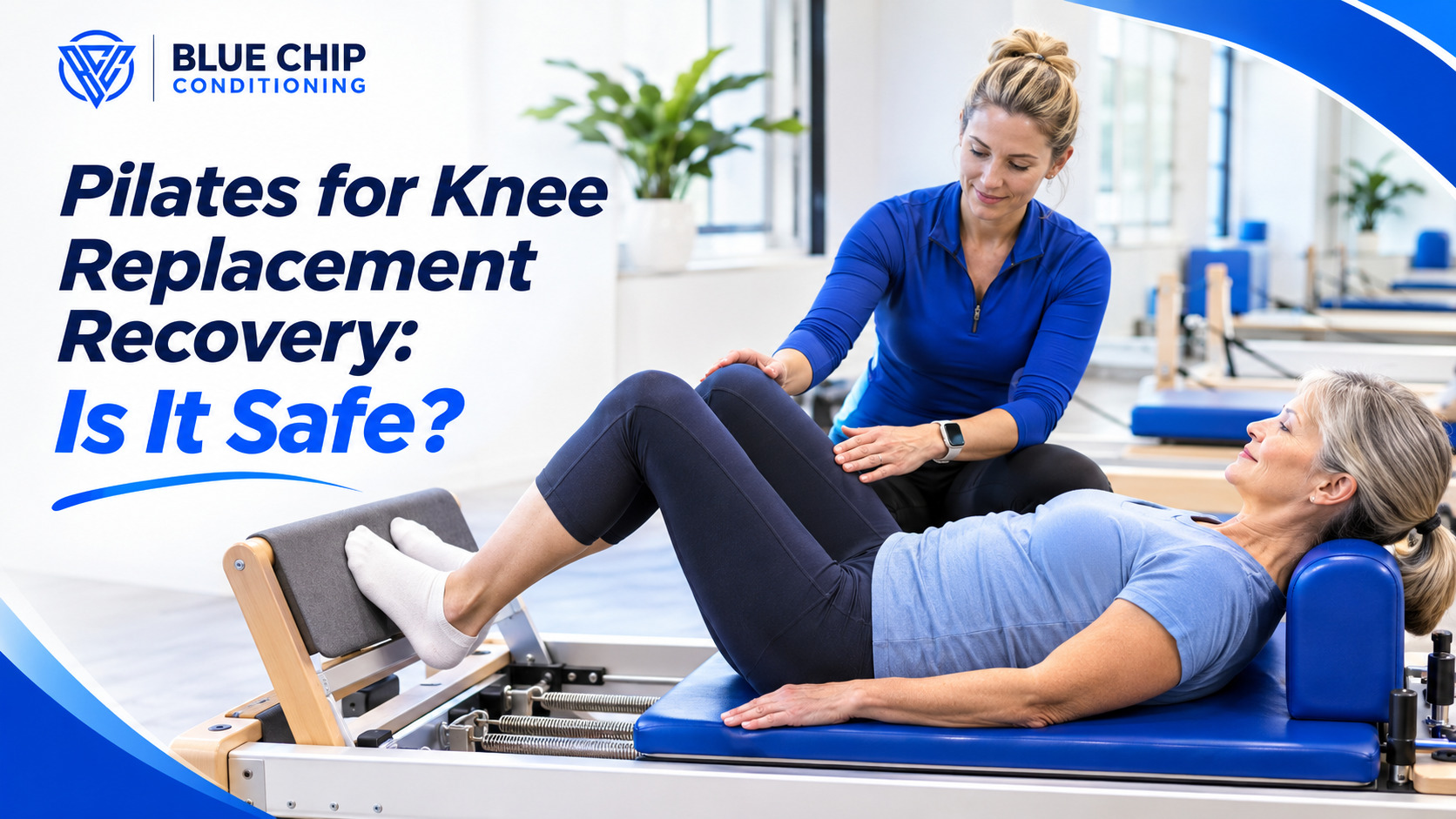
For most people, Pilates for knee replacement recovery can be a safe and valuable addition to rehabilitation, provided it begins with your surgeon’s clearance, follows your physical therapist’s guidance and is taught by an instructor who understands post-surgical needs. This article explains when Pilates typically fits into recovery, how it supports strength and mobility, which movements are generally appropriate, what to avoid and how to choose the right level of supervision.
Why Pilates for Knee Replacement Recovery Makes Sense
A total knee replacement resurfaces the damaged joint, but the muscles around the knee, hip and ankle still need to be rebuilt. The American Academy of Orthopaedic Surgeons notes that regular exercise to restore strength and mobility is important for full recovery after the procedure. Pilates for knee replacement recovery complements that work in several ways.
How Pilates Supports a New Knee
- Controlled, low-impact loading: Slow, precise movements let the joint work without jarring impact.
- Adjustable resistance: On the reformer, springs reduce or increase load so exercises match current strength.
- Whole-chain strengthening: Pilates trains the hips, glutes, core and ankles, which influence how forces travel through the knee.
- Alignment awareness: Instructors cue the knee to track over the second toe, helping correct compensations that develop after months of limping.
- Range-of-motion support: Gentle, supported bending and straightening reinforce the mobility goals set by your therapist.
When Is It Safe to Start Pilates After Knee Replacement Surgery?
Timing is the first question most people ask about Pilates for knee replacement recovery, and there is no single timeline that applies to everyone. Recovery speed depends on age, fitness before surgery, the procedure itself, wound healing and any complications. In the early weeks, rehabilitation should be led by your surgeon and physical therapist, who set the exercise program and its progressions.
Pilates after knee replacement surgery usually becomes appropriate once the incision has healed, you are walking with confidence and your care team agrees you are ready for supplementary exercise. Some people begin supervised sessions while still attending physical therapy; others start after discharge. Either way, bring your therapist’s notes and any restrictions to your first session.
Signs You May Be Ready
- Your surgeon or physical therapist has cleared you for additional exercise.
- The incision is fully closed and healed, with no signs of infection.
- You can walk short distances without significant pain or swelling afterward.
- You understand your current range-of-motion goals and any movement restrictions.
If any of these are not yet true, wait. Starting Pilates for knee replacement recovery too early adds risk without adding benefit.
Pilates for Knee Rehabilitation: Exercises That Commonly Help
Effective Pilates for knee replacement recovery starts with movements that are supported, low load and easy to modify. These post-knee replacement exercises focus on rebuilding control rather than chasing intensity, and every program should be individualized.
Supported Footwork on the Reformer
Lying on the back with the feet on the footbar, you press the carriage away and return it with control. Light springs reduce the load while the instructor monitors knee alignment and range. Footwork is a cornerstone of Pilates for knee rehabilitation because it mirrors a leg press in a fully supported position.
Bridging
Bridges strengthen the glutes and hamstrings, which help stabilize the knee. They can be performed on the mat or with the feet on the reformer footbar.
Side-Lying Leg Series
Lifting and circling the top leg while lying on your side strengthens the hip abductors. Stronger hips help reduce inward knee collapse during walking and stair climbing. The studio’s low-impact Pilates leg workout includes more lower-body exercises to discuss with your therapist once you are cleared.
Heel Slides and Supported Knee Bends
Sliding the heel toward the body and back, sometimes on a small ball or the reformer carriage, is a form of gentle Pilates for knee mobility that complements range-of-motion work from physical therapy.
Standing Balance Work
As strength improves, supported single-leg balance and shallow squats build confidence for daily activities. This stage is where Pilates for knee replacement recovery begins to bridge into everyday function.
Mat vs. Reformer: Which Suits Pilates for Knee Replacement Recovery?
| Factor | Mat Pilates | Reformer Pilates |
| Load control | Body weight only | Springs reduce or add resistance |
| Knee comfort | Kneeling positions may be uncomfortable | Lying-down footwork keeps body weight off the knee |
| Progression | Through leverage and repetitions | Through gradual spring and range changes |
| Supervision needs | Easier to practice independently once cleared | Best learned with an instructor |
| Best suited for | Home practice in later recovery | Earlier, supervised post-surgical work |
For many clients, reformer-based Pilates for knee replacement recovery is the more comfortable starting point because the knee can work without bearing full body weight. Mat work becomes more useful later, especially for maintaining strength at home. Spring support is also why the reformer is used for joint pain more broadly, as the studio’s guide to Pilates programs for pain-free movement explains.
Movements to Avoid or Modify
Safety in Pilates for knee replacement recovery depends as much on what you leave out as on what you include. Even gentle Pilates for knee mobility must respect the limits of the new joint:
- Deep kneeling: Many people find kneeling on a replaced knee uncomfortable; use padding or alternative positions.
- Forced deep bending: Avoid pushing the knee into deep flexion under load unless your therapist approves it.
- Twisting under load: Rotating the body over a planted foot can stress the joint.
- High-impact jumping: Jumpboard work belongs much later, if at all, and only with medical approval.
- Working through sharp pain: Muscular effort is expected; sharp, joint-line or increasing pain means stop.
Why One-on-One Pilates Training Matters
Supervision is one of the biggest factors in successful Pilates for knee replacement recovery. Group classes are designed for people with similar needs moving at the same pace, which is rarely the case after surgery. One-on-one Pilates training lets the instructor adjust springs, range and exercise selection set by set, watch alignment closely and adapt the session to how the knee feels that day.
At Blue Chip Conditioning, rehabilitation is part of the studio’s foundation, and the team regularly coaches clients through post-operative recovery and sport injuries. The studio recommends that anyone recovering from surgery begin with private or semi-private sessions before moving into group classes. Many clients start with one-on-one Pilates training to build a foundation, then continue Pilates after knee replacement surgery in a semi-private format once they need less hands-on attention.
Questions to Ask a Pilates Instructor
- Have you worked with clients after joint replacement surgery?
- How will you coordinate with my physical therapist’s recommendations?
- Which equipment will you use, and how will you adjust load for my knee?
- How will we decide when I am ready to progress or join group classes?
Blue Chip Conditioning’s instructors plan post-knee replacement exercises around your clearance, current range and goals, and progress them only when control is consistent. You can compare all of the studio’s Pilates for knee rehabilitation formats, from private to small-group, before booking.
Frequently Asked Questions
Is Pilates for knee replacement recovery safe?
Pilates is generally safe after total knee replacement once your surgeon or physical therapist clears you for additional exercise. Choose an instructor experienced with post-surgical clients, start with supported, low-load movements, avoid deep kneeling and high impact, and stop if you feel sharp or increasing joint pain.
How soon after knee replacement can I start Pilates?
There is no universal timeline. Most people start once the incision has healed, walking is steady and their care team approves supplementary exercise. Some begin supervised sessions during physical therapy, while others start after discharge. Always follow your surgeon’s and therapist’s guidance rather than a fixed calendar.
What are the best Pilates exercises after knee replacement?
Supported reformer footwork, bridging, side-lying leg work, heel slides and gentle balance drills are common post-knee replacement exercises in Pilates. They strengthen the quadriceps, hamstrings, glutes and hips with controlled load. An instructor should adjust springs, range and repetitions to match your stage of recovery.
Can Pilates replace physical therapy after knee surgery?
No. Physical therapy should lead rehabilitation after knee replacement, because therapists assess healing, range of motion and function clinically. Pilates for knee replacement recovery works best as a complement, either alongside therapy with approval or after discharge, to keep building strength, mobility and confidence over the longer term.
Is reformer Pilates good for knee replacement patients?
Reformer Pilates is often a good fit because springs let the instructor reduce or increase resistance, and many exercises are performed lying down, keeping full body weight off the knee. Sessions should be supervised, with load and range progressed gradually according to your clearance and comfort.
Can I do gentle Pilates at home after knee replacement?
Yes, once cleared. Gentle Pilates for knee mobility, such as heel slides, bridges and side-lying leg lifts, can be practiced at home on a mat. Learn the movements under supervision first so you understand correct alignment, and stop any exercise that causes sharp pain or swelling.
Do I need private sessions or can I join a group class?
Private sessions are usually the best starting point after knee replacement because exercises, springs and range can be adjusted for your knee in real time. Once strength and control improve, semi-private sessions or small group classes can be appropriate, ideally with your instructor’s and therapist’s agreement.
Conclusion
Pilates can be a safe, effective way to keep progressing after knee replacement, as long as it fits within the plan set by your surgeon and physical therapist. Pilates for knee replacement recovery works best when it starts with clearance, uses supported and adjustable equipment, avoids deep kneeling and impact, and is supervised closely in the early stages. Done this way, Pilates for knee replacement recovery helps rebuild the strength, alignment and confidence needed to return to walking, stairs and the low-impact activities you enjoy.
If you are ready to add Pilates to your rehabilitation, contact Blue Chip Conditioning in southwest Las Vegas. Share your surgeon’s clearance and therapist’s notes, and an instructor will recommend private or semi-private sessions built around your knee and your goals.