
A Pilates workout for weight loss works best as part of a structured weekly routine rather than an occasional class. Pilates builds lean muscle, improves posture and keeps you moving consistently, all of which support fat loss when combined with sensible nutrition and regular aerobic activity. This guide explains what Pilates can and cannot do for weight management, which exercises to prioritize, how to plan a realistic week and how to choose between home and studio training.
Can a Pilates Workout for Weight Loss Really Work?
Weight loss ultimately depends on a sustained energy deficit, meaning you consistently use more energy than you take in. No single exercise style guarantees results. What a Pilates workout for weight loss offers is a sustainable way to build strength, increase daily movement and support the habits that make that deficit easier to maintain.
Pilates for weight loss has three practical advantages. It builds and preserves muscle, which matters because dieting without strength training can mean losing muscle along with fat. It is low impact, so most people can train several times a week without joint pain forcing breaks. And because sessions are engaging and progressive, people tend to stick with them, which is the factor that decides long-term results.
What Pilates Contributes to a Weight Loss Plan
- Muscle strengthening: Spring and body-weight resistance work the legs, hips, back, abdomen, chest, shoulders and arms.
- Consistency: Low-impact training lowers the risk of the aches that derail many beginners.
- Posture and shape: Stronger postural muscles change how the body looks and moves, sometimes before the scale shifts much.
- Body awareness: Many people find the focus on breath and control carries over into calmer, more mindful daily habits.
For overall health, the CDC’s physical activity guidelines recommend at least 150 minutes of moderate-intensity aerobic activity each week plus muscle-strengthening activity on two or more days. That is why a Pilates workout for weight loss performs best alongside walking, cycling or swimming. Pilates covers the strength portion, and higher-tempo formats can contribute to the aerobic side as well.
The Best Pilates Exercises for Weight Loss
A strong Pilates workout for weight loss favors movements that involve large muscle groups, keep the heart rate up and can be progressed over time. The most effective Pilates exercises for weight loss usually fall into three categories.
Lower-Body Strength Moves
Reformer footwork, lunges on the carriage, bridging and the side-lying leg series target the glutes, quadriceps and hamstrings, the body’s largest muscles. Training big muscle groups raises the energy demand of each session. For more lower-body ideas, see the studio’s list of Pilates leg exercises for toned thighs and glutes.
Full-Body Flow Moves
Teaser, Rolling Like a Ball, plank-to-pike and Leg Pull Front connect the core with the arms and legs. Moving between them with minimal rest keeps the effort continuous.
Higher-Tempo Reformer Work
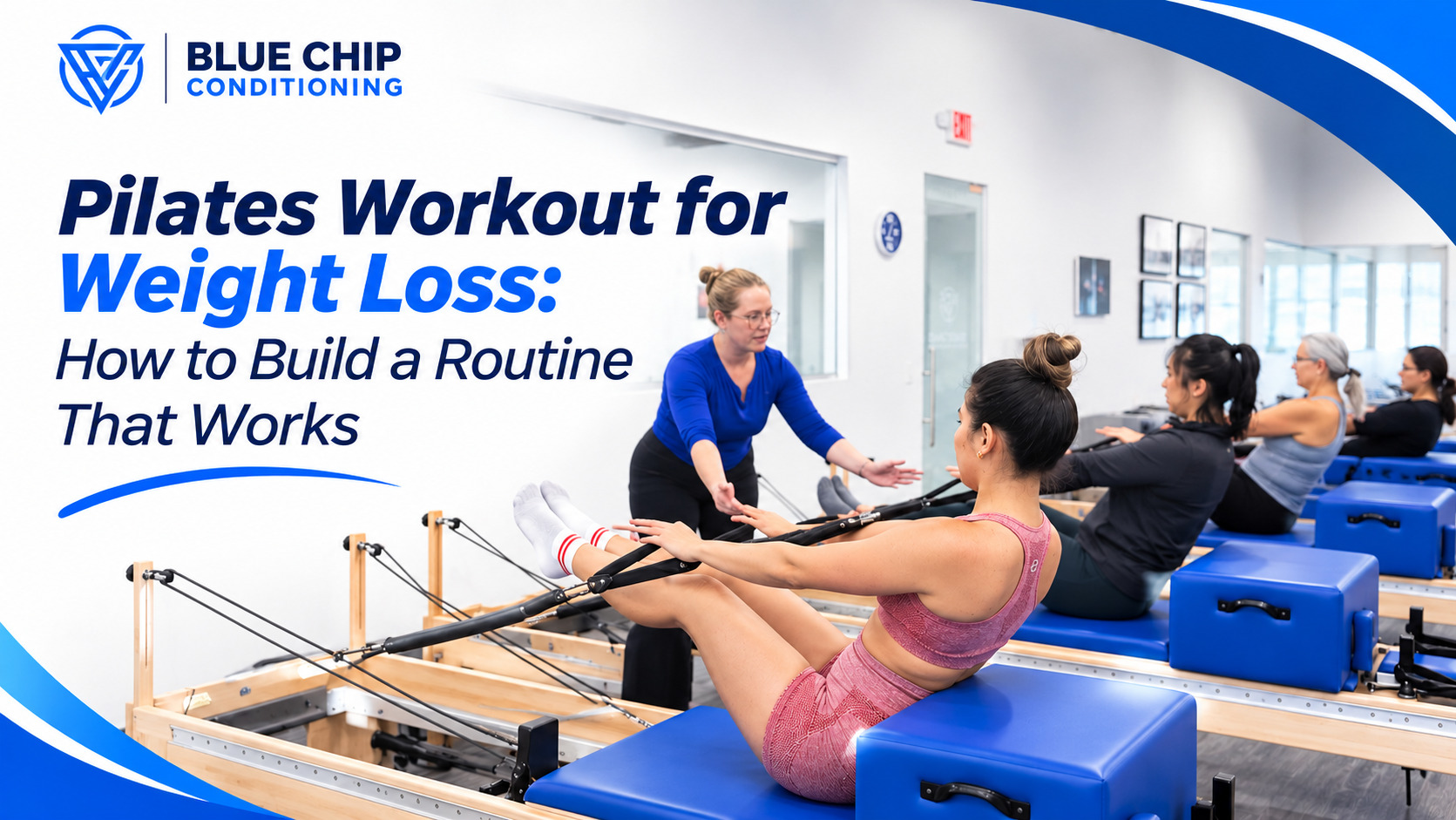
Jumpboard sessions on the reformer add a low-impact cardio element: you jump horizontally against spring resistance instead of landing on a hard floor. This is one reason Reformer Pilates for weight loss appeals to people who want cardio without the joint stress of running.
These Pilates exercises for weight loss work best with good form at a pace that challenges you while still allowing control. If you want a coach to select and progress Pilates exercises for weight loss for your body, semi-private sessions give you an individualized program with a hands-on instructor at a lower cost than private training.
How to Structure Your Weekly Pilates Workout for Weight Loss
A Pilates workout for weight loss only works if you can repeat it for months. Use this framework as a starting point, then adjust it to your schedule and fitness level.
| Day | Session type | Focus |
| Monday | Reformer or mat Pilates (45–50 min) | Full-body strength |
| Tuesday | Brisk walk or cycling (30–40 min) | Aerobic activity |
| Wednesday | Higher-tempo Pilates or jumpboard class | Strength plus cardio |
| Thursday | Rest or gentle mobility | Recovery |
| Friday | Reformer or mat Pilates (45–50 min) | Lower body and core |
| Saturday | Longer walk, hike or swim | Aerobic activity |
| Sunday | Rest or stretch class | Recovery |
This plan delivers three Pilates sessions plus regular aerobic activity each week, which lines up with general activity recommendations while leaving time to recover.
Tips for Making the Routine Stick
- Schedule sessions like appointments: Booking classes in advance reduces the chance of skipping them.
- Progress gradually: Increase spring resistance, repetitions or session length every few weeks, not every session.
- Track more than the scale: Note energy, strength, sleep and how clothes fit alongside body weight.
- Pair training with nutrition: Adequate protein and an appropriate calorie intake support fat loss while helping preserve muscle.
A Simple Starter Routine for Beginners
Your first Pilates workout for weight loss does not need to be long. This 25-minute beginner Pilates workout can be done on a mat two or three times a week:
- Warm-up (5 minutes): Pelvic curls, cat-cow and the Hundred with feet on the mat.
- Lower body (8 minutes): Bridges, side-lying leg lifts and clamshells.
- Core and upper body (8 minutes): Single-Leg Stretch, modified plank and Swimming.
- Cool-down (4 minutes): Spine stretch forward, hamstring stretch and slow breathing.
Keep transitions short so the session stays active, but never trade form for speed. Once this routine feels comfortable, add a session or move into reformer classes. To learn technique with coaching, Blue Chip Conditioning offers a new client special that pairs semi-private sessions with group classes, a structured way to turn a beginner Pilates workout into a lasting habit.
Home Practice vs. Studio Reformer Classes
A Pilates workout at home is convenient, free and easy to fit around work; all you need is a mat and some floor space. The limitation is load. Once body-weight exercises feel easy, progression becomes harder, and without feedback it is easy to develop habits like arching the lower back or straining the neck.
Studio sessions solve both problems. Reformer Pilates for weight loss uses adjustable springs, so resistance can increase as you get stronger, and instructors correct technique in real time. Many people combine the two: studio classes for progressive strength and coaching, plus a short Pilates workout at home on off days. At Blue Chip Conditioning, Reformer Pilates for weight loss is taught in small groups capped at eight, so every client gets attention. Whichever setting you choose, the principles of an effective Pilates workout for weight loss stay the same: large muscle groups, steady effort and gradual progression.
Common Mistakes to Avoid
The most common mistake is expecting exercise alone to offset eating habits that have not changed. Another is training too infrequently; one class a week rarely produces noticeable change. Many people also judge progress only by the scale and give up during weeks when strength and measurements are improving. Finally, rushing through movements shifts effort away from the target muscles. A Pilates workout for weight loss rewards control and consistency far more than speed. The studio’s Pilates transformation guide covers what steady, realistic progress looks like.
Frequently Asked Questions
Is Pilates good for weight loss?
Pilates for weight loss can be effective when it is part of a broader plan. It builds muscle, improves consistency and supports an active lifestyle, but fat loss still depends on an overall calorie deficit. Combining Pilates with aerobic activity and balanced nutrition gives the most reliable results.
How many times a week should I do a Pilates workout for weight loss?
Three sessions per week is a practical target for most people, combined with aerobic activity such as brisk walking or cycling on other days. Beginners can start with two sessions and add a third once recovery feels comfortable. Consistency over several months matters more than any single session’s intensity.
Is reformer Pilates better than mat Pilates for losing weight?
The reformer offers adjustable resistance and jumpboard cardio options, which makes progression easier. Mat Pilates is convenient and effective, especially for beginners and home practice. The better choice is the format you will perform consistently, and many people benefit from combining both throughout the week.
Can I do a Pilates workout at home to lose weight?
Yes. A Pilates workout at home can support weight loss when done consistently and paired with aerobic activity and good nutrition. Focus on full-body exercises, keep rest short and progress repetitions over time. Occasional studio sessions help check technique and add resistance once body-weight work becomes easy.
How long does it take to see results from a Pilates workout for weight loss?
Many people notice better posture, strength and energy within a few weeks of regular practice. Changes in body weight and shape usually take longer and depend on diet, overall activity and consistency. Tracking strength, measurements and how clothes fit gives a fuller picture than the scale alone.
Which Pilates exercises burn the most calories?
Exercises that use large muscle groups and keep you moving tend to demand the most energy. Jumpboard work, reformer lunges, Teaser, plank variations and flowing sequences with short rests are good examples. Energy use varies between individuals, so focus on effort and consistency rather than calorie estimates.
Is a beginner Pilates workout enough for weight loss?
A beginner Pilates workout is an excellent starting point, but progress requires gradually increasing the challenge. After a few weeks, add repetitions, resistance or an extra session, and pair Pilates with aerobic activity. Coached sessions help you progress safely, refine technique and avoid frustrating plateaus.
Conclusion
A Pilates workout for weight loss is most effective when it supports the fundamentals: a modest calorie deficit, regular aerobic activity and progressive strength training. Pilates contributes the strength, consistency and body awareness that make those fundamentals easier to sustain. Start with two or three sessions a week, follow a simple weekly structure, track progress beyond the scale and increase the challenge gradually.
If you would like coaching to build the right Pilates workout for weight loss for your body and schedule, visit Blue Chip Conditioning in southwest Las Vegas. Instructors can assess your starting point and recommend group reformer classes, semi-private sessions or private training based on your goals.