
Most serious competitors hit the same wall at some point. The lifts keep climbing, the training hours keep stacking up, and yet sprint times flatten out and the same hamstring keeps complaining every pre-season. That plateau is rarely a motivation problem. It is almost always a structural one, and closing it is precisely the job of a properly built elite athlete development program. Strength, speed and performance are not three separate projects to be chased in isolation. They are outputs of the same system, and when one of them stalls, the cause is usually hiding somewhere the athlete has not been looking.
At Bluechip Conditioning we have spent years working with competitors at every level, from high school prospects to professionals with contracts on the line. The pattern repeats itself often enough to be predictable. The athlete is strong. The athlete works hard. And the athlete is compensating for something a hip that will not extend, a shoulder that rotates unevenly, a core that switches on half a beat too late. Elite athlete development, done properly, finds those gaps and closes them before they turn into a season-ending problem.
What Elite Athlete Development Actually Means
The phrase gets used loosely. Plenty of gyms advertise elite athlete development and deliver a slightly harder version of a general fitness class. That is not the same thing.
A genuine program starts with assessment, not exercise. Before an athlete touches a piece of equipment, we want to know how they move: where range of motion is limited, which side dominates, how the pelvis behaves under load, whether breathing mechanics are supporting or sabotaging trunk stability. Only then does programming begin, and the programming is built backwards from the demands of the sport rather than forwards from a generic template.
A pitcher and a point guard both need rotational power, but they express it through entirely different chains. A dancer and a tennis player both need single-leg control, but the loading patterns look nothing alike. Elite athlete development respects those differences. Every session an athlete spends on work that does not transfer to their sport is a session spent on something else that would have.
The Difference Between Working Hard and Working Precisely
Volume is easy to add and difficult to recover from. Precision is harder to program and far more productive. When an athlete trains a compensation pattern for months, they do not eliminate it they reinforce it under heavier and heavier load. The strongest version of a faulty pattern is still a faulty pattern, and it usually fails at the worst possible moment.
The Three Pillars: Strength, Speed and Durability
Strength That Actually Transfers
Absolute strength matters, but transferable strength matters more. An athlete who can back squat impressive numbers and still collapses inward on a single-leg landing has strength that does not show up when it counts. Sport happens on one leg, off balance, in rotation, and under fatigue. Training should reflect that reality.
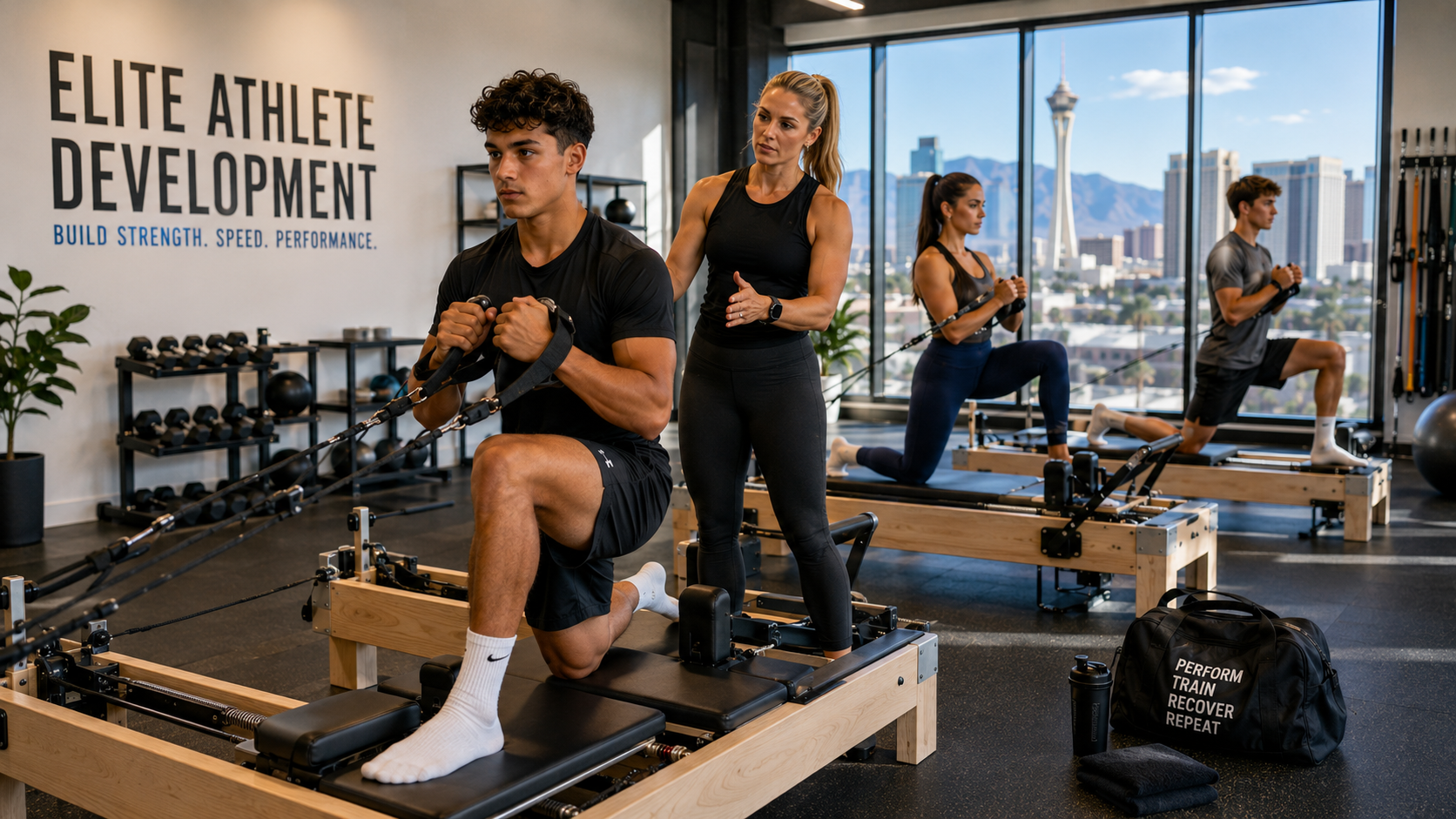
Reformer and apparatus-based work is unusually good at this because resistance is applied through springs rather than gravity alone. Load can be adjusted in tiny increments, angles can be changed instantly, and the athlete has to control both the concentric and the eccentric phase of every repetition. That eccentric control is where a great deal of injury resistance lives.
Speed as a Trainable Skill
Speed is often treated as something an athlete either has or does not have. In practice, most athletes are leaking speed rather than lacking it. Restricted hip extension shortens stride. A stiff thoracic spine limits arm drive. Poor pelvic control means force applied to the ground scatters sideways instead of driving the body forward.
Restore the range and the control, and speed frequently improves without a single additional sprint session. That is one of the quieter wins in elite athlete development work, and it is a consistent one.
Durability and Availability
The most underrated athletic quality is availability. An athlete who plays thirty games is worth more than an equally talented athlete who plays eighteen. Durability comes from balanced development — symmetrical strength, adequate range of motion, connective tissue that has been progressively loaded rather than suddenly shocked, and a nervous system that is not permanently running at maximum.
Why Pilates-Based Training Belongs in Elite Athlete Development
Top-level athletes across professional sport have adopted apparatus-based conditioning for reasons that have nothing to do with trends. The method offers a set of advantages that traditional strength work struggles to match:
- Precise, adjustable resistance. Spring tension can be dialled up or down in small steps, which allows loading to be matched exactly to an athlete’s current capacity rather than to the nearest available plate.
- Low joint impact with high neuromuscular demand. Athletes can accumulate quality work without adding the cumulative joint stress that comes with heavy compound lifting every session.
- Built-in unilateral and rotational work. Imbalances become obvious immediately rather than staying hidden behind a barbell that lets the stronger side take over.
- Trainable control through full range. Athletes learn to produce and absorb force at end range, which is exactly where most non-contact injuries occur.
- Compatibility with in-season loads. The work supports competition schedules instead of competing with them for recovery capacity.
- Direct carryover to rehabilitation. When an injury does happen, the athlete already knows the equipment and can keep training the rest of the body while the injured area heals.
Working with a well-equipped pilates studio Las Vegas athletes actually trust gives access to reformers, towers, chairs and barrels a far broader toolkit than a mat and a set of bands.
Conventional Strength Work vs. Pilates-Based Athletic Conditioning
Neither approach replaces the other. The point is understanding what each one does well so the two can be sequenced intelligently across a training year.
| Training Variable | Conventional Strength Training | Pilates-Based Conditioning |
| Primary quality developed | Maximal force production | Control, stability and force absorption |
| Joint impact | Moderate to high | Low |
| Load adjustment | Fixed increments (plates) | Continuous (spring tension) |
| Imbalance detection | Often masked by bilateral lifts | Exposed immediately |
| Recovery cost | High | Low to moderate |
| In-season suitability | Requires careful volume management | Well suited to weekly use |
| Rehabilitation value | Limited during acute phases | High throughout the process |
What a Structured Program Looks Like Across a Season
A serious elite athlete development plan is periodised, not improvised. The emphasis shifts as the competitive calendar moves.
- Off-season (assessment and rebuild). Movement screening, correction of asymmetries, restoration of range of motion, and a base of controlled strength. This is when the deepest changes are possible.
- Pre-season (capacity and power). Load and intensity rise. Rotational power, single-leg strength and reactive control move to the front of the programme.
- In-season (maintenance and management). Volume drops sharply, quality stays high. Sessions protect the qualities already built and manage accumulated fatigue.
- Post-season (restoration). Deliberate recovery of range, tissue quality and mental freshness before the next cycle begins.
Athletes who skip the off-season assessment phase almost always pay for it later in the year. The work is not glamorous, but it is the foundation everything else stands on.
Measuring Progress Honestly
Feeling better is not the same as measurably improving. Objective markers keep programming accountable. The metrics below represent the kind of tracking used in a well-run elite athlete development programme.
| Assessment | What It Measures | Typical Review Interval |
| Single-leg squat quality | Frontal-plane control and hip strength | Every 6 weeks |
| Active straight-leg raise | Posterior chain range of motion | Every 4 weeks |
| Thoracic rotation range | Available rotation for throwing and swinging | Every 6 weeks |
| Left/right strength differential | Asymmetry risk | Every 8 weeks |
| Sport-specific output test | Transfer to competition | Every 8–12 weeks |
The differential between limbs is the number that most often changes an athlete’s mind about this work. A fifteen per cent imbalance is invisible in the weight room and glaringly obvious on a single-leg landing.
Who This Work Is For
Elite athlete development is not restricted to professionals, though we certainly work with them. The framework applies to:
- Collegiate and high school athletes protecting scholarship potential
- Professional and semi-professional competitors managing long seasons
- Dancers and performers whose careers depend on range and control, supported through our Pilates for dancers programming
- Masters athletes who intend to compete for another decade
- Athletes returning from injury who need a structured bridge back to full training
The common thread is intent. Anyone training with a defined performance target benefits from the same principles, scaled appropriately.
Choosing Where to Train
Facilities vary enormously. Before committing, it is worth asking three questions: Who is programming the sessions, and what is their background with athletes specifically? Is there a formal assessment before training starts? And is progress tracked against anything measurable?
Equipment matters too. A serious Pilates studio Las Vegas athletes train in should have more than a row of reformers. Towers, chairs, barrels and spine correctors each unlock loading positions the reformer alone cannot reach, and an athlete working through a full development block will use most of them at some point in the year.
Our instructors work one-on-one and in small groups precisely because hands-on correction cannot be delivered across a room of thirty people. If you would like to see how our team approaches this, our private Pilates sessions are where most athletes begin. Bluechip Conditioning also offers semi-private formats for teammates or training partners who prefer to work together.
Finally, consider the environment itself. Athletes train more consistently in a space where the coaching is attentive and the atmosphere is serious without being intimidating. That is a genuine differentiator between a Pilates studio Las Vegas competitors return to season after season and one they try twice and quietly abandon.
Conclusion
Strength, speed and performance are not won by adding more of everything. They are won by identifying the specific limitation holding an athlete back and addressing it with precision. That is the entire premise of elite athlete development, and it is why so many high-level competitors now build apparatus-based conditioning into their week alongside traditional strength work.
If your training has stalled, or if the same niggle keeps returning every season, the answer is probably not another set. It is a clear-eyed look at how you move under load, followed by a programme built around what that assessment reveals. Bluechip Conditioning has been doing exactly that for athletes across Las Vegas for years, and the process starts with a conversation. Get in touch with our team and we will talk through where you are, where you want to be, and what a realistic path between the two looks like.
Frequently Asked Questions
What is elite athlete development?
Elite athlete development is a structured training approach that improves strength, speed and durability through assessment-led, sport-specific programming. It targets the individual limitations holding an athlete back rather than applying a generic plan.
How is elite athlete development different from regular strength training?
Regular strength training focuses mainly on producing maximal force. Elite athlete development also addresses movement quality, asymmetry, range of motion and force absorption, which is where most performance gains and injury protection come from.
Can Pilates-based training really improve speed?
Yes. Most athletes lose speed to restricted hip extension, limited thoracic rotation and poor pelvic control. Restoring range and stability lets existing strength transfer into the ground more efficiently, which often improves times without extra sprint volume.
How often should an athlete train in a development programme?
Two to three focused sessions per week is typical in the off-season, dropping to one or two during competition. The exact frequency depends on the sport, the calendar and the athlete’s current training load.
Is this suitable for younger or amateur athletes?
It is. High school and collegiate athletes often benefit most, because correcting movement patterns early prevents years of compensation. The programming is simply scaled to their training age and competitive demands.
Can I train this way while recovering from an injury?
In most cases, yes, and with clearance from your medical provider. Spring-based resistance allows precise, low-impact loading, so athletes can keep the rest of the body strong and mobile while an injured area heals.
How long before results become measurable?
Range of motion and control usually shift within four to six weeks. Changes in sport-specific output, such as sprint times or rotational power, typically become measurable across an eight to twelve week block.