
If you have been stretching the same hamstring for two years and it is still tight, the problem is not your discipline. It is the method. Flexibility training Pilates works differently from static stretching because it loads a joint at the end of its range instead of merely holding it there. This article covers what the research actually supports, why passive stretching produces temporary results, and how to structure loaded work that changes range permanently.
Why Static Stretching Disappoints and Flexibility Training Pilates Does Not
Hold a stretch for thirty seconds and the muscle feels longer. Measure it a week later and the range is usually gone. That is not a failure of effort it is what the physiology predicts, and it is the gap flexibility training Pilates was designed to close.
Static stretching primarily changes stretch tolerance your nervous system’s willingness to accept a position rather than the structural properties of the tissue. Tolerance is real and useful, but it is also fragile. It decays quickly without repetition, and it does not give you control in the new range.
The distinction matters because tolerance and capability are not the same thing. You can tolerate a deep hamstring position while lying on the floor and still be unable to lift your leg to half that height under your own power. That gap between passive range and active range is where injuries happen, and closing it is the entire purpose of flexibility training Pilates.
Reviews indexed on PubMed and summarised through the National Institutes of Health literature database have consistently found that stretching alone produces modest, short-lived changes in range of motion, while resistance training through a full range produces comparable or greater gains that persist. That finding is the entire basis of modern mobility programming.
What Flexibility Training Pilates Does Differently
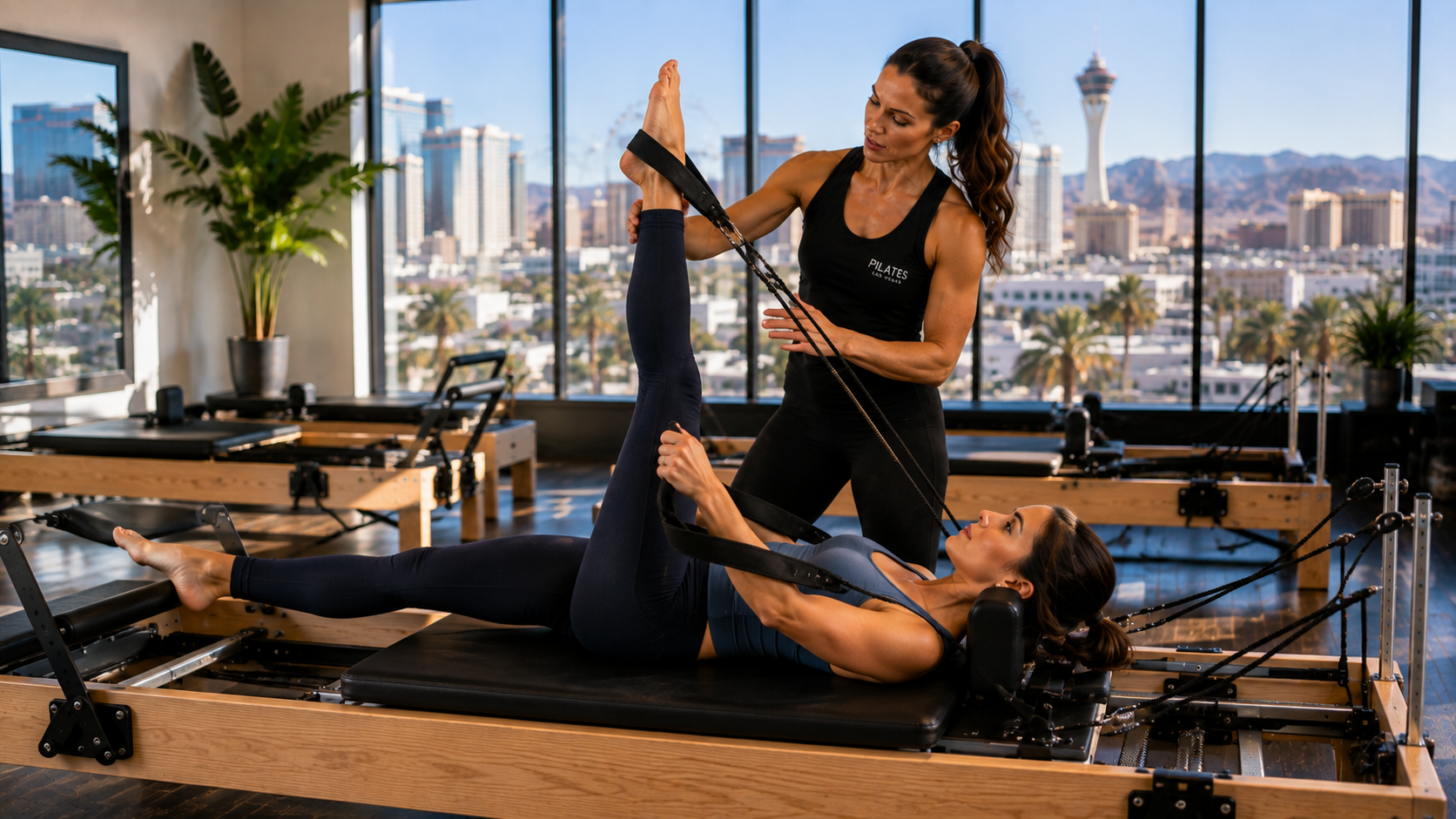
Flexibility training Pilates solves the tolerance problem mechanically. A strap holds the limb in a lengthened position while a spring demands active resistance. You are not passively hanging in a position you are producing force at the far end of your range.
This is the core of flexibility training Pilates: every position that lengthens tissue also loads it. The hamstring in a supine strap series is not being stretched. It is working eccentrically against spring tension while long.
Three mechanisms make that effective:
- Sarcomerogenesis, the addition of contractile units in series when muscle is loaded in a lengthened position, which changes structure rather than tolerance a mechanism reviewed in the British Journal of Sports Medicine
- Neural permission, where the nervous system releases protective tension once it registers strength at the end range
- Tendon and fascial adaptation, which requires mechanical load and simply does not occur during passive holding
Instructors see the consequence clearly. A client who has stretched daily for years often shows large passive range and almost no active control. Two weeks of loaded reformer work usually closes more of that gap than two years of stretching did.
Passive Stretching Versus Flexibility Training Pilates
The two approaches are frequently confused because they look similar from the outside. They are not similar in outcome.
| Factor | Static Passive Stretching | Loaded Range Work on the Reformer |
| Primary adaptation | Stretch tolerance | Tissue structure and neural control |
| Duration of gains | Days | Months to permanent |
| Active range gained | Minimal | Substantial |
| Strength at end range | None | Direct |
| Injury risk reduction | Weak evidence | Supported |
| Transfer to sport | Low | High |
| Session time required | 15–20 minutes | Integrated into training |
| Progression method | Longer holds | Increased load and range |
The practical takeaway is not that stretching is useless. It is that stretching is a warm-up tool and a recovery tool, not a method for permanently changing how far you can move under your own control.
Active Mobility Is the Metric Flexibility Training Pilates Targets
Active mobility is the range you can reach and control using your own muscles, with no external assistance. Passive range is the range someone else, or gravity, can put you in.
The difference between those two numbers is your vulnerability. A dancer with 140 degrees of passive hip flexion and 95 degrees of active hip flexion has forty-five degrees of range her body cannot protect. That is precisely where hamstring strains occur, and it is why Pilates for dancers is programmed around control rather than range for its own sake.
Flexibility training Pilates closes that gap from both directions. Loaded work raises active mobility while spring assistance allows controlled exploration of the passive end. Over time the two numbers converge, which is the actual definition of usable mobility.
Testing Your Own Gap
You can check this without equipment. Lie on your back and have someone raise your straight leg until you feel a firm stretch note that height. Then lower it and lift the same leg yourself, actively, as high as you can hold for three seconds.
If the second number is dramatically lower than the first, active mobility is your limiting factor, not tissue length. More stretching will not fix it. Loaded work will.
How Flexibility Training Pilates Builds End Range Strength
End range strength is the ability to produce force in the outer portion of a joint’s range, and it is the single most protective quality in mobility training.
Flexibility training Pilates builds it through a predictable sequence on the reformer:
- Establish the position. Reach the end range with spring assistance and hold it with active tension for five to eight seconds.
- Add isometric load. Press into the strap or footboard at the end range for six to ten seconds, three to four repetitions.
- Load the eccentric. Move slowly out to the end range against spring resistance over four to five seconds, controlling the entire path.
- Own the concentric. Return from the end range under your own power without momentum, matching the eccentric tempo.
- Progress the load. Once the pattern is controlled, increase spring tension rather than range.
A full block of that kind is priced as a package rather than per session, so it is worth reading Pilates pricing and packages before you start. That progression takes roughly six to eight weeks per major joint, and it moves fastest under direct supervision our certified Pilates instructors prescribe spring load to your measured range rather than to a class average. End range strength built this way tends to persist, because it is a strength adaptation rather than a tolerance one.
Loaded Stretching in Practice
Loaded stretching is a term borrowed from strength coaching the National Strength and Conditioning Association uses it in much the same way And it describes exactly what a reformer strap series does: resistance applied while the target tissue is at length.
The version most people attempt at home fails for a simple reason. Without a spring or cable providing consistent resistance through the range, you either hold a position passively or you load only the mid-range. The reformer’s spring supplies smoothly variable resistance across the entire path, which is why loaded stretching is far more practical on the equipment than off it.
Dancers and performers were the earliest adopters of this approach, which is why our Pilates for dancers programming has always been built around loaded work rather than passive holds. The extreme ranges that professional performance demands are only safe when they are strong.
The same logic now drives adoption among lifters and male athletes, which we cover separately in Pilates for men.
Joint Range of Motion Is Position-Specific
One of the most misunderstood findings in mobility research is that joint range of motion does not generalise well. Gaining hip flexion while lying down does not automatically give you hip flexion while standing and loaded.
This is why flexibility training Pilates programmes the same joint in multiple positions supine, seated, kneeling, standing, single-leg. Each position changes the length-tension relationship of the surrounding musculature and trains a different portion of usable joint range of motion.
It also explains a common frustration. Someone gains impressive floor-based range but sees no improvement in their squat, because they never trained the joint range of motion in a loaded, upright position. Range is a skill, and skills are context-dependent.
Instructors also watch for compensation. When hip range runs out, the lumbar spine offers to help. Effective flexibility training Pilates identifies that substitution early, which is difficult in a large class and straightforward in a semi-private setting where our certified Pilates instructors can see your pelvis.
Book a Session and Test the Difference
You can read about loaded range work or you can feel it in fifty minutes. Blue Chip Conditioning offers a free 30-minute demo, a $20 first group class, and a $99 new client special including two semi-private sessions and two group classes enough to test your own active-versus-passive gap under instruction.
Browse our Pilates class schedule or compare Pilates pricing and packages, then call (702) 848-2583 to book. Performers should ask about Pilates for dancers when they call, since that programming runs on a separate track.
Conclusion
The research has been reasonably consistent for over a decade: range of motion that lasts comes from loading tissue at length, not from holding a position and hoping. Flexibility training Pilates applies that principle by design, using spring resistance to make every lengthened position a working one.
Blue Chip Conditioning has built its mobility programming on that evidence rather than on tradition. Founded in 2020 by Danielle a former Nevada Ballet Theatre dancer, UNLV BFA graduate and DK Body Balancing Master Trainer the studio at 6275 S Rainbow Blvd in Las Vegas works with dancers, athletes and adults who want range they can actually use. Meet our certified Pilates instructors or open our Pilates class schedule to find a starting slot. If you have spent years stretching without progress, Blue Chip Conditioning offers a method with a mechanism behind it.
Frequently Asked Questions
Is flexibility training Pilates better than stretching?
For lasting range of motion, yes. Loaded work on a reformer changes tissue structure and builds strength at end range, while passive stretching mainly changes short-term tolerance. Stretching remains useful for warm-up and recovery, but it is not an effective standalone method for permanently increasing usable range.
How long before I see real flexibility changes?
Most clients notice improved active range within three to four weeks and structural change by eight to twelve weeks. Passive tolerance can improve within a single session, but that gain disappears quickly. Judge progress by what you can control under your own power, not by how far someone can push you.
Can I do loaded stretching without a reformer?
Partially. Resistance bands and cables allow some loaded end-range work, and slow full-range weight training helps considerably. The reformer is more effective because its spring provides smooth, adjustable resistance through the whole path while supporting body position, which is difficult to replicate at home.
Does more flexibility increase injury risk?
Passive flexibility without matching strength does increase risk, because it creates range the body cannot control. Systematic reviews in the Cochrane Library have found little injury-prevention benefit from stretching alone. Flexibility gained through loaded work does not carry that problem, since strength develops alongside range. The goal is not maximum range but the smallest possible gap between passive and active range.
How often should I train mobility?
Two to three loaded sessions per week per target area is the effective range for most people. Daily passive stretching adds little on top of that. Consistency over eight to twelve weeks matters far more than session length or intensity on any given day check our Pilates class schedule and book the same two slots each week.
Will this help my squat, golf swing or running form?
It should, provided the work is done in positions resembling the activity. Range gained lying down transfers poorly to standing tasks. Training hips and thoracic spine in loaded, upright and single-leg positions is what produces carryover into sport-specific movement.
Is this appropriate if I already have an injury?
Often yes, with modification, but tell your instructor first and clear it with your treating clinician. Spring load, range and position can all be adjusted around an existing issue, and controlled loading is frequently part of rehabilitation rather than something to avoid.
What does a mobility block cost?
A full eight-to-twelve-week block is usually cheapest on a membership. Pilates pricing and packages are listed in full on the site, including the $99 new client special.