
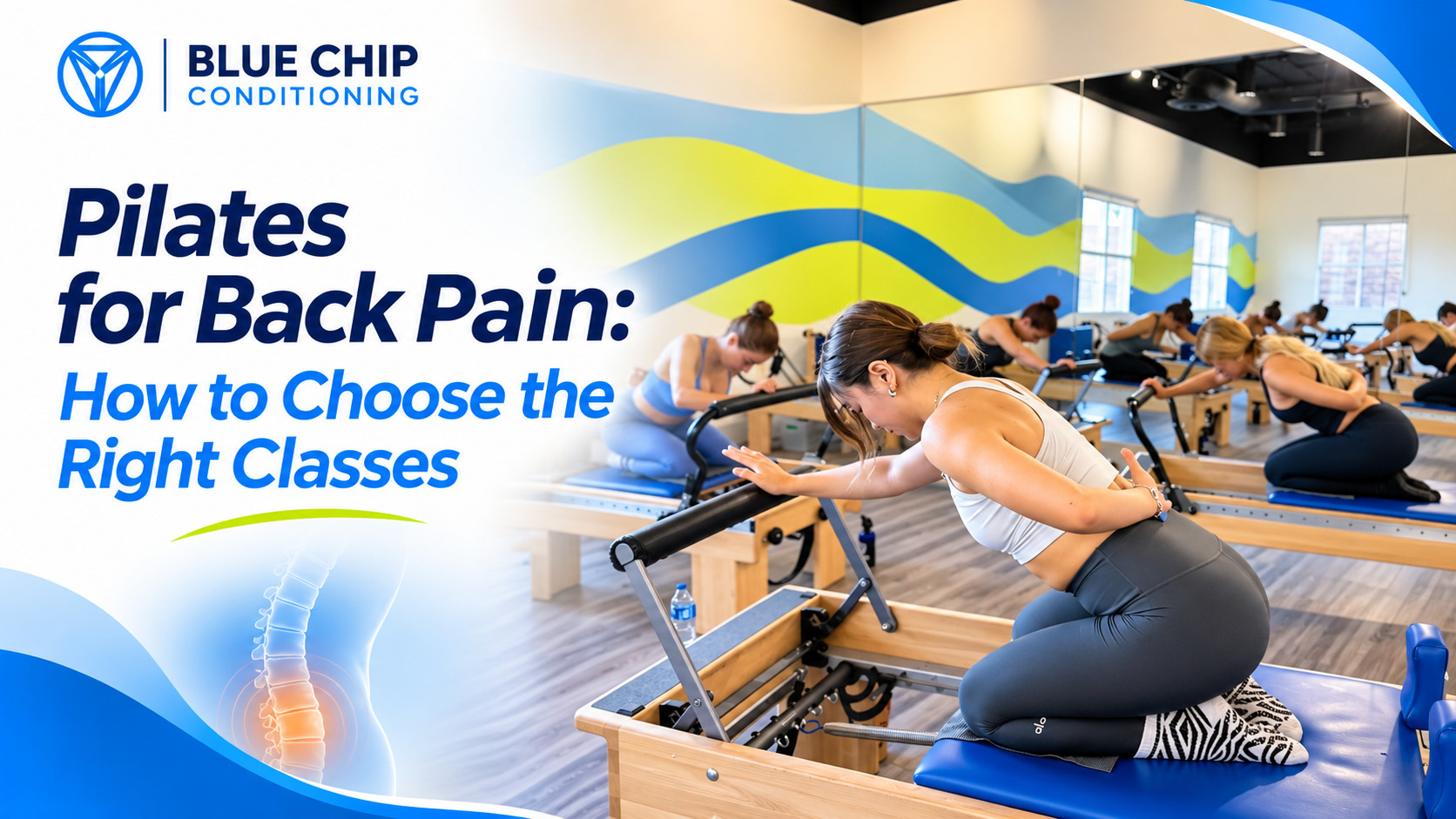
Pilates for back pain can be a practical, low-impact way to rebuild strength and confidence in your spine, but only when the class format matches your condition. This guide explains how Pilates supports a sore back, which class types suit different kinds of pain, what to ask an instructor, and the warning signs that mean you should see a clinician first.
Back pain is extremely common. According to the National Center for Complementary and Integrative Health, about 80 percent of adults experience low-back pain at some point, and pain lasting 12 weeks or longer is considered chronic. Exercise-based approaches are widely used, and Pilates for back pain has become one of the most popular options because it can be scaled precisely to each person.
How Pilates for Back Pain Works
Pilates focuses on controlled movement, breathing and alignment. Instead of loading the spine heavily, it trains the muscles that support it, including the deep abdominals, glutes, hip stabilizers and the small muscles along the spine.
That is why Pilates for core strength sits at the center of most back programs. A well-coordinated core helps distribute load during everyday tasks such as lifting, bending and sitting. Pilates for posture adds another layer by addressing rounded shoulders, a forward head position and uneven hips, patterns that often place extra strain on the back. We cover this in more depth in how core strengthening supports low back relief.
Mobility matters too. Stiff hips and a rigid upper back can force the lower back to move more than it should. Pilates for mobility gently restores range of motion in those neighboring areas, so the lumbar spine is not doing all the work. It also supports better balance and stability through Pilates.
Pilates for back pain is not a cure, and research generally shows it helps about as well as other structured exercise. Its advantage is precision: exercises can be adjusted repetition by repetition.
Know Your Type of Back Pain First
The right class depends on what kind of back pain you have. Before booking, it helps to understand where you fit.
Acute Pain
Recent pain after a strain or awkward movement often settles with time and gentle activity. If pain is severe or worsening, get it assessed before starting any program.
Pilates for Lower Back Pain
Pilates for lower back pain is the most common request instructors receive, often linked to long hours sitting, weak glutes or poor lifting mechanics. Gentle core activation, pelvic control and hip mobility usually form the foundation.
Pilates for Chronic Back Pain
Pilates for chronic back pain requires patience. Pain that has lasted months often involves fear of movement, deconditioning and protective muscle tension. Slow, confidence-building progressions matter more than intensity. Pilates for chronic back pain works best when it is consistent and coordinated with any care plan from your doctor or physical therapist.
When to See a Clinician Before Starting
Pilates for back pain is appropriate for many people, but some symptoms need medical evaluation first.
- Numbness, tingling or weakness in the legs: These may indicate nerve involvement that should be assessed.
- Changes in bladder or bowel control: Seek urgent medical care.
- Pain after a fall or accident: Rule out structural injury before exercising.
- Unexplained weight loss, fever or night pain: These require prompt medical review.
If you have a diagnosis such as a herniated disc, spinal stenosis or recent surgery, ask your clinician which movements to avoid and share that guidance with your instructor.
Choosing the Right Class Format
Not every Pilates class suits a sore back. The format you choose affects how much individual attention and modification you receive.
| Format | Individual attention | Best suited for | Considerations |
| Private Pilates training | Full, one-on-one | New, chronic or complex pain; post-surgery | Highest cost per session |
| Semi-private sessions | High, shared with a few clients | Ongoing back care after initial guidance | Less flexibility for sudden changes |
| Small group reformer | Moderate | Stable, well-managed pain | Need to self-modify at times |
| Large group or online mat | Low | Prevention once pain is resolved | Limited correction |
Why Private Pilates Training Often Comes First
Private Pilates training allows the instructor to assess your movement, identify painful positions and design a program around them. For many people, a few private sessions build enough body awareness to move safely into small-group classes later. Private Pilates training is also the most sensible choice after surgery or when pain flares unpredictably.
Reformer Pilates for Back Pain
Reformer Pilates for back pain is popular because spring resistance can assist movement as well as challenge it. Lying on a moving carriage also reduces the need to support your full body weight in difficult positions. Many clients find Reformer Pilates for back pain more comfortable than floor-based mat work in the early stages, then add mat work as control improves.
What a Good Back-Focused Session Includes
A thoughtful instructor follows a clear structure when working with back pain.
- An assessment first: Posture, breathing, hip and spinal mobility, and pain-provoking movements are reviewed before programming.
- Neutral spine and breath: Clients learn to find a comfortable spinal position and coordinate breathing with movement.
- Gradual loading: Exercises progress in small steps, from supported positions to more challenging ones.
- Balanced training: Work includes Pilates for core strength, hip stability, Pilates for posture and Pilates for mobility, not only abdominal exercises.
Common Mistakes to Avoid
- Pushing through sharp pain: Mild muscle effort is normal; sharp, shooting or worsening pain is a signal to stop.
- Over-bracing the abs: Gripping the stomach constantly can increase tension. Effective Pilates for core strength teaches balanced, breath-led activation instead.
- Skipping the hips and upper back: Stiffness above and below the lower back often contributes to pain.
- Doing too much too soon: Two consistent sessions per week usually beat one exhausting workout.
If intense workouts tend to leave your back sore, read about training smarter without pain.
Pilates for Back Pain in Las Vegas: Your Options
Las Vegas residents have several routes. Solidity Studio in Henderson combines chiropractic care with athletic reformer Pilates. Some physical therapy clinics, such as Rapid Rehab on W Charleston Blvd, integrate Pilates into rehab. Boutique studios such as No Limit Pilates and Blue Chip Conditioning offer private and small-group training with a rehabilitation focus.
At Blue Chip Conditioning, Pilates for back pain is built on a rehabilitation and athletic-enhancement foundation, with group classes capped at eight and private and semi-private options for closer attention. The studio also states that it coordinates with physical therapists when useful.
If your main concern is the lower back, start with an assessment and a small number of guided sessions before joining groups. For Reformer Pilates for back pain, ask how the instructor adjusts springs and positions for your specific limitations.
Frequently Asked Questions
Is Pilates good for back pain?
Pilates can help many people with back pain by strengthening the core, hips and spinal support muscles while improving posture and mobility. Research suggests it helps about as much as other structured exercise. It works best when sessions are adapted to your condition and coordinated with medical advice when needed.
Is reformer or mat Pilates better for back pain?
Reformer Pilates is often more comfortable for back pain in the early stages because springs can assist movement and the carriage supports your body. Mat Pilates relies on body weight and can be harder to modify. Many people start on the reformer, then add mat work as control and confidence improve.
How often should I do Pilates for lower back pain?
Two to three sessions per week is a common starting point for Pilates for lower back pain. This frequency builds strength and motor control while allowing recovery. Consistency over several weeks matters more than intensity, and your schedule may be adjusted if your physical therapist recommends a different plan.
Can Pilates make back pain worse?
Pilates can aggravate back pain if exercises are too advanced, poorly modified or performed through sharp pain. Telling your instructor about your history, starting with guided sessions and progressing gradually reduces that risk. If pain worsens or new symptoms appear, stop and consult a clinician before continuing.
Is Pilates safe with a herniated disc?
Many people with a herniated disc do Pilates safely, but exercise selection matters. Some flexion-based movements may need to be avoided or modified. Get clearance from your doctor or physical therapist, share their guidance with your instructor, and start with private sessions so the program can be tailored to your symptoms.
How long does it take for Pilates to help back pain?
Some people notice easier movement within a few weeks, while meaningful strength and posture changes usually take longer with consistent practice. Progress depends on the type and duration of pain, session frequency and other care you receive. Chronic pain often improves gradually rather than quickly.
Should I do private or group Pilates for back pain?
Private sessions are usually best when pain is new, chronic, complex or follows surgery, because the instructor can tailor every exercise. Group classes suit people whose pain is stable and who already understand how to modify movements. Many clients begin privately and move into small-group classes once confident.
Conclusion
Pilates for back pain works best when the class matches your condition. Understand whether your pain is acute, lower-back focused or chronic, rule out red-flag symptoms, and choose a format with enough individual attention. Look for an assessment, gradual loading and balanced training that combines Pilates for core strength, Pilates for posture and Pilates for mobility. Handled this way, Pilates for back pain becomes a sustainable part of long-term spine health rather than a short-term fix.
If back pain is holding you back, note your symptoms, any diagnosis and your clinician’s guidance, then book a free demo or private session at Blue Chip Conditioning on S Rainbow Blvd to discuss which format suits your back. Athletes weighing other reformer methods can also read Pilates vs Lagree for injury recovery.