
Walk into a Pilates studio Las Vegas residents booked five years ago and the questions were about waistlines. Today they are about knees, spines, balance and whether someone will still be hiking Red Rock at seventy. That shift is real, and it has changed how every Pilates studio Las Vegas markets programmer. This article explains what longevity training actually is, what it changes inside a reformer class, and how to judge whether a studio is genuinely built for it.
What Clients Now Ask a Pilates Studio Las Vegas For
Five years ago the intake conversation at almost every Pilates studio Las Vegas offered started with a number: a dress size, a scale weight, a wedding date. Those conversations still happen, but no longer dominate.
What we hear now at our Pilates studio Las Vegas is functional. A client wants to lift a grandchild without guarding their lower back. A nurse working twelve-hour shifts wants her hips to stop aching by hour nine.
Neither goal is cosmetic. Both are trainable. That reframing is what the fitness industry now calls health span training building the physical capacity to stay independent and capable for as many years as possible, rather than optimizing how you look for a single season.
The American College of Sports Medicine has tracked this movement in its annual fitness trend survey, where training for healthy aging and functional capacity has climbed steadily into the top tier of industry priorities. You can read their published trend research at acsm.org. Our booking data reflects the same pattern from the other direction: clients arriving with a goal they can describe in verbs rather than measurements.
Healthspan Is Not Lifespan, and the Difference Matters
Lifespan is how long you live. Healthspan is how long you live well, without disability, chronic pain or dependence on assistance. The gap between the two is roughly a decade for most adults, and almost all of it is physical.
That distinction reshapes programming. If the goal is a number on a scale, you chase calorie burn. If the goal is healthspan, you chase four specific physical capacities that decline with age and respond well to training:
- Lean muscle mass, which begins declining in the fourth decade and accelerates without resistance loading
- Bone mineral density, which responds to mechanical load through tendon and muscle attachment
- Balance and proprioception, the single strongest predictor of fall risk after sixty
- Usable joint range of motion, particularly at the hips, thoracic spine and shoulders
A reformer trains all four in the same hour. That is the practical reason longevity fitness and every serious Pilates studio Las Vegas has converged so quickly the equipment was already doing the job before the market had a name for it.
Why the Reformer Suits Longevity Work
The reformer’s spring system produces resistance that varies through the range of motion and is absorbed by the carriage rather than the joint. Load without impact is what an ageing musculoskeletal system needs.
A moving carriage also forces continuous postural correction, so every repetition is quietly a balance drill. In a traditional gym you would need two exercises to get what one reformer footwork series delivers.
What Longevity Programming Changes Inside a Session
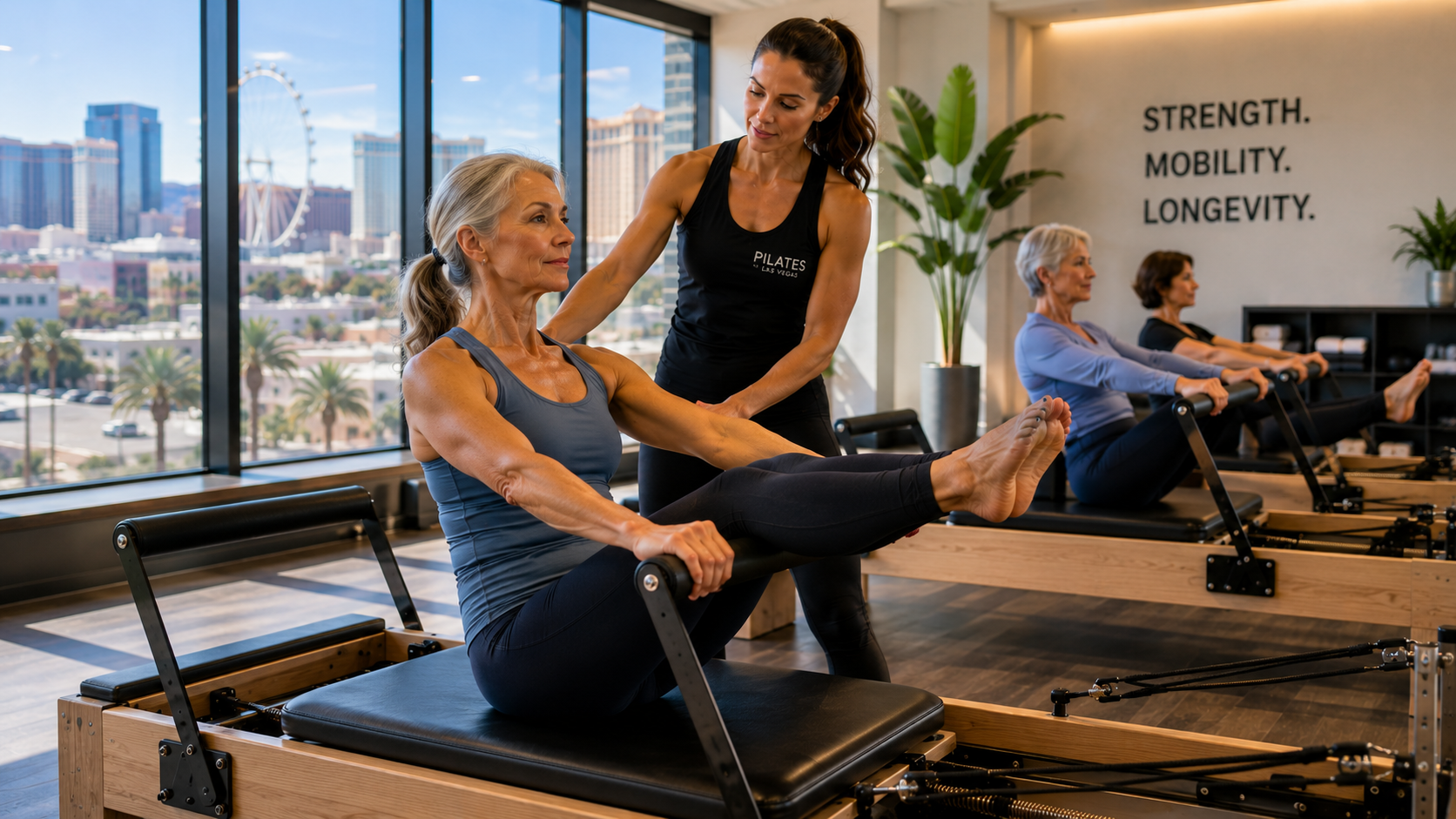
At our Pilates studio Las Vegas clients train in, a longevity-focused session looks different from a general conditioning class in four concrete ways.
Load goes up, not down. The old assumption that a Pilates studio Las Vegas should give older clients lighter springs is backwards. Muscle responds to meaningful resistance at every age. We progress spring load for a sixty-two-year-old the same way we progress it for a thirty-year-old, just with a longer runway.
Tempo slows. Longer eccentric phases the lowering, controlled part of a movement create more time under tension and more tendon adaptation with less joint stress.
Single-limb work increases. Life is asymmetrical. Stairs, curbs and getting out of a car are all single-leg tasks. Bilateral-only training hides the imbalance that eventually causes the injury.
Standing and transitional work is added. Getting up off the floor is a trainable skill. So is stepping down from height under control. Active aging Pilates classes programming treats these as exercises, not as things that happen between exercises. Active aging Pilates classes also assumes progression, not maintenance.
Instructors notice a predictable arc. Week two is about feeling deep hip and abdominal musculature that has been dormant. By week eight, clients report the change outside the studio: a flight of stairs, a golf swing, a night of sleep without shifting position.
Appearance-Driven Versus Longevity-Driven Programming
The two approaches share equipment and share vocabulary. They do not share priorities. This table shows where they diverge.
| Programming Element | Appearance-Driven Approach | Longevity-Driven Approach |
| Primary metric | Scale weight, visual change | Strength, balance, usable range of motion |
| Spring load | Light to moderate, high repetition | Progressive, moderate to heavy |
| Session tempo | Fast, continuous, cardio-flavoured | Controlled, longer eccentric phases |
| Balance work | Incidental | Programmed every session |
| Single-limb work | Occasional | Core structural element |
| Success timeline | 6-12 weeks | Measured in years and decades |
| Deload and recovery | Often ignored | Built into the calendar |
| Typical client age | 25-40 | 35-75 |
Neither column is wrong. But a client who wants to be capable at eighty is poorly served by a programme built to produce a visible result by August.
The Demographic That Changed Fastest at Every Pilates Studio Las Vegas
The clearest signal came from a group boutique fitness historically underserved: adults aged fifty to seventy-five.
This group arrives with specific, informed questions. They have read about sarcopenia. They ask what spring tension corresponds to, how progressive overload is applied, and how a studio handles an existing shoulder or knee issue. They are not looking for a class. They want a Pilates studio Las Vegas can hold to a standard, and a training relationship inside it.
Our team is built for that conversation. Founder Danielle Maas trained with Nevada Ballet Theater, holds a UNLV BFA and is a DK Body Balancing Master Trainer, and the studio’s certified Pilates instructors come from professional performance backgrounds. That depth matters when a client’s history is complicated.
The second group that shifted is working adults in their late thirties and forties who train hard elsewhere and use a Pilates studio Las Vegas offers as the connective tissue in their week. They are not looking for another hard session. They are looking for the session that lets the hard ones keep happening functional strength Las Vegas athletes and desk-bound professionals both need but rarely programme for themselves. Functional strength Las Vegas clients build here transfers directly to sport and work.
How to Evaluate a Studio for Longevity Goals
Not every reformer class is longevity training with a new label. When you are assessing any Pilates studio Las Vegas has to offer, these are the questions worth asking before you buy a package:
- Does the studio assess balance, single-leg control and joint range before assigning you to a class?
- Can the instructor explain how spring load will progress over eight weeks, not just today?
- Are class sizes small enough that form corrections actually reach you?
- Does the studio offer private or semi-private options when a condition needs individual attention?
- Are instructors certified Pilates instructors through a recognized body, and will the studio tell you where?
A Pilates studio Las Vegas clients trust will answer all five clearly, because that is what health span training requires. One that cannot answer the second or third is selling a workout, which is a fine product but a different one.
The Semi-Private Middle Ground
Most clients pursuing longevity fitness at a Pilates studio Las Vegas do not need one-to-one coaching forever, but they do need more attention than a large class provides. Semi-private sessions two to four clients with one instructor are usually the right density. You get individual load prescription without private-session pricing. Our Pilates pricing and packages page lays out how those tiers compare.
Start With a Session, Not a Commitment
If your goals have moved from appearance to capability, the useful next step is small. Book a free 30-minute demo or take your first group class for $20 and see how a reformer feels under a proper spring load. If you want more instructor attention from the start, the $99 new client special includes two semi-private sessions and two group classes. Check Pilates class schedule or call the studio at (702) 848-2583 to book.
Conclusion
The market did not drift toward longevity training by accident. Clients got better information, they started asking about function instead of appearance, and studios that could not answer those questions lost them. What people want now from a Pilates studio Las Vegas offers is a programmer that will still be relevant in fifteen years.
Blue Chip Conditioning was built for exactly that conversation. Since 2020, the studio at 6275 S Rainbow Blvd has combined professional performance credentials with progressive, individually loaded reformer programming the kind of training that treats strength, balance and mobility as long-term assets rather than short-term results. Whether you are an athlete protecting a career, an adult protecting your independence, or someone who simply wants to move well for another forty years, Blue Chip Conditioning programmer for the decade ahead, not just the next eight weeks.
This article is educational and is not medical advice. Consult a qualified healthcare provider before beginning any exercise programmer, particularly if you have an existing injury or medical condition. Additional guidance on physical activity for adults is available from the Centers for Disease Control and Prevention.
Frequently Asked Questions
What is longevity training in Pilates?
Longevity training is programming built to preserve strength, bone density, balance and joint range of motion over decades rather than to change appearance over weeks. On a reformer it means progressive spring load, slower tempos, single-limb work and programmed balance drills in every session.
Is a Pilates studio Las Vegas offers suitable if I am over sixty?
Yes, and it is one of the best-suited environments. The reformer provides meaningful resistance without impact, the carriage supports the body during transitions, and load can be adjusted precisely. Tell the studio about any existing condition first so your instructor can adapt the programming appropriately.
Can Pilates actually build muscle, or only tone?
Pilates class schedule can build muscle when the spring load is progressive and the volume is sufficient. The distinction is not the method but the loading. Light springs and high repetitions build endurance; heavier springs with controlled tempo and adequate rest build strength and lean mass.
How often should I train for health span benefits?
Two to three sessions per week is the range where most clients see meaningful change in strength and balance, and health span training responds best to that frequency. One session per week maintains what you have. Four or more is appropriate only when load and recovery are managed deliberately, usually with instructor oversight.
Do I need to be flexible before starting?
No. Flexibility is an outcome of training, not a prerequisite. The reformer’s straps and carriage let you work in a range you can currently control, and that range expands with consistent practice. Instructors regularly start clients who cannot touch their toes.
What is the difference between group and semi-private sessions here?
Group reformer classes follow a set programmer with instructor cueing across the room. Semi-private sessions place two to four clients with one instructor, allowing individual spring prescription and modification. Clients with a condition, an injury history or a specific performance goal generally progress faster in semi-private.
Will Pilates help with balance and fall prevention?
Yes. Balance is a trainable skill built through proprioceptive challenge, single-leg loading and controlled transitions between positions all of which appear in well-designed reformer programming. Improvement in single-leg stance time is one of the most consistent changes instructors observe in older clients.