
Introduction
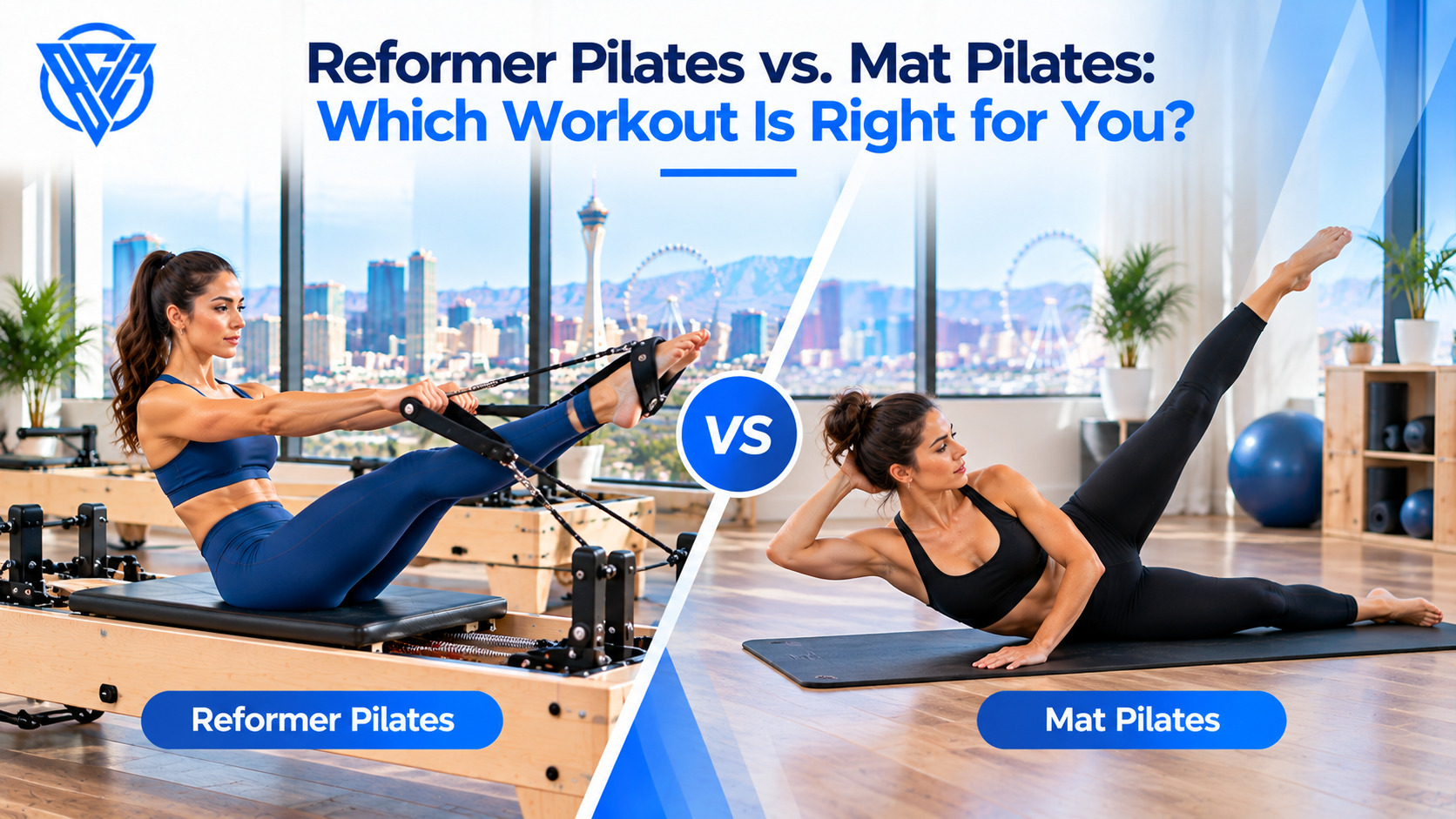
The reformer Pilates vs mat Pilates decision comes down to how you want resistance delivered: through adjustable springs on a machine, or through your own body weight on the floor. Both build core strength, control and flexibility, but they differ in support, intensity, cost and how quickly you can progress. This guide compares the two side by side, explains who each one suits and helps you choose the right starting point.
Both formats share the same roots. Joseph Pilates created the mat repertoire alongside apparatus such as the reformer, and both rely on the same principles of breath, alignment, concentration and controlled movement. Understanding how each applies those principles makes the reformer Pilates vs mat Pilates question much easier to answer for yourself.
What Is Mat Pilates?
Mat Pilates is performed on a padded mat, using body weight as the main source of resistance, sometimes with small props such as resistance bands, a Pilates ring or a small ball. A typical mat Pilates workout includes exercises such as the hundred, roll-up, single-leg circles, bridging and the side-lying leg series.
Because no machine assists you, mat work can be surprisingly demanding. Your core has to stabilize your body without outside support, which makes precise control essential from the first repetition.
Mat Pilates for Beginners
Mat Pilates for beginners focuses on fundamentals: finding a neutral spine, coordinating breath with movement and engaging the deep abdominal muscles before adding complexity. These basics are easiest to learn with direct feedback, which is why many newcomers book a private session before practicing on their own.
What Is Reformer Pilates?
Reformer Pilates is performed on a machine with a sliding carriage, adjustable springs, straps and a footbar. The springs can add resistance or provide assistance, so the same exercise can be made harder or easier simply by changing the setting.
A typical reformer Pilates workout moves through footwork, leg work in straps, rowing and arm series, long stretch variations and kneeling or standing exercises, all on the same apparatus.
Understanding Reformer Pilates Equipment
The reformer frame holds a padded carriage that glides on rails. Springs of different tensions attach beneath it, while a footbar, shoulder blocks, a headrest and long straps give you points to push against or pull from. Many studios also use accessories such as a sitting box or jump board. Learning how each part works is one reason supervised sessions are recommended at the start.
Reformer Pilates vs Mat Pilates: Key Differences
The table below sets out the reformer Pilates vs mat Pilates comparison across the factors that matter most when choosing a workout.
| Factor | Reformer Pilates | Mat Pilates |
| Resistance source | Adjustable springs | Body weight and small props |
| Support | Springs and carriage can assist movement | Little external support |
| How intensity changes | Spring settings and exercise choice | Leverage, range and tempo |
| Equipment and setting | Reformer machine, usually in a studio | A mat, at home or in a studio |
| Relative cost | Usually higher per class | Usually lower per class |
| Learning curve | Easier with instructor guidance | Simple setup, but technique still needs coaching |
| Best suited for | Progressive strength, athletes, guided rehab with clearance | Foundational control, home practice, travel |
A Healthline comparison of mat and reformer Pilates reaches a similar conclusion, describing mat work as the more affordable route to foundational movement and the reformer as the more adjustable option that can suit a wider range of people.
In other words, the reformer Pilates vs mat Pilates choice is rarely about which method is better overall. It is about which one fits your body, goals and budget right now.
Pros and Cons: Reformer Pilates vs Mat Pilates
Reformer Pilates
- Advantage: Adjustable resistance supports steady, progressive strength gains.
- Advantage: Springs can assist movement, making many exercises accessible for beginners and people returning from injury with medical clearance.
- Advantage: Wide exercise variety in lying, seated, kneeling and standing positions.
- Disadvantage: Higher cost and the need for studio access.
- Disadvantage: The equipment takes time to learn, and unsupervised use can be unsafe.
Mat Pilates
- Advantage: Minimal equipment, so you can practice almost anywhere.
- Advantage: Builds strong body awareness because nothing supports you.
- Advantage: Usually lower cost per class.
- Disadvantage: Some classic exercises are difficult for beginners without assistance.
- Disadvantage: Fewer ways to add progressive resistance over time.
Which Is Better for Beginners?
For beginners, there is no single right answer. Our guide on whether beginners should start with reformer or mat Pilates looks at the first few months in more detail.
Mat Pilates for beginners teaches fundamentals with nothing to set up, but some classic mat exercises, such as the roll-up, require abdominal strength many new clients do not have yet.
The reformer can make early progress feel more manageable because springs support the movement. Under close supervision, many beginners find it easier to feel correct alignment on the machine before trying the same patterns on the mat. Either route works if you start with qualified instruction and progress gradually.
Which Builds More Strength?
For progressive strength, the reformer has an edge because spring resistance can be increased step by step. A consistent reformer Pilates workout can challenge the legs, glutes, back and arms in ways body weight alone may not.
That does not make mat work easy. A well-taught mat Pilates workout is demanding because your core must create all of the stability. Advanced mat sequences can feel as tough as anything on the machine.
When people weigh reformer Pilates vs mat Pilates for strength, the most effective answer is often to combine them.
How to Decide: Reformer Pilates vs Mat Pilates
Questions to Ask Yourself
- What is my main goal: strength, flexibility, posture, rehabilitation or general fitness?
- Do I have an injury or condition that needs adjustable support?
- What can I comfortably spend on classes each month?
- Will I practice at home, in a studio or both?
- Do I learn better with hands-on coaching or self-directed practice?
If most of your answers point to support, progression and coaching, start on the reformer. If they point to budget and the freedom to train anywhere, start on the mat.
Combining Both for Better Results
The smartest resolution to reformer Pilates vs mat Pilates is often to use both. Studio sessions build strength and technique with guidance, while a short mat routine at home reinforces control between classes.
At Blue Chip Conditioning, group reformer classes, semi-private sessions and private sessions let clients learn the apparatus with hands-on corrections. Instructors who need space and reformer Pilates equipment for their own clients can also ask about studio rental.
Common Mistakes to Avoid
A few misconceptions lead people to the wrong format and slow their progress:
- Assuming reformer classes are only for advanced or very fit clients.
- Treating mat Pilates as gentle stretching rather than genuine strength work.
- Adding heavy springs to make a session feel harder instead of focusing on control.
- Learning entirely from videos with no feedback on form.
- Switching formats every week before either has time to work.
Frequently Asked Questions
Is reformer Pilates better than mat Pilates?
Neither is better for everyone. In the reformer Pilates vs mat Pilates comparison, the reformer offers adjustable resistance and support, while mat work is affordable and portable. The better choice depends on your goals, budget, injury history and whether you prefer studio coaching or home practice.
Is mat Pilates for beginners harder than reformer Pilates?
It can be. Mat work offers no spring assistance, so exercises like the roll-up rely entirely on your own core strength, while the reformer can support movement as you learn. That said, mat sessions taught at a true beginner level are very accessible and build excellent body awareness.
Can a reformer Pilates workout train the whole body?
Yes. A well-designed reformer Pilates workout trains the legs, glutes, core, back, shoulders and arms through footwork, strap work, rowing series and standing exercises. Spring settings let the instructor adjust resistance for each muscle group, creating a complete, low-impact full-body session.
Can a mat Pilates workout build muscle?
A mat Pilates workout builds muscular endurance, core strength and control, particularly in the abdominals, glutes and hips. Because resistance comes mainly from body weight, gains in muscle size tend to be modest. Adding props or reformer sessions provides more progressive resistance for strength goals.
Do I need reformer Pilates equipment at home?
No. Most people start in a studio, where instructors set up reformer Pilates equipment safely and teach proper technique. Home reformers take up space and require a solid understanding of spring settings. A mat and a few small props are enough for home practice between studio sessions.
How often should I do Pilates each week?
Two to three sessions per week is a practical target for most people. That frequency builds strength and control while allowing recovery between workouts. You can split sessions between reformer classes and mat practice, adjusting the balance as your goals and schedule change.
Should I start with reformer Pilates vs mat Pilates?
Start with the reformer if you want guided support, adjustable resistance or are returning from an injury with medical clearance. Start with mat Pilates if budget or flexibility of location matters most. Either way, begin with qualified instruction so you learn breathing and alignment correctly.
Conclusion
The reformer Pilates vs mat Pilates decision is less about choosing a winner and more about matching a method to your needs. The reformer offers adjustable resistance, support and clear progression, while the mat offers accessibility, affordability and a deep test of core control. Both build strength, posture and flexibility when they are taught well.
The practical takeaway: if you want guidance and measurable progression, start with supervised reformer sessions, then add short mat routines at home. Revisit your reformer Pilates vs mat Pilates balance every few months as your goals evolve.
Try the reformer with expert guidance. Blue Chip Conditioning’s group, semi-private and private sessions in Las Vegas pair reformer training with hands-on corrections, so you can learn proper technique from your very first class.