
If you are trying to establish what is pilates beyond the marketing language, the short answer is that it is a systematic method of low-impact exercise built around controlled movement, breath and spinal alignment, developed in the early twentieth century and now practised both on a mat and on spring-loaded apparatus. This guide explains where the method came from, how it works mechanically, what the main formats are, what it realistically does for your body, and how to approach your first few sessions.
It helps to answer what is pilates in two parts: the system itself, and the many formats that system is now taught in. The method has spread far beyond its origins, which means the word covers a wide range of class styles, and understanding the underlying system makes choosing a class considerably easier.
The Origin and Meaning of the Method
Any serious answer to what is pilates has to begin with its origins, because the method’s structure follows directly from them. The system was developed by Joseph Pilates, a German-born physical trainer who called his method Contrology. He refined it during the First World War while working with immobilised patients, reportedly using bed springs for assisted resistance the conceptual ancestor of today’s apparatus. He emigrated to New York in 1926 and opened a studio with his wife Clara, where dancers became early and influential clients.
The pilates meaning that survives from that period is essentially control: a practice in which every repetition is deliberate, sequenced and executed with attention rather than performed quickly for volume. That pilates meaning still separates a well-taught session from a generic core class, and it explains why the pilates meaning of “exercise” differs from what most gyms imply by the word.
The principles it is built on
Contemporary teaching commonly organises the method around six principles: concentration, control, centring, precision, breath and flow. These principles are the clearest short answer to what is pilates as a discipline rather than a class format. They describe how each exercise is meant to be performed, and they are why a well-taught session is mentally demanding as well as physically demanding.
How Does Pilates Work?
Understanding how does pilates work mechanically is more useful than any list of benefits, and it is the part of the explanation most articles skip. It is also the part of what is pilates that separates the method from general core training. The method operates on several levels at once.
- Deep stabiliser recruitment. The repertoire targets the transverse abdominis, pelvic floor, multifidus and deep hip stabilisers muscles that support the spine but are rarely trained directly.
- Controlled eccentric loading. Movements are slowed in both directions, building strength through range rather than only at the point of contraction.
- Motor pattern retraining. Repeated precise movement teaches the nervous system better sequencing, which is why posture often changes before visible muscle does.
- Breath-linked movement. Coordinated breathing supports rib and spinal mechanics and helps regulate intra-abdominal pressure under effort.
Asking how does pilates work is ultimately a question about the nervous system as much as the muscles, which is why progress can feel slow for three weeks and then arrive suddenly. This is also why understanding how does pilates work matters more than counting repetitions.
The Main Types of Pilates
Knowing the main types of pilates helps you interpret a studio timetable, since the same word can describe quite different experiences. The question of what is pilates has a slightly different practical answer in each format below.
Mat Pilates
This is what is pilates in its original form: work performed on the floor using body weight and gravity. Classical mat repertoire follows a specific sequence and order, and it is accessible, inexpensive and demanding in its own right.
Reformer Pilates
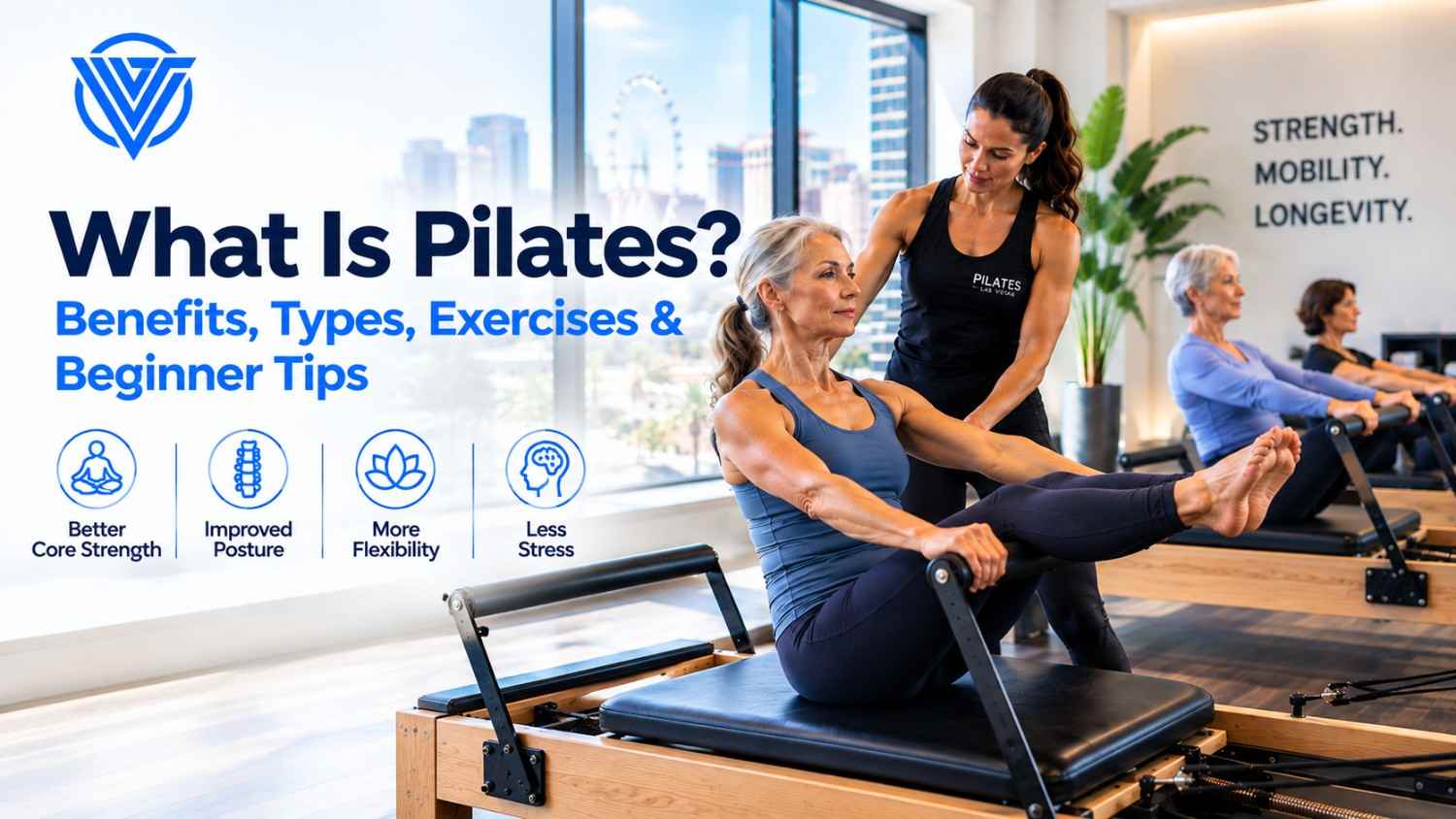
So what is reformer pilates, specifically? It is work performed on a carriage that slides along rails against adjustable springs, with a footbar, shoulder rests and long straps. The springs can resist a movement or assist it, which makes the reformer unusually adaptable across ability levels.
Most people first understand what is reformer pilates in practice rather than theory during a beginner class, when the carriage gives immediate feedback about stability. Anyone asking what is reformer pilates compared with mat work is really asking about that spring assistance.
Other Apparatus
Beyond the reformer, the equipment repertoire includes the Cadillac or trapeze table, the Wunda chair, the ladder barrel and the spine corrector. Each supports and isolates the body differently, and together they show how broad the answer to what is pilates has become.
Classical Versus Contemporary
Classical schools preserve the original exercises and sequencing, while contemporary schools incorporate later movement-science research and adapt more freely. Both are legitimate types of pilates; the difference is emphasis rather than quality. Clinical and rehabilitative types of pilates form a further category, delivered by instructors with additional training and often coordinated with healthcare providers.
What Does Pilates Do for Your Body?
Having covered what is pilates and how it works, the natural next question is what it produces. Asking what does pilates do deserves a precise answer rather than sweeping claims, and the realistic outcomes align closely with what the method actually trains.
- Core strength and trunk stability, developed through deep stabilisers rather than superficial abdominal work.
- Improved posture and body awareness, since the practice repeatedly draws attention to rib, pelvis and shoulder position.
- Increased usable mobility, meaning range of motion you can actively control rather than passively reach.
- Better balance and proprioception, particularly valuable for athletes and for maintaining function with age.
- Low-impact loading, making the method sustainable for people who cannot tolerate high-impact training.
So what does pilates do that other training does not? It improves movement quality in a way that transfers to running, lifting, a golf swing or simply carrying a load. The realistic benefits of pilates depend on consistent, well-taught practice, and attending occasionally produces occasional results.
Is Pilates a Workout?
Asking is pilates a workout is fair, because the pace looks unhurried from outside. The answer is yes, and it follows directly from what is pilates as a system: a strength and control practice rather than a cardiovascular one. It builds muscular endurance and stability effectively, but it does not replace cardiovascular training if heart and lung conditioning is your goal.
A useful framing: is pilates a workout in the sense of leaving you breathless? Not usually. Is pilates a workout in the sense of building strength and control? Definitely. Most people pair it with some cardiovascular activity, and the benefits of pilates complement that training rather than duplicating it, which is why the benefits of pilates are widely used to support performance in a primary sport.
Getting Started: Practical Advice
Understanding what is pilates on paper is useful, but the method only makes sense once you have felt the movements under instruction. Approaching pilates for beginners sensibly makes a substantial difference to whether you stay with it.
- Start with a beginner-designated class, not a general-level class that happens to have space.
- Consider one or two private or small-group sessions first. Small-group instruction is the most efficient route into pilates for beginners, because fundamentals are corrected before they become habits.
- Tell your instructor about injuries before class begins, not afterwards.
- Bring grip socks, which most studios require on shared equipment.
- Commit to roughly two sessions weekly for two months before evaluating results, since early progress is largely neurological.
- Prioritise instructor quality over studio aesthetics. Precision is taught, not absorbed by proximity to good equipment.
Most well-run pilates for beginners programmes will assess your alignment before assigning you to a format, which is the quickest way to see what is pilates likely to offer someone with your history.
What Not to Do When Starting Pilates
Starting Pilates is straightforward, but a few common mistakes can reduce the benefits or make the experience unnecessarily difficult. Keep these points in mind when beginning:
- Do not rush through the exercises. Pilates is built around controlled, precise movement, so speed should not come at the expense of technique.
- Do not ignore your instructor’s corrections. Small adjustments to your posture, breathing or alignment can make a significant difference in how an exercise is performed.
- Do not choose an advanced class too soon. Build your understanding of the fundamental movements before progressing to more demanding sessions.
- Do not hold your breath. Breathing is an important part of Pilates and should be coordinated with movement rather than forgotten during challenging exercises.
- Do not compare your progress with others. Flexibility, strength, coordination and movement control develop at different rates for different people.
- Do not exercise through pain. Muscle effort and challenge are normal, but sharp or unusual pain should not be ignored. Stop the movement and speak with your instructor or healthcare provider when appropriate.
- Do not focus only on the number of repetitions. Quality, control and proper alignment are more important than completing as many repetitions as possible.
- Do not assume expensive equipment guarantees better results. The quality of instruction and your ability to perform movements correctly matter more than the appearance of the studio or equipment.
Conclusion
What is pilates, in the end, is less a workout style than a system for training how your body actually moves deliberately, in sequence, with the deep stabilisers doing the work they were designed to do. Whether you begin on a mat or on the reformer, the answer to what is pilates does not change and the same principles apply, and results come from precision and consistency rather than intensity. Anyone comparing options will find a fuller history of the Pilates method useful background, but the practice itself is best understood by doing it under competent instruction.
If you are ready to move from reading about what is pilates to practising it, start with a beginner-appropriate session where an instructor can assess your alignment directly. Explore the Pilates programmes at Blue Chip Conditioning in Las Vegas, or contact the team to discuss which format suits your goals, your history and your schedule.
Frequently Asked Questions
What is pilates in simple terms?
It is a low-impact exercise method focused on controlled, precise movement, breath coordination and spinal alignment. It strengthens the deep stabilising muscles of the trunk and hips, and is practised either on a mat or on spring-loaded apparatus such as the reformer.
What does it do for your body?
It builds core strength, improves posture and body awareness, increases usable mobility, and enhances balance and movement control. Because it is low-impact, it suits people managing injuries or joint limitations as well as athletes seeking better movement quality.
Is it good for weight loss?
It supports weight management indirectly, through lean muscle and improved movement capacity, but it is not primarily a calorie-burning activity. Sustainable weight change depends mainly on nutrition combined with regular activity, including cardiovascular exercise.
How long before I notice results?
Some people may notice improvements in body awareness, posture and movement control after several weeks of consistent practice, although the timeline varies depending on the individual, training frequency and type of Pilates programme.
Do I need to be flexible to start?
No. Flexibility is an outcome of the practice rather than a prerequisite. Instructors adjust range, spring settings and repertoire to your current capacity, which is precisely why the method is widely used with newcomers and in rehabilitation.
How often should I practise?
Two sessions per week is a realistic and effective starting point. Three offers faster progress if your schedule and recovery allow. Consistency over months matters considerably more than intensity in any single session.
Is it safe during pregnancy or with an injury?
It can be, with appropriate modification and qualified supervision. Consult your healthcare provider first, and work with an instructor experienced in prenatal or clinical programming rather than joining a general group class unsupervised.