
A well-structured Pilates workout can build real strength, improve your posture and leave you feeling more energized, all in under an hour. This guide takes you through a complete 45-minute session, divided into timed blocks, so you know exactly what to do from the first breath of the warm-up to the final stretch. You will also learn why the method works, how to adjust each movement to your level, which mistakes quietly slow progress, and when it makes sense to move from the mat to the reformer.
Why a 45-Minute Pilates Workout Works So Well
Forty-five minutes gives you time to warm up properly, work every major muscle group with control and cool down without rushing, yet it still fits into a lunch break.
The Pilates method, developed by Joseph Pilates in the early twentieth century and originally called Contrology, is built on a few core principles: concentration, control, centering, precision, breath and flowing movement. Rather than chasing exhaustion, a Pilates workout asks you to move with intention, which is why a shorter session can be so effective.
How Pilates for Energy Actually Works
Many people finish a session feeling alert rather than drained. Pilates for energy works through a combination of moderate muscular effort, deliberate breathing and postural correction. Long hours of sitting tend to round the shoulders, compress the chest and stiffen the spine. Controlled spinal movement and deep, lateral breathing counteract those patterns, which helps you feel more upright and awake.
Because the effort is sustained but not punishing, Pilates for energy is a useful strategy on days when you want to move well without depleting yourself.
Key Benefits of a Regular Pilates Routine
A consistent Pilates routine delivers benefits that build on each other over time:
- Core strength and spinal support: The method trains the deep abdominal muscles, pelvic floor and back extensors together, creating a stable base for everyday movement and sport.
- Balanced muscle development: Smaller stabilizing muscles are worked alongside larger ones, which helps correct the imbalances that develop from repetitive daily habits.
- Improved posture and mobility: Exercises that lengthen the spine and open the hips and chest encourage better alignment and freer movement.
- Joint-friendly loading: The low-impact nature of the work means you can build strength without the repeated jarring of running or jumping.
Before You Start Your Pilates Workout
Start by learning two foundational positions. Neutral spine means your pelvis is level, with a small natural curve in your lower back. An imprinted spine means you gently draw your lower back toward the mat, which is useful when your legs are lifted and your back needs extra support.
Breathing matters just as much. Pilates generally uses lateral breathing: inhale through the nose and feel the ribs widen to the sides, then exhale fully through the mouth while drawing the abdominals in and up.
What You Need
- A supportive mat: A slightly thicker mat than a standard yoga mat protects your spine during rolling and lying exercises.
- Clear floor space: Allow room to lie fully stretched out with your arms overhead and to extend your legs to the side.
- Fitted, comfortable clothing: Clothing that stays in place lets you check your alignment and avoids distractions mid-exercise.
- Optional props: A small soft ball, a resistance band or a folded towel can add support or challenge as you progress.
The 45-Minute Full Body Pilates Workout
This full body Pilates workout moves from gentle activation to more demanding integrated exercises before bringing your body back to calm. Here is an overview of the session:
| Block | Time | Main Focus | Key Pilates Exercises |
| Warm-up | 0–5 min | Breath and spinal mobility | Breathing, pelvic curl, spine twist supine |
| Core activation | 5–15 min | Deep abdominal strength | The Hundred, single-leg stretch, criss-cross, roll-up |
| Lower body | 15–25 min | Glutes, hips and legs | Side-lying leg series, single-leg bridge, clam |
| Upper body and back | 25–35 min | Posture and shoulder stability | Swan prep, swimming, plank, side plank |
| Full-body integration | 35–40 min | Coordination and control | Leg pull front, modified teaser, saw |
| Cool-down | 40–45 min | Mobility and recovery | Spine stretch forward, mermaid, child’s pose |
Warm-Up (Minutes 0–5)
Lie on your back with knees bent and feet flat. Take five slow lateral breaths to connect with your ribs and abdominals. Move into eight pelvic curls, peeling the spine off the mat one vertebra at a time and lowering with the same control. Finish with six supine spine twists, letting both knees drop gently to one side and then the other.
Core Activation (Minutes 5–15)
Begin with The Hundred: lift your head and shoulders, extend your legs to a comfortable height and pump your arms while breathing in for five counts and out for five, building up to ten sets. Follow with ten single-leg stretches per side and ten criss-cross rotations. Close this block with six slow roll-ups; if a full roll-up is not yet possible, perform a half roll-down from sitting instead. These Pilates exercises set the tone for the session, so prioritize control over speed.
Lower Body Strength (Minutes 15–25)
Lie on your side with your body in one long line. Perform ten leg lifts, ten small forward-and-back kicks and ten small circles in each direction, then repeat on the other side. Add ten clams per side to target the outer hip. Return to your back for eight single-leg bridges per side, keeping the pelvis level as you lift.
Upper Body and Back (Minutes 25–35)
Turn onto your stomach for six swan preps, lifting the chest slightly while keeping the neck long. Follow with thirty seconds of swimming, alternating opposite arm and leg lifts with steady breathing. Move into a forearm or high plank for thirty to forty-five seconds, then hold a side plank for twenty to thirty seconds on each side, dropping to the knee if needed.
Full-Body Integration (Minutes 35–40)
Perform six leg pull fronts from a high plank, lifting one leg at a time without letting your hips sway. Add four modified teasers, balancing with knees bent if necessary, and finish with six saw rotations per side from a seated position.
Cool-Down (Minutes 40–45)
Sit tall for five spine stretches forward, reaching toward your feet as you round through the back. Perform three mermaid side stretches per side, then rest in child’s pose for several slow breaths.
How to Get the Most From Your Pilates Workout
Ten precise repetitions will do more for you than twenty rushed ones, so treat every Pilates workout as practice in control.
Common Mistakes to Avoid
- Rushing through repetitions: Speed usually means momentum is doing the work instead of your muscles. Slow down, especially on the lowering phase.
- Holding your breath: Breath-holding increases tension and makes it harder to maintain core engagement. Keep breathing steadily throughout.
- Straining the neck: During curl-ups and The Hundred, lead with your breastbone rather than your chin, and rest your head if your neck starts to ache.
- Losing pelvic control: Letting the lower back arch when your legs are extended shifts effort away from the abdominals. Raise your legs higher or bend your knees until you can stay stable.
How Often Should You Train?
For most people, performing this Pilates routine two to four times a week provides a good balance between progress and recovery. As the movements become familiar, progress by slowing the tempo, adding repetitions or introducing props rather than simply moving faster.
Adapting the Pilates Workout to Your Level
Every exercise in this plan can be scaled up or down:
- Beginners: Keep knees bent in core exercises, reduce repetitions by a third and rest between blocks whenever you need to.
- Intermediate: Extend your legs lower in The Hundred and single-leg stretch, and hold planks for the full recommended time.
- Advanced: Perform full teasers, add a leg lift to your side plank and reduce rest to create a more flowing, continuous session.
- Recovering from injury or pregnant: Speak with your healthcare provider first, and consider working with a qualified instructor who can modify the program for your needs.
Mat or Reformer: Where to Take Your Pilates Workout Next
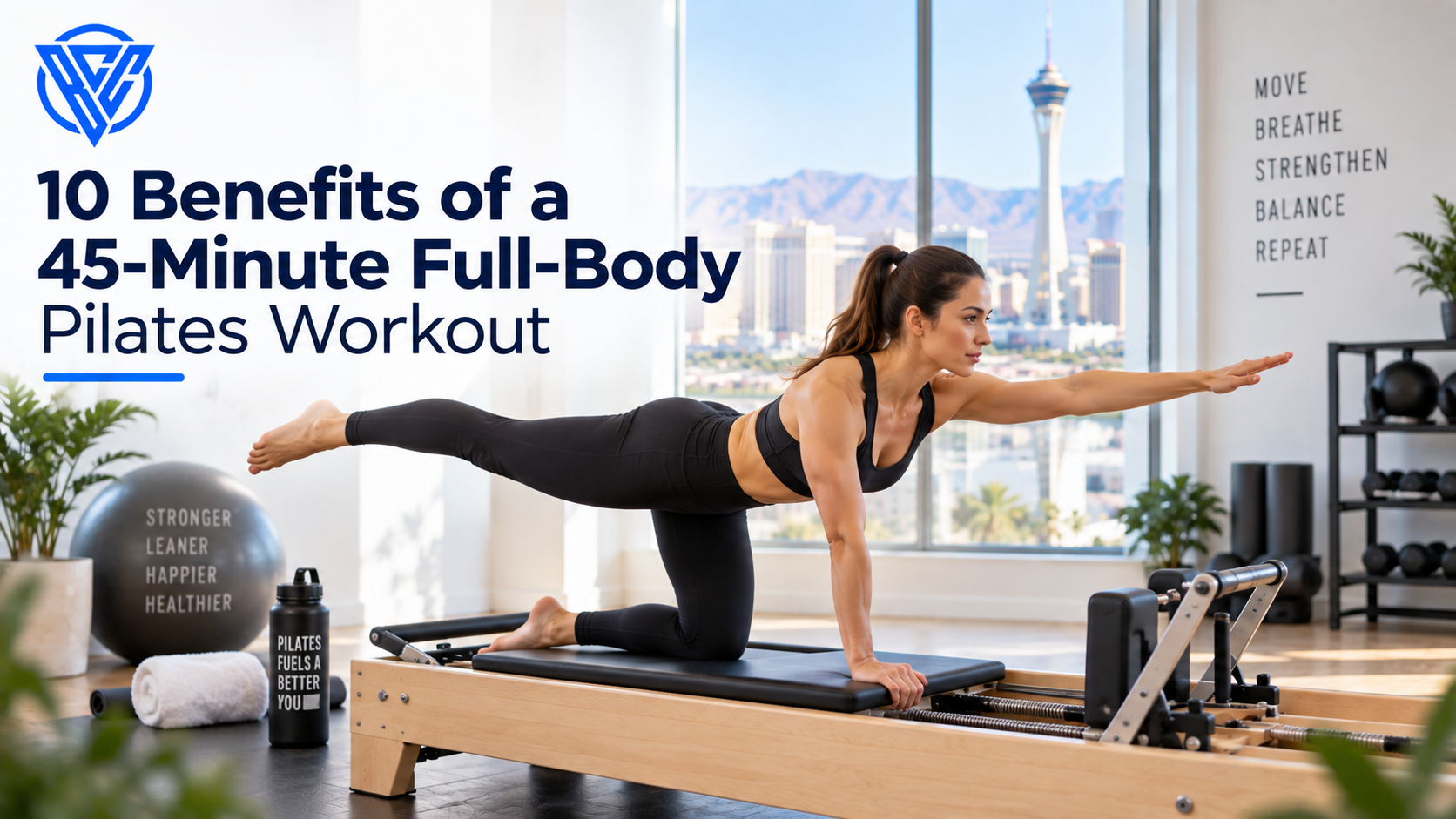
The session above is designed for mat work, but many people eventually explore the reformer, a sliding carriage machine with springs that add adjustable resistance and support.
| Factor | Mat Pilates | Reformer Pilates |
| Equipment | A mat and optional small props | Spring-loaded reformer machine |
| Resistance | Mainly body weight | Adjustable spring tension |
| Support | Less external support | Springs can assist or challenge movement |
| Best suited for | Home practice and building fundamentals | Progressive strength and guided variety |
| Instruction | Can be self-guided once learned | Usually taught in a studio setting |
A personalized Pilates routine with a qualified instructor can address injuries, athletic demands or postural concerns in ways a general plan cannot. For those who want structured accountability while using Pilates for energy and consistency, small-group sessions offer a balance of personal attention and shared motivation. If you are still learning the fundamentals, this guide to core Pilates exercises and beginner tips is a helpful next read.
Do Not Do This During Your Pilates Workout
- Don’t rush: Take your time.
- Don’t hold your breath: Keep breathing.
- Don’t force it: Stop if it hurts.
- Don’t ignore your form: Keep your body in the right position.
Conclusion
A thoughtfully structured Pilates workout offers a rare combination of strength, mobility and renewed energy in a single 45-minute session. Moving from warm-up through core, lower-body, postural and integrated work to a calm cool-down trains your body as a connected system. Precision, steady breathing and consistency will take you further than intensity alone.
Start with the version that matches your current level, repeat it a few times each week and progress gradually. When you want expert feedback or a program shaped around your goals, experienced instructors can help you get more from every session.
If you are ready to take the next step, explore the class options at Blue Chip Conditioning in Las Vegas, from group reformer classes to private sessions, or book your first session and receive guidance tailored to your body, lifestyle and goals.
Frequently Asked Questions
Is a 45-minute Pilates workout enough to build strength?
Yes. Forty-five minutes of controlled, well-sequenced exercise can build meaningful strength, particularly in the core, hips and back. Consistency matters more than session length, so completing this plan two to four times a week while gradually increasing the challenge produces steady progress.
Can Pilates really help boost energy levels?
Many people feel more alert after Pilates because it combines moderate muscular effort with deep breathing and posture work. It counteracts the stiffness of prolonged sitting without the heavy fatigue of very intense training. Sleep, nutrition and hydration also play important roles in daily energy.
How often should I do a full body Pilates workout?
Two to four sessions per week suits most people. This allows your muscles to adapt and recover. Beginners may start with two sessions and add more as their strength and confidence improve, pairing Pilates with walking or other activity on alternate days.
Is this workout suitable for beginners?
Yes, with modifications. Beginners should bend the knees during core work, reduce repetitions and rest whenever needed. Focus on breathing, neutral spine and slow, controlled movement before adding difficulty. A qualified instructor can help you learn correct form early.
Do I need equipment for this Pilates workout?
No specialized equipment is required. A supportive mat and enough floor space to lie fully stretched out are sufficient. Optional props such as a small soft ball, resistance band or folded towel can add support for beginners or extra challenge for more experienced participants as they progress.
Is mat Pilates or reformer Pilates better?
Neither is universally better; they serve different purposes. Mat Pilates uses body weight and is ideal for home practice and mastering fundamentals. Reformer Pilates adds adjustable spring resistance and support, making it well suited to progressive strength work. Many people benefit from combining both.
Can Pilates replace traditional strength training?
Pilates builds functional strength, stability and control, and for many people it can form the main part of a fitness program. However, those aiming for maximal strength or significant muscle size often benefit from combining Pilates with progressive resistance training. The best mix depends on your individual goals.