
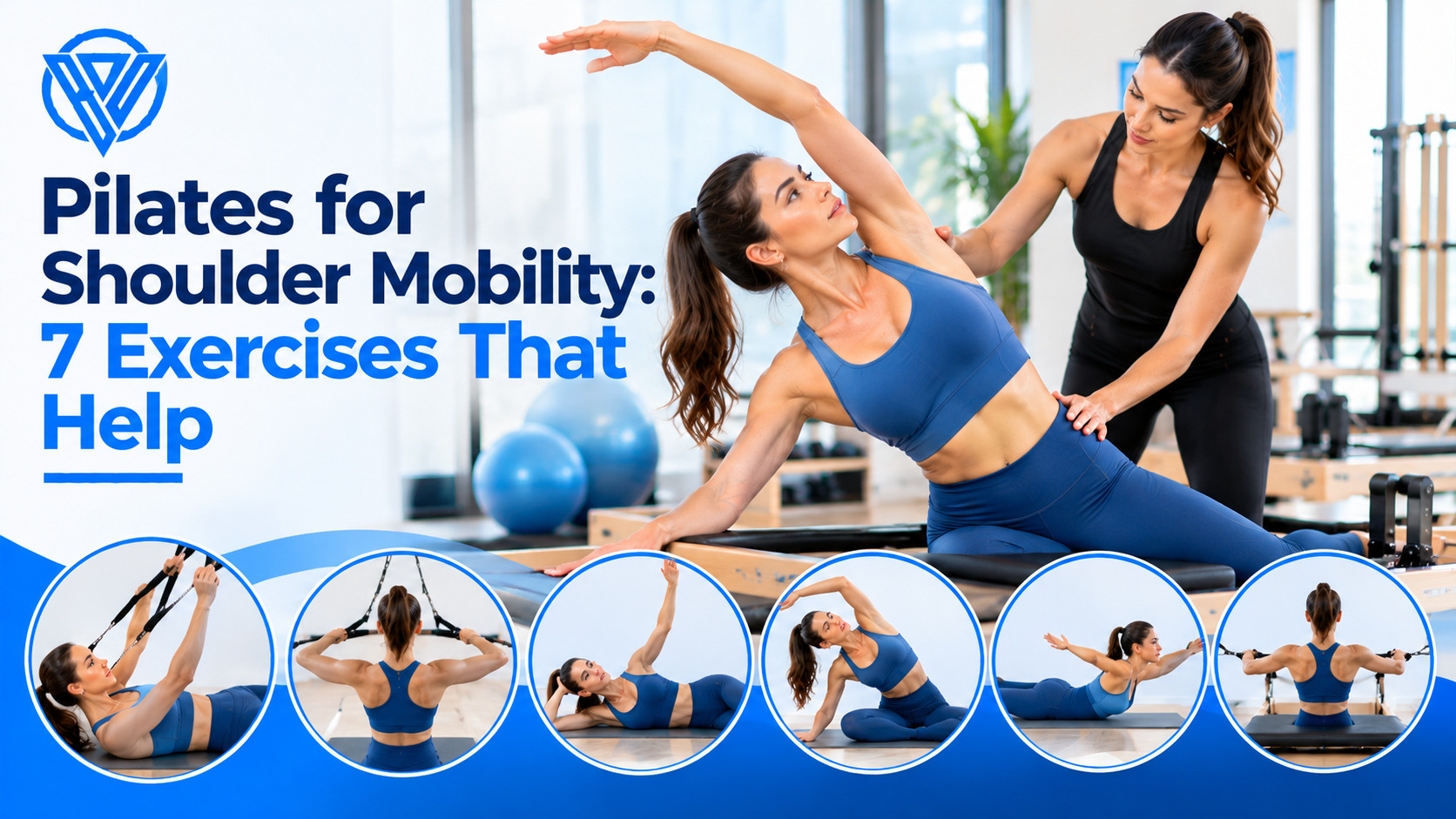
Pilates for shoulder mobility focuses on restoring how the shoulder blade, upper back and arm move together, rather than simply stretching tight muscles. In this guide, you will learn why shoulders lose range, which seven exercises help most, how to perform them with good form, and which mistakes quietly slow your progress.
Stiff shoulders rarely come from the shoulder alone; desk posture, overhead sport, old injuries and a rigid upper back all play a part. That is why Pilates for shoulder mobility works on the whole system: the thoracic spine, the shoulder blade, the deep stabilizing muscles and even the breath.
Why Shoulder Mobility Matters
The shoulder is the most mobile joint in the body, and that freedom comes at a cost. Its stability depends heavily on the muscles of the rotator cuff and on how smoothly the shoulder blade glides over the rib cage. When one part stops moving well, another part compensates, usually the neck or the lower back.
Pilates for shoulder mobility aims to restore that balance. Healthy range lets you reach overhead without arching your back, carry bags without hiking your shoulders toward your ears, and throw, swim or lift with less strain. Shoulder mobility exercises work best when they build control at the end of your range, not just passive flexibility you cannot use.
Common Causes of Limited Shoulder Range
- Rounded posture: Hours at a keyboard or phone shorten the chest muscles and stiffen the upper back, which limits how far the arms can lift.
- Weak shoulder blade control: When the muscles that stabilize the scapula are underused, the shoulder joint loses its stable base.
- Repetitive sport patterns: Tennis, golf, swimming and baseball load one side or one direction far more than the other.
- Old injuries: Strains or periods of immobilization can leave lasting stiffness if movement is never fully retrained.
How Pilates Improves Shoulder Mobility
Pilates for shoulder mobility is built on precise, controlled movement coordinated with breathing. Instead of forcing a stretch, each exercise asks you to move the arm while keeping the ribs, pelvis and shoulder blades organized. That combination of length and control is what makes new range usable in daily life and sport.
Springs on a reformer can assist a movement when you are stiff or add resistance when you need strength. Reformer Pilates exercises can therefore be scaled precisely, which is harder to achieve with free weights alone.
Compared with static stretching, Pilates for shoulder mobility trains the stabilizers and the mobilizers at the same time. You open the chest while strengthening the upper back, and you explore the overhead position while teaching the core to stay quiet.
The 7 Best Exercises in Pilates for Shoulder Mobility
Move slowly within a comfortable range. Two or three controlled sets of six to ten repetitions is a sensible starting point unless your instructor or clinician advises otherwise.
1. Arm Circles in the Straps
Lie on your back on the reformer with the straps in your hands and arms reaching toward the ceiling. Draw small circles down toward the hips and back up, keeping the ribs heavy and the back of the shoulders wide. The light spring tension supports the arms, which makes this one of the gentler shoulder range of motion exercises for stiff beginners.
2. Chest Expansion
Kneel facing the straps with arms reaching forward. Pull the arms back alongside the hips, turn the head right and left, then return with control. This opens the chest and strengthens the muscles between the shoulder blades.
3. Book Openings
Lie on your side with knees bent and arms stacked in front of you. Open the top arm in an arc toward the floor behind you, following it with your eyes, then return. Because the movement comes from upper-back rotation, keep the knees together. Book openings are among the most useful shoulder flexibility exercises because they address the upper back as well as the chest.
4. Mermaid Side Stretch
Sit sideways on a reformer or mat, reach one arm overhead and lean away, lengthening the side of the body from hip to fingertips. On the reformer, the moving carriage lets you travel further while the springs keep the stretch controlled. Mermaid targets the lats, which often restrict overhead reach, so it belongs in any Pilates for shoulder mobility routine.
5. Swan Prep
Lie face down with hands under the shoulders. Press gently to lift the chest a few inches, drawing the shoulder blades down and keeping the neck long. Without upper-back extension, the arm cannot reach fully overhead, which is why shoulder range of motion exercises should include it.
6. Rowing Series
Seated on the reformer, the rowing exercises take the arms through pulling, reaching and circling patterns against light springs. They strengthen the shoulder through a large range, making them excellent Pilates shoulder exercises for swimmers, tennis players and anyone who reaches overhead often.
7. Scapular Push-Up in Plank
From a plank on the mat or the reformer frame, keep the elbows straight and let the chest sink slightly between the shoulder blades, then press the floor away to spread them apart. This trains the serratus anterior, which helps the shoulder blade rotate upward when you raise your arms.
Mat vs Reformer: Which Works Better?
Both formats are effective. The right choice depends on your current mobility, your goals and how much support you need.
| Factor | Mat Pilates | Reformer Pilates |
| Support for stiff shoulders | Body weight only | Springs can assist the movement |
| Resistance options | Limited, small props | Adjustable spring tension |
| Variety of arm work | Moderate | Extensive, including straps and rowing |
| Home practice | Easy to do anywhere | Requires equipment |
| Best suited for | Maintenance and daily routines | Rebuilding range with guided progression |
Many people combine guided reformer Pilates exercises in the studio with a short mat routine at home. Compared with yoga, which emphasizes holding positions, or gym circuits that isolate single muscles, Pilates for shoulder mobility pairs range with active control through the whole movement.
Common Mistakes That Limit Progress
- Shrugging during arm work: Lifting the shoulders toward the ears shifts the load onto the neck. Keep the collarbones wide.
- Arching the lower back to reach overhead: This creates the appearance of range without improving the shoulder. Keep the ribs connected to the pelvis.
- Pushing into pain: Mild stretching sensations are normal; sharp or pinching pain is a signal to stop and get assessed.
- Inconsistent practice: Mobility responds to repetition. Short, frequent sessions usually outperform one long session a week.
How Often Should You Practice?
For most people, two or three sessions a week of Pilates for shoulder mobility, plus a few minutes of daily shoulder mobility exercises at home, is a practical rhythm. Expect ease of movement to improve before range does. Pair your sessions with simple shoulder flexibility exercises such as a doorway chest stretch.
If you have a diagnosed injury, recent surgery or persistent pain, check with your physician or physical therapist first. A qualified instructor can then adapt Pilates for shoulder mobility to fit their guidance.
Who Benefits Most
- Office workers with rounded shoulders and neck tension
- Overhead athletes such as swimmers, tennis players and volleyball players
- Dancers who rely on shoulder flexibility exercises to achieve clean, open lines
- People finishing physical therapy who want to keep progressing
Why Guided Instruction Makes a Difference
Shoulders compensate easily, and that is the biggest obstacle in Pilates for shoulder mobility. Without feedback, many people practice Pilates shoulder exercises while subtly shrugging or arching, which reinforces the original problem. Hands-on cues help you feel the difference between moving the arm and moving around it.
At Blue Chip Conditioning in Las Vegas, instructors emphasize hands-on corrections and tailor each session to the client’s goals and history. In semi-private sessions, an instructor can adjust your shoulder mobility exercises in real time, while group reformer classes let you practice reformer Pilates exercises alongside others at a steady pace. If you are new, it helps to know what your first private session looks like, since the instructor will review how you move before choosing the right shoulder range of motion exercises for you.
Frequently Asked Questions
What is Pilates for shoulder mobility?
Pilates for shoulder mobility is a training approach that improves how the shoulder blade, upper back and arm move together. It combines controlled stretching with strengthening of the stabilizing muscles, so the new range you gain is supported, usable and less likely to tighten up again.
How long does it take to improve shoulder mobility with Pilates?
Many people notice easier movement within a few weeks of consistent practice two or three times a week. Larger gains in range usually take longer and depend on your starting point, history of injury and how regularly you practice outside the studio.
Is reformer Pilates good for shoulder mobility?
Yes. The reformer’s springs can assist stiff shoulders or add resistance as you get stronger, and the straps allow a wide variety of arm patterns. This makes it easier to work through a full range safely while an instructor monitors your alignment.
Can I do Pilates shoulder exercises at home?
Yes. Book openings, swan prep, mermaid and scapular push-ups need only a mat. Learning them with an instructor first helps you avoid shrugging or arching, the most common errors when practicing alone.
Is Pilates better than stretching for shoulder flexibility?
Pilates is often more effective for lasting change because it adds strength and control to the stretch. Passive stretching can increase range temporarily, but without stability work the shoulder tends to return to old patterns.
Can Pilates help with shoulder stiffness after an injury?
Pilates can be a helpful part of recovery once a physician or physical therapist has cleared you for exercise. Its low-impact, adjustable nature allows gradual progression. Always follow your clinician’s guidance and tell your instructor about the injury before you begin.
Should I avoid Pilates if my shoulder hurts?
Not necessarily, but persistent or sharp pain should be assessed by a medical professional first. Once you know the cause, an instructor can modify or skip exercises that aggravate symptoms.
Conclusion
Shoulder range improves when the whole system moves well: a mobile upper back, a stable shoulder blade and a well-controlled arm. Pilates for shoulder mobility addresses all three at once, which is why it often succeeds where stretching alone falls short. Start with the seven exercises above, practice them consistently, and prioritize quality over depth of stretch.
For help choosing the right setting, read our guide comparing a Pilates studio vs a gym for your fitness goals. If stiff or restricted shoulders are holding you back at work, in sport or in daily life, consider a session at Blue Chip Conditioning in Las Vegas. An instructor can assess how you move and build a Pilates for shoulder mobility plan around your goals. Book your first session to get started.