
If you want a stronger, more stable midsection without endless crunches, Pilates for core strength is one of the most effective approaches you can choose. This guide covers seven exercises instructors regularly build into their programs, explains how each one trains the deep abdominal muscles, and shows how to progress safely from mat work to the reformer. You will also learn the mistakes that commonly slow progress.
Why Pilates for Core Strength Works Differently
Most people picture the core as the “six-pack” at the front of the stomach. In reality, it is a cylinder of muscles that includes the transversus abdominis, the obliques, the multifidus along the spine, the diaphragm above and the pelvic floor below. Sit-ups mainly train the rectus abdominis, which flexes the spine. Pilates for core strength takes a broader view, asking these muscles to work together to stabilize the spine and pelvis while the arms and legs move.
That is why Pilates core exercises often feel deceptively hard. A small movement performed slowly, with controlled breathing and a neutral pelvis, demands more from the deep stabilizers than a fast set of crunches.
What the Deep Core Actually Does
- Stabilizes the spine: The transversus abdominis and multifidus help support the lower back before and during movement.
- Coordinates breathing: The diaphragm and pelvic floor work with the abdominals, which is why Pilates emphasizes breath.
- Transfers force: A stable trunk lets power travel efficiently between the legs and arms during lifting, running and sport.
- Supports posture: Balanced core endurance makes it easier to sit and stand tall without the lower back taking over.
Seven Exercises Instructors Recommend
These staples of Pilates for core strength appear in mat and reformer programs because they challenge the core from different angles: flexion, rotation, extension and stability. Together they form a well-rounded core strengthening workout that can be scaled for almost any level.
1. The Hundred
Lie on your back, lift your head and shoulders, extend the legs to tabletop or a low diagonal, and pump the arms while inhaling for five counts and exhaling for five. It builds abdominal endurance and rhythmic breathing. Beginners can keep the feet down to protect the lower back.
2. Roll-Up
Starting flat with the arms overhead, peel the spine off the mat one vertebra at a time, reach toward the toes and roll back down with control. If momentum takes over, bend the knees or loop a band around the feet. It is one of the most useful deep core strengthening exercises for learning sequential spinal control.
3. Single-Leg Stretch
With the head and shoulders lifted, draw one knee in while extending the other leg, then switch smoothly. The pelvis must stay still as the legs move, which makes this a reliable choice for anyone interested in Pilates for abdominal strength.
4. Criss-Cross
Criss-Cross adds rotation. As one leg extends, rotate the ribcage toward the opposite knee, keeping the elbows wide. The obliques do most of the work. Twisting from the elbows rather than the ribs is a common error that reduces the benefit.
5. Toe Taps
Toe Taps are a staple of Pilates for beginners. With the legs in tabletop and a neutral spine, lower one foot to tap the mat and return it, keeping the pelvis level and the back from arching. It teaches the pelvic control every other exercise depends on.
6. Swimming
Lying face down, lift the opposite arm and leg in a quick, fluttering pattern while keeping the abdominals drawn in. Swimming strengthens the spinal extensors and glutes, balancing all the forward-flexion work above.
7. Reformer Plank and Knee Stretches
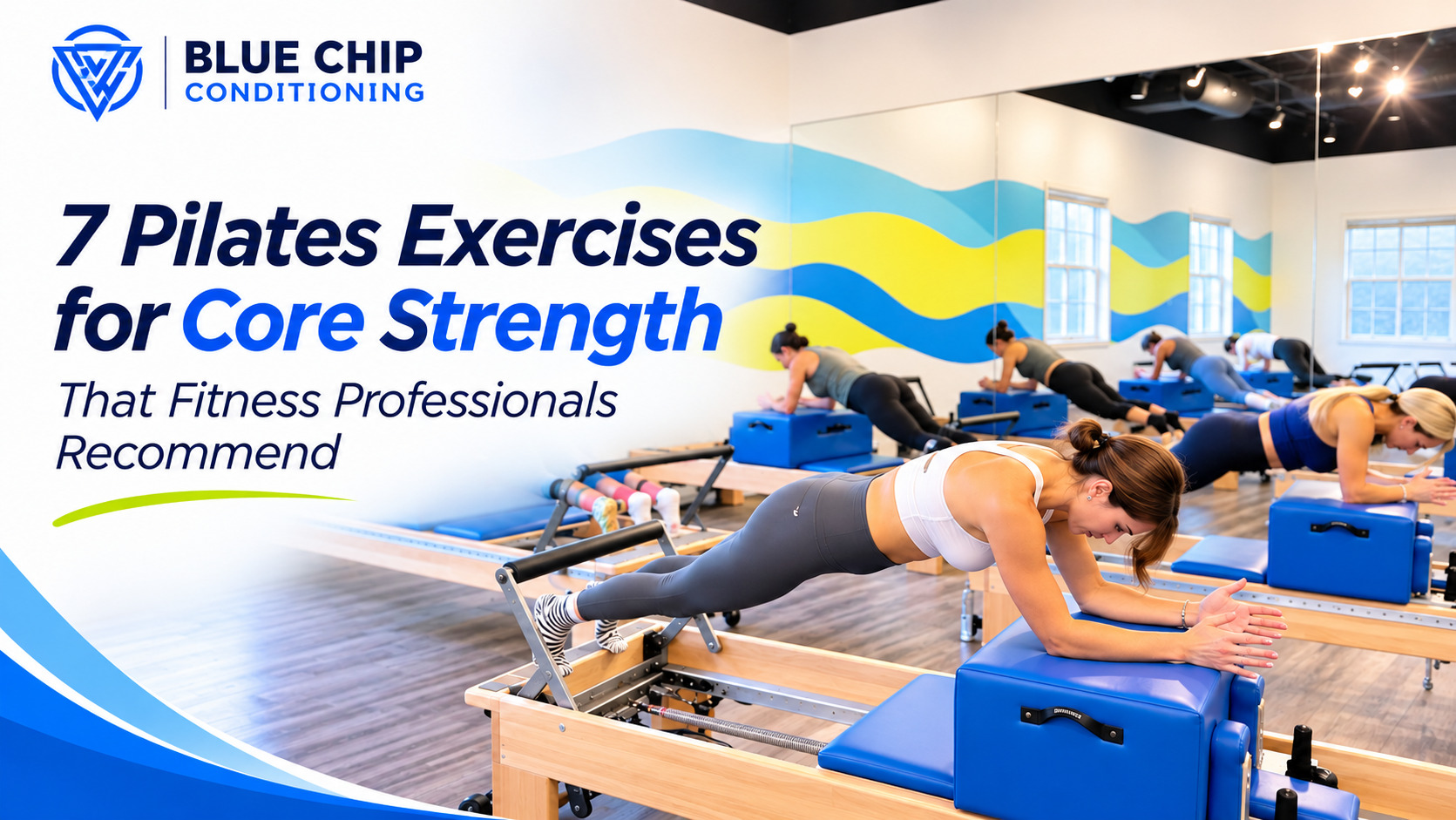
On the reformer, plank-based exercises and Knee Stretches challenge the trunk to stay stable while the legs move a sliding carriage against spring resistance. This is where Reformer Pilates for core strength adds something mat work cannot easily replicate.
Mat vs. Reformer: Choosing Your Approach
Both formats are effective, and many programs combine them.
| Factor | Mat Pilates | Reformer Pilates |
| Resistance | Body weight and gravity | Adjustable springs plus body weight |
| Support for beginners | Fewer assists; some moves feel harder early on | Springs and straps can assist or challenge |
| Feedback | Relies on body awareness | Carriage movement reveals instability quickly |
| Best suited for | Home practice, travel, foundational skills | Progressive strength and coached sessions |
| Equipment needed | Mat only | Reformer machine, usually in a studio |
Reformer Pilates for core strength is particularly helpful when you need more support or more load than the mat provides. Springs can assist a movement you cannot yet control or add resistance once body weight is no longer enough. At Blue Chip Conditioning, small-group classes in Reformer Pilates for core strength are capped at eight people, so instructors can watch form and adjust springs for each client.
How to Build a Core Strengthening Workout
Sequencing and frequency determine whether you make progress. A balanced 30-minute session built around Pilates for core strength often looks like this:
- Breath and pelvic control (5 minutes): Pelvic tilts, imprinting and the Hundred.
- Flexion and rotation (10 minutes): Roll-Up, Single-Leg Stretch and Criss-Cross, focusing on quality over repetitions.
- Stability and extension (10 minutes): Toe Taps, Swimming and a plank variation.
- Mobility (5 minutes): Spine stretches and gentle rotation.
Two to three sessions a week is a practical target. Deep core strengthening exercises respond to regular, precise practice, and most people notice better control and posture before they see visible changes. For a longer session that trains the whole body, the studio’s guide to the benefits of a 45-minute full-body Pilates workout shows how core work fits into a complete routine.
Common Mistakes That Limit Progress
Even experienced exercisers develop habits that reduce the effectiveness of Pilates for core strength:
- Holding the breath: This raises tension in the trunk; exhale on the effort instead.
- Straining the neck: If the neck works hard, lower the head and build strength gradually.
- Chasing repetitions: Fast reps shift work to the hip flexors. Fewer, slower reps are more productive.
- Letting the back arch: When the legs lower too far, shorten the lever until control returns.
- Skipping extension: Training only the front of the body creates imbalance.
Pilates for Beginners: Where to Start
Begin with foundational versions: Toe Taps, a modified Hundred and a bent-knee Roll-Up. Pilates for beginners should prioritize neutral spine, breath and pelvic control before adding speed or load. A few coached sessions often shorten the learning curve, because an instructor can spot compensations you cannot feel yet. If you are booking your first class, this guide on what to expect in your first Pilates session explains how a beginner session is structured.
Coaching is especially worthwhile if you have a history of back pain, are returning after pregnancy or are managing an injury. Private sessions built around deep core strengthening exercises let the instructor tailor every movement, while semi-private training in Pilates for abdominal strength offers individual programming at a lower cost. Blue Chip Conditioning’s Pilates for beginners options include a new client special that combines semi-private sessions with group classes.
Who Benefits Most From Pilates for Core Strength
Desk workers, athletes, dancers and people returning to exercise all benefit, as do those with a history of back discomfort once cleared by a healthcare provider. Pilates for abdominal strength also appeals to anyone who wants a firmer, more functional midsection. Look for an instructor who cues breath and alignment and explains why each exercise is in the plan. At Blue Chip Conditioning, experienced instructors design each core strengthening workout around your goals and current level.
Frequently Asked Questions
Is Pilates good for core strength?
Yes. Pilates for core strength trains the deep stabilizing muscles, including the transversus abdominis, obliques, multifidus and pelvic floor, rather than only the surface abdominals. Its focus on controlled movement, breathing and spinal alignment builds endurance and stability that support posture, daily movement and athletic performance.
How often should I do Pilates to strengthen my core?
Two to three sessions per week is a practical starting point for most people. That frequency gives the deep core muscles regular practice while allowing time to recover. Many people notice better control and posture within a few weeks, though visible changes depend on overall activity, nutrition and consistency.
Which exercises should beginners start with?
Toe Taps, a modified Hundred, pelvic tilts and a bent-knee Roll-Up are excellent first choices. They teach neutral spine, breath control and pelvic stability without overloading the neck or lower back. Once these feel controlled, progress to Single-Leg Stretch, Criss-Cross and reformer-based work with an instructor.
Is reformer Pilates better than mat Pilates for the core?
Neither is universally better. Reformer Pilates for core strength adds adjustable spring resistance and support, which helps both beginners and advanced clients progress. Mat Pilates uses body weight and can be done anywhere. Many effective programs combine both formats for balanced, well-rounded results.
Can Pilates help with lower back pain?
Pilates can help many people with non-specific lower back discomfort by improving core endurance, posture and movement control. Anyone with a diagnosed spinal condition, recent injury or persistent pain should get clearance from a healthcare provider first and work with a qualified instructor who can modify exercises.
How long does it take to see results from Pilates for core strength?
Many people feel improved control and posture within a few weeks of practicing two to three times a week. Visible definition takes longer and depends on body composition, overall activity and diet. Focusing on precise technique rather than volume usually produces faster and more lasting progress.
Do I need equipment for Pilates core exercises?
No. Many Pilates core exercises require only a mat, which makes them easy to practice at home. A reformer, resistance band or small ball can add support or challenge, and studio sessions provide coaching that helps you progress safely and correct your technique.
Conclusion
Building a strong midsection is less about volume and more about precision. The seven exercises above, from the Hundred to reformer planks, train the core as a coordinated system that supports your spine, posture and movement. Pilates for core strength rewards patience: start with foundational versions, breathe through each effort, include back extension and progress only when control is solid.
If you would like guidance on technique or a program built around your goals, book an introductory session at Blue Chip Conditioning in southwest Las Vegas. An instructor can assess your current core control, recommend the right format and build a plan of Pilates for core strength that matches your level.