
Pilates vs Yoga: Which Is Better for Strength, Mobility and Recovery?
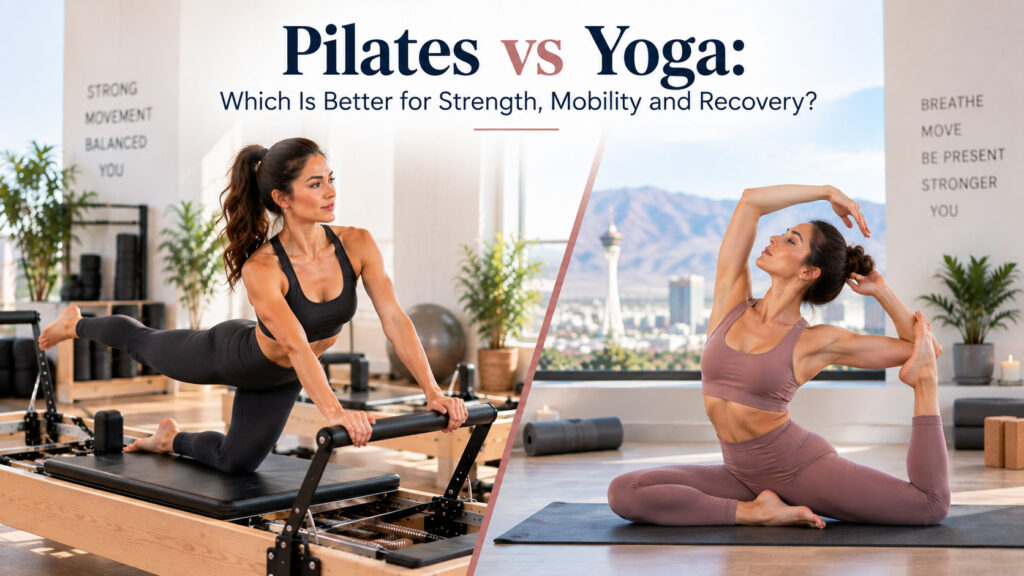
Choosing between Pilates vs yoga usually comes down to one question: what do you want your body to do better? Both methods build strength, flexibility and body awareness, yet they reach those results through different paths. This guide explains the real difference between Pilates and yoga, how each supports strength and recovery, which may suit back pain or weight management, and how to combine the two in a sensible weekly routine. Two Disciplines, Two Goals Yoga is a mind and body practice with roots in ancient Indian philosophy. As the National Center for Complementary and Integrative Health explains, most styles combine physical postures, breathing techniques and meditation or relaxation. Depending on the style, a class can feel slow and meditative or athletic and demanding. Pilates was developed by Joseph Pilates in the early twentieth century, originally under the name Contrology. It centres on precise, controlled movement driven from the deep core muscles, with a strong emphasis on alignment, breath and quality over quantity. It can be practised on a mat or on specialised equipment such as the reformer, which uses springs to add resistance or support. When people compare yoga vs Pilates, the simplest framing is this: yoga tends to prioritise flexibility, balance and a calm mental state, while Pilates tends to prioritise core strength, stability and movement control. There is plenty of overlap, but the intent behind each session is different, and that intent shapes the results you can expect. Understanding it is the first step in any Pilates vs yoga decision. How Pilates vs Yoga Compare The table below summarises the main difference between Pilates and yoga across the factors most people weigh up before booking a class. Factor Pilates Yoga Primary focus Core strength, stability and controlled movement Flexibility, balance, breath and mindfulness Typical pace Moderate, with controlled repetitions Varies widely, from long holds to flowing sequences Equipment Mat or apparatus such as the reformer Usually a mat, with blocks and straps as props Role of breathing Supports movement and core engagement Often central to the practice and meditation Mind-body element Concentration and precision Meditation, relaxation and, in some styles, spiritual roots Often chosen for Strength, posture and rehabilitation support Mobility, stress relief and balance Strength and Core Control Pilates is built around what Joseph Pilates called the powerhouse: the muscles of the abdomen, lower back, hips and pelvic floor. Exercises are performed with careful control, so muscles work through their full range under steady tension. On a reformer, spring resistance can make an exercise harder or easier, which lets an instructor progress strength gradually and safely. Yoga builds strength too, particularly in vinyasa or power styles, where you support your bodyweight through planks, lunges and arm balances. However, the load is limited to bodyweight and static holds. If your main aim is targeted core strength and stability, Pilates generally offers more direct and adjustable training. For many people asking is Pilates better than yoga for strength, that adjustability is the deciding factor. Flexibility and Mobility Yoga typically asks you to hold stretches for longer, which suits people who want to improve passive flexibility. Pilates approaches mobility differently: it trains you to control your range of motion, so flexibility and strength develop together. Our article on yoga vs Pilates for long-term mobility looks at what the research says about range of motion over time. A useful rule of thumb for the Pilates vs yoga choice on mobility: if you are very stiff, yoga’s longer holds can help open things up; if you are already flexible but feel unstable, the Pilates emphasis on control is often more valuable. Stress and Recovery Yoga’s breathing and meditation components make it a strong option for managing stress. Pilates also uses deliberate breathing and concentration, and many clients find the focus it demands genuinely calming. For physical recovery, Pilates is low impact and highly adaptable, which is why it is often used alongside physical therapy and athletic rehabilitation. On recovery, the Pilates vs yoga question is less about which is superior and more about timing and intent. Key recovery considerations for each approach: Difficulty for Beginners Deciding on Pilates vs yoga for beginners is less about which is easier and more about which environment helps you learn safely. Beginner yoga classes introduce foundational postures and breathing, while beginner Pilates introduces core engagement and a neutral spine. Reformer classes can feel unfamiliar at first, but the springs often support the body and make movements more accessible. Our guide to Pilates vs yoga for beginners covers whether to start on the mat or the reformer. So, which is harder, Pilates or yoga? It depends on the class. A power yoga session can be very demanding, while a slow mat Pilates class can feel manageable. In general, Pilates feels harder on the core and deep stabilising muscles, and yoga feels harder on flexibility and balance. The best way to learn which is harder, Pilates or yoga, for your own body is to try a beginner-level class of each. Which Is Better for Back Pain People often ask about Pilates or yoga for back pain because both are commonly recommended. A considerable amount of research has looked at yoga for low-back pain and suggests there may be some benefit, while Pilates is widely used in rehabilitation settings because it trains the deep stabilising muscles of the trunk. The better choice depends on the cause and stage of your pain: In the Pilates vs yoga discussion around back health, individual instruction matters more than the label on the class. An instructor who can modify exercises for your spine is the real advantage, which is why many people with back concerns begin in private or semi-private sessions before joining group classes. Which Is Better for Weight Management When looking at Pilates vs yoga for weight loss, it helps to be realistic. Neither is primarily a calorie-burning workout compared with running or high-intensity interval training, and weight management depends mostly on overall energy balance, sleep, stress and consistency.
Flexibility Training Pilates: What Mobility Research Actually Says About Long-Term Range of Motion
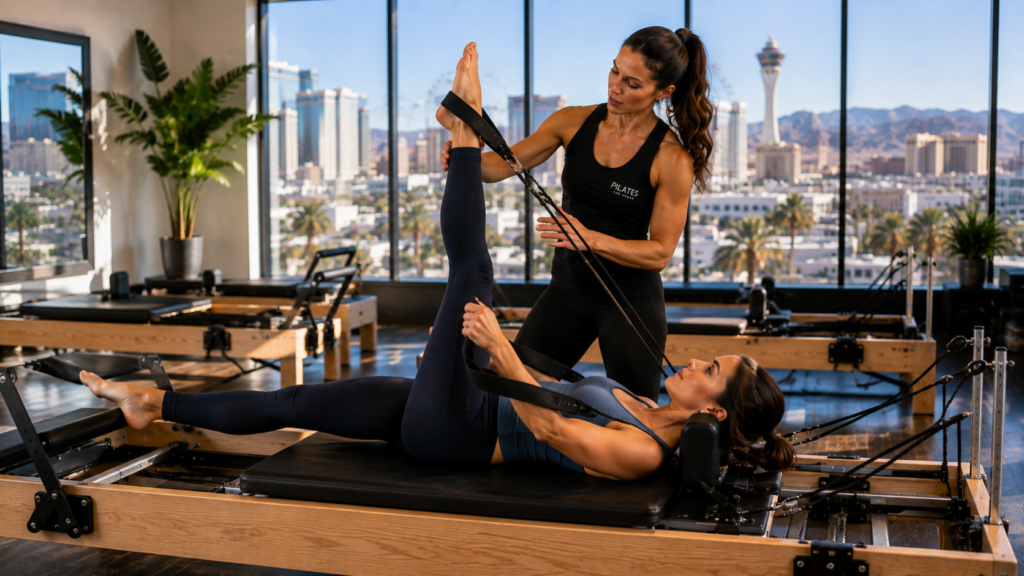
If you have been stretching the same hamstring for two years and it is still tight, the problem is not your discipline. It is the method. Flexibility training Pilates works differently from static stretching because it loads a joint at the end of its range instead of merely holding it there. This article covers what the research actually supports, why passive stretching produces temporary results, and how to structure loaded work that changes range permanently. Why Static Stretching Disappoints and Flexibility Training Pilates Does Not Hold a stretch for thirty seconds and the muscle feels longer. Measure it a week later and the range is usually gone. That is not a failure of effort it is what the physiology predicts, and it is the gap flexibility training Pilates was designed to close. Static stretching primarily changes stretch tolerance your nervous system’s willingness to accept a position rather than the structural properties of the tissue. Tolerance is real and useful, but it is also fragile. It decays quickly without repetition, and it does not give you control in the new range. The distinction matters because tolerance and capability are not the same thing. You can tolerate a deep hamstring position while lying on the floor and still be unable to lift your leg to half that height under your own power. That gap between passive range and active range is where injuries happen, and closing it is the entire purpose of flexibility training Pilates. Reviews indexed on PubMed and summarised through the National Institutes of Health literature database have consistently found that stretching alone produces modest, short-lived changes in range of motion, while resistance training through a full range produces comparable or greater gains that persist. That finding is the entire basis of modern mobility programming. What Flexibility Training Pilates Does Differently Flexibility training Pilates solves the tolerance problem mechanically. A strap holds the limb in a lengthened position while a spring demands active resistance. You are not passively hanging in a position you are producing force at the far end of your range. This is the core of flexibility training Pilates: every position that lengthens tissue also loads it. The hamstring in a supine strap series is not being stretched. It is working eccentrically against spring tension while long. Three mechanisms make that effective: Instructors see the consequence clearly. A client who has stretched daily for years often shows large passive range and almost no active control. Two weeks of loaded reformer work usually closes more of that gap than two years of stretching did. Passive Stretching Versus Flexibility Training Pilates The two approaches are frequently confused because they look similar from the outside. They are not similar in outcome. Factor Static Passive Stretching Loaded Range Work on the Reformer Primary adaptation Stretch tolerance Tissue structure and neural control Duration of gains Days Months to permanent Active range gained Minimal Substantial Strength at end range None Direct Injury risk reduction Weak evidence Supported Transfer to sport Low High Session time required 15–20 minutes Integrated into training Progression method Longer holds Increased load and range The practical takeaway is not that stretching is useless. It is that stretching is a warm-up tool and a recovery tool, not a method for permanently changing how far you can move under your own control. Active Mobility Is the Metric Flexibility Training Pilates Targets Active mobility is the range you can reach and control using your own muscles, with no external assistance. Passive range is the range someone else, or gravity, can put you in. The difference between those two numbers is your vulnerability. A dancer with 140 degrees of passive hip flexion and 95 degrees of active hip flexion has forty-five degrees of range her body cannot protect. That is precisely where hamstring strains occur, and it is why Pilates for dancers is programmed around control rather than range for its own sake. Flexibility training Pilates closes that gap from both directions. Loaded work raises active mobility while spring assistance allows controlled exploration of the passive end. Over time the two numbers converge, which is the actual definition of usable mobility. Testing Your Own Gap You can check this without equipment. Lie on your back and have someone raise your straight leg until you feel a firm stretch note that height. Then lower it and lift the same leg yourself, actively, as high as you can hold for three seconds. If the second number is dramatically lower than the first, active mobility is your limiting factor, not tissue length. More stretching will not fix it. Loaded work will. How Flexibility Training Pilates Builds End Range Strength End range strength is the ability to produce force in the outer portion of a joint’s range, and it is the single most protective quality in mobility training. Flexibility training Pilates builds it through a predictable sequence on the reformer: A full block of that kind is priced as a package rather than per session, so it is worth reading Pilates pricing and packages before you start. That progression takes roughly six to eight weeks per major joint, and it moves fastest under direct supervision our certified Pilates instructors prescribe spring load to your measured range rather than to a class average. End range strength built this way tends to persist, because it is a strength adaptation rather than a tolerance one. Loaded Stretching in Practice Loaded stretching is a term borrowed from strength coaching the National Strength and Conditioning Association uses it in much the same way And it describes exactly what a reformer strap series does: resistance applied while the target tissue is at length. The version most people attempt at home fails for a simple reason. Without a spring or cable providing consistent resistance through the range, you either hold a position passively or you load only the mid-range. The reformer’s spring supplies smoothly variable resistance across the entire path, which is why loaded stretching is far more practical on the equipment than off