
What to Wear to Pilates: A 2026 Guide for Comfort, Grip, and Performance
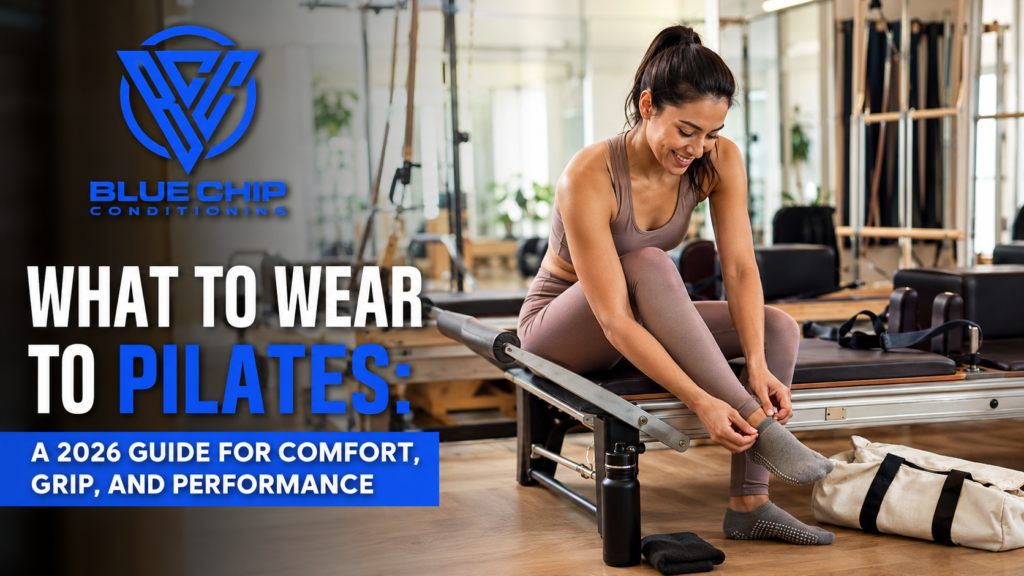
Introduction The first time you walk into a reformer room, the outfit question can feel bigger than it should. People worry about looking awkward, sliding on the carriage, wearing the wrong fabric, or showing up underdressed for the room. That nervous moment is exactly why what to wear to pilates matters more than most beginners think. At Blue Chip Conditioning, the focus is on precise movement, strong instruction, and a comfortable training environment built for private, semi-private, and group work in Las Vegas. That’s also why the outfit should be simple, fitted, and functional rather than fancy. Blue Chip’s own guidance and nearby studio FAQs consistently point to comfortable activewear, grip socks, and clothes that move cleanly with the body. Quick Answer Section Wear fitted, breathable activewear that stays in place, such as leggings or snug shorts with a supportive top, and choose grip socks if your studio requires them. For reformer classes, your outfit should let your instructor see your alignment, avoid snags on moving equipment, and keep you comfortable through stretching, core work, and controlled transitions. Key Takeaways What Pilates clothing should actually do The best way to think about what to wear to pilates is this: your clothes should disappear during class. You should not be tugging at your waistband, worrying about a top slipping down, or wondering whether your shorts are riding up during a bridge, teaser, or footwork series. That is why experienced studios keep repeating the same basics. Comfortable activewear, fitted shapes, and grip socks show up again and again in studio guidance because they reduce friction, improve stability, and help the instructor see your body more clearly. At Blue Chip Conditioning, that practicality fits a training style built around personalized correction and controlled movement. Best outfit formula for reformer classes When clients ask what to wear to pilates, the safest answer is usually a simple formula: Wear a fitted top, supportive bottoms, and socks with grip. If the class is heated, intense, or athletic, choose moisture-wicking fabric. If the class is slower and beginner-focused, comfort matters even more because you will spend more time learning positions and transitions. For women, high-waisted leggings with a snug tank or sports bra often work best. For men, athletic shorts that stay secure and a fitted tee or performance top are usually the easiest choice. The key is freedom without excess fabric. That’s one reason this choice is less about fashion and more about how your clothing behaves when you move. What to wear to Pilates if it is your first class First-time students usually overthink the outfit and underthink the function. Start simple. Bring a bottle of water, wear clothing that lets you reach, hinge, curl, and rotate, and keep accessories to a minimum. A good beginner rule is to test your outfit before class. Sit down, squat, reach overhead, and lie on the floor. If you keep adjusting your outfit, it will probably bother you in class too. That is why what to wear to pilates for a first session should favor comfort, coverage, and confidence over trend-driven looks. Grip socks, bare feet, and studio rules A lot of people ask what to wear to pilates and forget that the feet matter too. On reformers, grip socks are often recommended or required because they improve traction and help with safety and cleanliness. Some studios allow barefoot work in certain settings, but many reformer spaces prefer socks with rubber grips. If you are going to a premium or boutique studio, check the class policy before you arrive. That small step prevents awkward surprises at the front desk and helps you walk in ready to train instead of scrambling for gear. In practice, what to wear to pilates often comes down to one simple detail: does your outfit support control on the equipment? What not to wear: the most common mistakes People usually do not fail because they lack good taste. They fail because they pick clothes that fight the workout. The biggest mistakes are baggy shirts that cover your form, shorts that shift during leg work, and thick seams that dig into your body on the reformer. Jewelry, zippers, and overly loose layers can also become distracting. If you are unsure about what to wear to pilates, choose the outfit that will stay out of your way when you are moving slowly and precisely. Comparison section: what works best and what usually gets in the way Here is the easiest way to compare outfits before class. Fitted leggings or snug shorts: best for alignment, smooth movement, and machine safety.Loose gym shorts or oversized sweats: best for lounging, not for reformer control.Supportive top or fitted tank: best for staying in place through roll-downs, planks, and stretches.Baggy tee or wide crop: best for casual wear, but it can hide posture and shift during class. This is why what to wear to pilates should be chosen with movement in mind, not just the mirror. The best outfit helps your body feel organized, and that matters even more in focused studios such as a pilates reformer studio las vegas that values precision and coaching. Why outfit choice affects your performance Clothing changes how people move. That sounds small, but in Pilates it is huge. If your top rides up, your brain splits attention between form and fixing clothing. your waistband rolls, you lose focus. If your socks slip, your confidence drops. That is why what to wear to pilates is also a performance decision. Blue Chip Conditioning’s brand message centers on alignment, control, and personalized instruction, which fits a style of training where small distractions matter. In a well-run class, what you wear should support the instructor’s ability to coach and your ability to feel every rep. Step-by-step: how to choose your outfit before class Use this simple process before every session. First-choose a base layer that fits close to the body.Second-check whether the fabric stretches and breathes well.Third-make sure the outfit stays secure when you bend, twist, and
Types of Pilates: Which Style Fits Your Body, Routine, and Fitness Level?
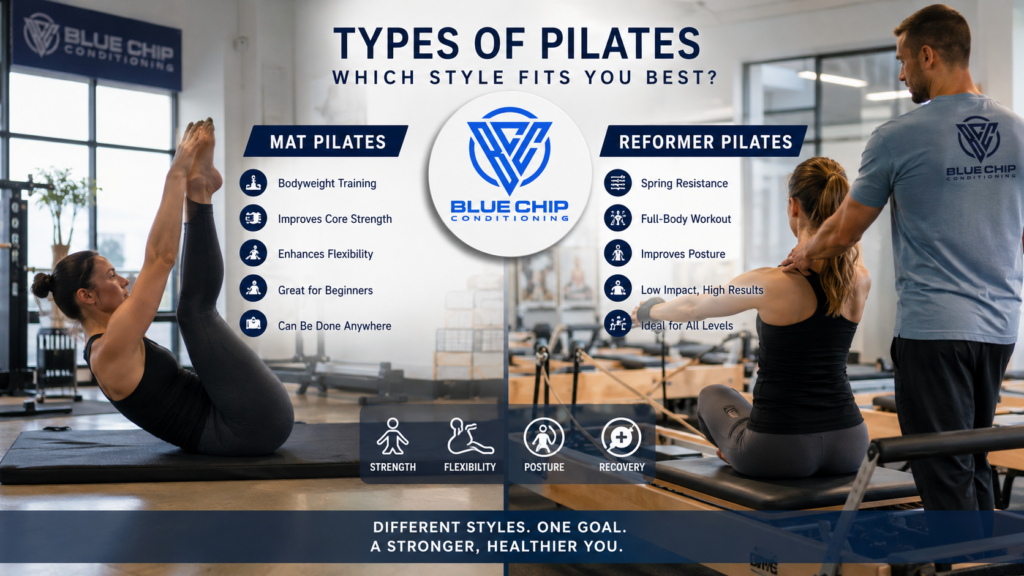
Introduction Types of Pilates can feel surprisingly personal. One person wants a gentle way to build strength. Another wants a smarter cross-training tool. Someone else needs support after an injury or wants a class that fits a packed schedule. The good news is that the right choice is usually obvious once you match the style to the goal. That is the real value of Pilates styles: each style solves a slightly different problem. Blue Chip Conditioning in Las Vegas leans into private, semi-private, and group Pilates with a strong emphasis on athletic enhancement, rehabilitation, and personalized instruction, so this topic fits its audience especially well. Quick Answer Section Types of Pilates are different ways of practicing the same core method. The best match depends on whether you want mat-based control, machine-assisted support, traditional sequencing, modern modifications, or rehab-focused coaching. For many readers, the choice comes down to fitness level, injury history, and whether they prefer solo practice or studio guidance. Key Takeaways What are the main options? When people search for Types of Pilates, they usually want one thing: clarity. They want to know which style is safest, which one feels hardest, and which one fits their life. That is a smart question, because the answer changes based on body type, training history, and whether you are building confidence or chasing performance. The most common Types of Pilates are mat, reformer, classical, contemporary, and clinical styles. Mat Pilates Mat Pilates is often the most approachable place to start. It uses bodyweight, breath control, and precise movement to build core strength, posture improvement, and control and alignment. For many beginners, it is the clearest way to learn the method before adding equipment. This is also why many instructors treat mat work as the foundation of the method. Reformer Pilates Reformer Pilates uses springs, straps, and a moving carriage to add resistance and support. It can feel smoother than people expect, but it still challenges the body in a serious way. For clients who want guided movement, stronger feedback, and more progression, reformer pilates las vegas is often a very good fit. That is one reason reformer pilates las vegas is such a strong local search phrase for studios like Blue Chip Conditioning. Classical Pilates Classical Pilates follows the original exercise order and principles more closely. It emphasizes precision, flow, and a consistent sequence, which many experienced students appreciate because it teaches discipline and body awareness. If you like structure and measurable progress, this style can feel very grounding. Contemporary Pilates Contemporary Pilates keeps the core ideas but often updates the movement selection, teaching style, or equipment use. Many modern studios use these adaptations to serve a wider range of bodies, especially people who need modifications, recovery support, or progressive coaching. This style is often the easiest to scale for mixed-level groups. Clinical Pilates Clinical Pilates is usually the most tailored option. It is often used in rehabilitation settings or under highly specific supervision because the exercises are adjusted to the person, not the other way around. That makes it especially useful when someone is managing pain, returning from injury, or rebuilding movement confidence. Blue Chip Conditioning’s service mix clearly leans into that personalized approach. Comparison: which style fits which goal? If you want a simple comparison, think of it this way. Mat work is best for learning control. Reformer work is best for feedback and resistance. Classical work is best for structure. Contemporary work is best for flexibility in programming. Clinical work is best for careful adaptation. That is the practical lens most people miss when they compare types of pilates too quickly. For a busy adult looking for local Pilates classes, the decision usually comes down to convenience and coaching. If you want a class you can repeat weekly without overthinking, reformer-based group work is often the easiest path. If you want private attention, semi-private sessions may be a better entry point because the instructor can adjust the plan as you go. Blue Chip Conditioning offers exactly that kind of format, including private, semi-private, and group sessions. Why the right style matters more than the “hardest” class A common mistake is assuming the hardest option is automatically the best. It is not. The best style is the one that improves consistency, protects form, and keeps you engaged long enough to see results. Pilates is a low-impact, full-body workout that can improve strength, flexibility, and posture without needing to feel punishing every session. That matters for athletes, too. Blue Chip Conditioning presents Pilates as part of athletic enhancement and rehabilitation, which matches what many sports-minded clients need: strong hips, better trunk control, cleaner movement, and recovery-friendly training. For that audience, reformer pilates las vegas is less about trendiness and more about useful, repeatable training. A simple step-by-step way to choose your style Here is an easy process. Real-life examples people relate to A runner who wants better hip stability may do well with reformer sessions because the springs give feedback while still allowing controlled loading. A desk worker dealing with stiffness may prefer mat Pilates because it is easy to repeat at home and reinforces breathing and alignment. Someone returning from an old injury may benefit most from clinical work or a private session where the plan is adjusted carefully. These are exactly the kinds of situations where Types of Pilates stop being theory and start becoming practical. Mistakes to avoid The biggest mistake is choosing a class based only on popularity. Another mistake is assuming reformer training is only for advanced students. A third is skipping instructor guidance when your body needs modification. Many new clients also jump into harder classes before they have learned breath control, control and alignment, or the basic rhythm of the method. That usually makes the experience feel more confusing than it needs to be. Myth vs fact Myth: Pilates is only for flexible people. Fact: Pilates is often used to build flexibility, control, and strength at the same time, which is why it
How to Compare Pilates Class Cost, Packages, and Memberships
Introduction Trying to compare Pilates pricing can feel strange at first. One studio offers a low drop-in rate, another pushes unlimited membership, and a third hides the real value behind credits and class packs. That is exactly why people searching for pilates class cost often end up more confused than informed. At Blue Chip Conditioning in Las Vegas, the pricing structure shows the real decision is not just about the number on the screen. It is about how often you train, whether you want a small group setting, and how much coaching support you need. The studio lists options such as a free 30-minute demo, a $20 first reformer class, membership tiers, and class packages, which makes it a useful example for comparing value in a practical way. The best way to compare pilates class cost is to calculate the price per class, then compare what each option includes. A cheaper drop-in may work for occasional visitors, while a membership or class pack usually offers better value for regular clients. In Las Vegas, the real difference often comes down to class size, reformer access, and instructor attention. Key Takeaways What actually drives pilates class cost? Most people think pilates class cost is simple. It is not. The final number depends on the training format, the studio model, and the level of instruction. A basic mat session usually costs less than a reformer session because the reformer brings equipment, setup, and more direct coaching into the experience. Blue Chip Conditioning describes its work as specialized training for athletic enhancement, rehabilitation, and overall physical fitness, which helps explain why its pricing is tied to value, not just time on a schedule. There is also a big difference between a studio that sells one-off entry and a studio that builds long-term loyalty. Blue Chip Conditioning offers a free demo, a first reformer special, monthly memberships, and package options, while another Las Vegas studio lists a $36 single drop-in and monthly unlimited options at $109, $169, $239, $149, and more depending on the plan. That spread shows how wide pilates class cost can be in a competitive market. How to compare packages the smart way Here is the simplest way to judge a package: divide the total cost by the number of classes you will realistically attend. If a 10-class pack saves money but expires too fast for your schedule, it is not a real deal. If a membership reduces the per-class rate and you actually show up often, the math usually favors the membership. At Blue Chip Conditioning, the package structure makes this easy to see. The 5-class pack is $125 total, the 10-class pack is $220 total, and the 20-class pack is $360 total. That means your effective class cost drops as volume rises, but only if you use the sessions before expiration. That is the first lesson many people miss when comparing pilates class cost. A low sticker price is not automatically the best price. The smarter question is whether the package matches your actual routine. Memberships versus class packs This is where many buyers hesitate. A membership feels like a commitment, while a class pack feels safer. Both can be right. A membership usually works best when you have a predictable weekly schedule. Blue Chip Conditioning shows that clearly with membership tiers that include 4, 8, 12, or unlimited group classes each month. The monthly charge changes depending on how much you attend, which is exactly how most serious clients should compare pilates class cost. A class pack is better when your schedule changes often or when you are testing the studio before committing. A pack also makes sense if you travel, work irregular hours, or want to sample a studio before locking into a recurring payment. In a city like Las Vegas, that flexibility can matter as much as the price itself. Why reformer studios usually cost more People often ask why pilates class cost is higher at a reformer studio than at a general fitness studio. The short answer is coaching and equipment. Reformer sessions are more guided, more technical, and usually more personalized. Blue Chip Conditioning even frames its experience around hands-on corrections, proper form, and tailored sessions for different fitness levels. That is also why searchers looking for pilates class las vegas tend to care about much more than a city name. They want to know whether the class is beginner friendly, whether the instructor corrects form, and whether the workout feels safe on the joints. Blue Chip Conditioning’s own content stresses flexibility, balance, posture, and core stability as key outcomes, which aligns with what most clients actually want from a premium session. A practical comparison framework Use this step-by-step process before you buy anything: This is the same lens you would use when evaluating pilates reformer studio las vegas options. A studio may look affordable at first, but once you factor in class size, access rules, and how often you plan to attend, the value picture changes quickly. Blue Chip Conditioning’s pricing page is a strong example because it lays out the choices in a way that makes comparison easier. Common mistakes people make The first mistake is focusing only on the lowest advertised number. The second mistake is ignoring expiration dates. The third mistake is buying a membership before checking whether the class format fits your body and goals. Another common mistake is assuming every studio offers the same experience, especially when comparing pilates reformer studio las vegas choices. That is not true. Some places are crowded and fast, while others emphasize small class size, personal attention, and better cueing. Blue Chip Conditioning repeatedly highlights small class size and hands-on instruction, which matters when you compare studios that market themselves very differently. The hidden value most buyers overlook A cheaper session is not always the better session. Sometimes the extra cost buys better instruction, better corrections, and better long-term results. That matters if your goal is posture improvement, flexibility, core strength, or recovery
Pilates for Seniors: 7 Smart Ways to Improve Flexibility and Core Support
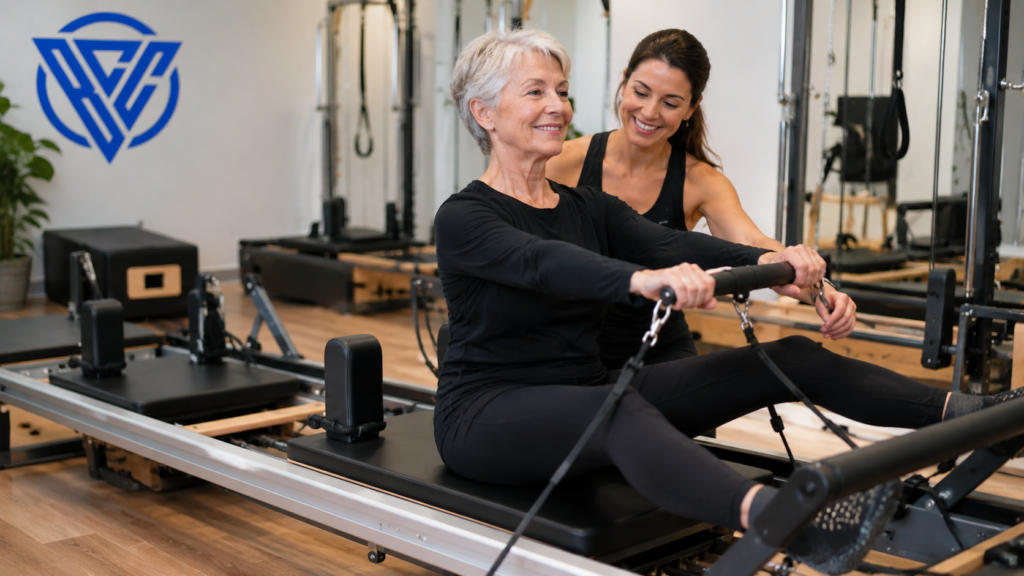
Introduction A lot of older adults do not quit moving because they lose motivation. They slow down because stiffness, balance worries, or joint discomfort make exercise feel less friendly than it used to. That is exactly where pilates for seniors stands out: it is controlled, low-impact, and built around better movement instead of punishing effort. At Blue Chip Conditioning, that same approach fits naturally with their rehab-minded, personalized style, including reformer pilates las vegas and pilates classes in las vegas for people who want guidance, confidence, and real support. Pilates for seniors is a low-impact way to build core stability, improve posture, and move with more control. It can be a smart fit for adults who want better flexibility, balance, and confidence in daily movement. When the program is scaled correctly, it can also feel safer and more approachable than high-impact workouts. Key Takeaways Why This Approach Works So Well The reason pilates for seniors gets attention is simple: it trains the body to move well before it tries to move harder. That matters because older adults often need more stability, not more strain. Pilates emphasizes controlled breathing, mindful movement, alignment, and core engagement, which are all useful for everyday strength and safer movement. Mayo Clinic notes that core work supports balance and stability, while gentle movement can help flexibility. 1. Start with breath before motion In pilates for seniors, breath is not just a nice detail. It helps set rhythm, reduce rushing, and improve body awareness. That slower pace is especially helpful for beginners who feel nervous, stiff, or out of practice. 2. Build core support without heavy strain A strong center helps the body stay organized during standing, walking, reaching, and twisting. That is one reason this style of training is so practical for daily life: it trains support muscles that many people ignore until they start feeling unstable. Research and clinical resources on older-adult exercise continue to point to strength and balance work as useful fall-prevention tools. 7 Smart Ways to Improve Flexibility and Core Support 1) Begin with the most comfortable version of each move For many adults, the first win is simply learning how to move without tension. In a well-designed senior-friendly session, an instructor can shorten the range of motion, slow the pace, or use support from equipment so the body feels safe enough to open up. That is one reason reformer-based training can be a strong choice for older adults who want guided resistance instead of jumping straight into floor work. Blue Chip Conditioning offers private and semi-private options, plus beginner-friendly training that can be adapted to the person in front of the instructor. 2) Train posture as a daily habit, not a once-in-a-while fix Poor posture usually builds slowly. So does better posture. That is why this training works best when people think of it as a practice, not a challenge. Repeated alignment work can help the shoulders, ribs, pelvis, and spine cooperate better, which often makes standing, sitting, and walking feel easier. Mayo Clinic’s fitness guidance also connects Pilates-style training with improved posture, balance, and range of motion. 3) Use controlled resistance to wake up the stabilizers Muscles do not need to be exhausted to be useful. Sometimes they just need a clear signal. A reformer gives spring-based feedback that helps people feel where they are moving well and where they are compensating. That is a big reason reformer pilates las vegas is appealing to seniors who want support, not chaos. It can feel especially helpful when stiffness, previous injury, or fear of falling makes a person overly cautious. 4) Keep flexibility work gentle and repeatable The goal is not to force a deeper stretch every session. The goal is to teach the body that movement is safe again. Gentle rotation, hip opening, chest expansion, and hamstring work can gradually improve mobility without the “next day regret” many people get from aggressive workouts. A review of Pilates training in older adults found improvements in flexibility, and other studies suggest possible balance benefits, though outcomes depend on the program and the person. 5) Choose the right setting for your confidence level Some people enjoy a group atmosphere. Others do better with more eyes on them. Both can work, but the best setting depends on confidence, mobility, and prior exercise experience. At Blue Chip Conditioning, small-group classes in Las Vegas are paired with private and semi-private training so the session can match the level of attention a client actually needs. That flexibility matters for older adults who want a slower ramp-up, more feedback, or a rehab-friendly environment. 6) Make consistency the real goal A lot of people overestimate what one hard workout can do and underestimate what eight steady weeks can do. For older adults, regular activity that includes strength and balance work is a proven part of reducing fall risk. Two well-coached sessions a week can often do more than a random burst of intense exercise followed by a long break. 7) Link every exercise to a real-life movement This is where the method starts feeling useful fast. Reaching into a cabinet, getting up from a chair, turning to look behind you, or standing on one foot while putting on a shoe all depend on the same qualities: core support, balance, and mobility. When pilates for seniors is taught well, those daily actions become the training goal, not just the byproduct. Comparison: What Seniors Usually Notice First When people compare pilates for seniors with other low-impact options, the first difference is usually the level of control. Walking is excellent for general activity, but it does not always challenge the core or posture in a targeted way. Yoga can improve flexibility, but some seniors prefer the more structured support and feedback of Pilates. That is why many people exploring pilates classes in las vegas and reformer-based sessions are really looking for one thing: a guided workout that feels safe, useful, and specific to their body. Option Best for Main feel Walking General
How the benefits of pilates reformer Can Transform Your Body and Daily Movement
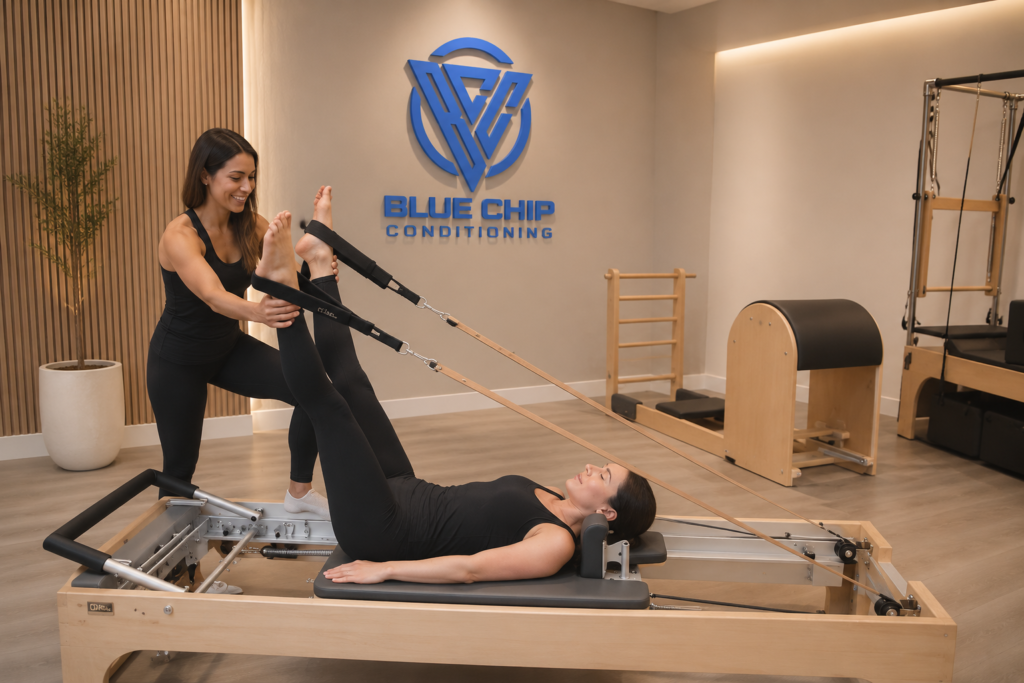
The benefits of pilates reformer are easy to notice when training is done with clear coaching, steady progress, and a plan that fits the body in front of you. At Blue Chip Conditioning, that idea matters because the studio focuses on athletic enhancement, rehabilitation, and overall physical fitness, not just a quick sweat session. For athletes, fitness enthusiasts, and injury recovery clients, the real value is simple: better control, better alignment, and better movement in daily life. In a strong pilates reformer studio las vegas, those gains can show up in the gym, on the field, at work, and even in how you walk up stairs or get out of a chair. Many people looking for reformer pilates las vegas want that exact blend of structure and coaching. Key Takeaways Why the benefits of pilates reformer stand out in real life The benefits of pilates reformer start with control. The springs, carriage, and guided resistance help you move through a full range without guessing what your body should do next. That makes the workout useful for people who want strength without beating up the joints. Blue Chip Conditioning highlights low-impact, customized Pilates conditioning as part of its approach, especially for athletes and people recovering from injury. One reason this training feels different from many other workouts is that the machine gives feedback immediately. If your alignment is off, you feel it. If your breath is rushed, your control drops. That instant feedback helps you learn faster and move better. What changes first? The first change is usually body awareness. You begin noticing how you stand, sit, and shift weight during simple tasks. Who feels the difference fastest? People with tight hips, weak cores, old injuries, or unstable movement patterns often notice it early. How the benefits of pilates reformer support strength without extra strain This method is often linked to strength, but the deeper value is how that strength is built. Instead of chasing speed or impact, reformer work asks for precision. That is useful for athletes who need force transfer, for fitness clients who want toned and stable movement, and for recovery clients who need a safer path back to training. Blue Chip Conditioning describes its sessions as highly personalized, with hands-on corrections and tailored workouts that match the client’s goals and fitness level. A problem many people face is simple: they want to get stronger, but their body starts to feel tight, tired, or irritated before they get real results. The solution is not always more effort. Often, it is smarter effort. That is where the benefits of pilates reformer become practical. The machine allows resistance to be scaled up or down, so the body can work hard without being overloaded. Comparison: reformer training vs. a basic floor workout A floor workout can be great, but it usually depends more on bodyweight and self-correction. Reformer work gives more structure. The machine supports you while still challenging you, which makes the benefits of pilates reformer easier to access for mixed levels. In a good local studio, that structure is paired with coaching, so each rep has a clear purpose. A useful reformer session also trains the small things that people usually ignore. Breath rhythm, foot pressure, spinal control, and tempo all matter more than many beginners expect. When these basics improve, people often notice that walking feels lighter, sitting feels less stiff, and standing from a chair takes less effort. That is the kind of change that makes training feel valuable beyond the studio. For athletes, those same details support cleaner mechanics and steadier force. For recovery clients, they can make movement feel less scary and more predictable. everyday clients, they can make a long workday or a busy weekend feel easier to handle. The best sessions do not try to impress you. They teach your body to organize itself better, one rep at a time. Why athletes and recovery clients choose this method The benefits of pilates reformer are especially useful for athletes because performance is not only about power. It is also about control, balance, and the ability to repeat movement well. Blue Chip Conditioning says its programs are built for athletic enhancement and rehabilitation, which fits clients who want performance gains without losing movement quality. For injury recovery clients, the benefits of pilates reformer are just as important. Controlled resistance can help keep the rest of the body active while a painful area heals. That matters when someone wants to return to sport, return to work, or simply return to daily life with more confidence. The studio’s own pricing page also shows beginner-friendly options, including a free 30-minute first demo class and a $20 first reformer class for new clients. Use case: a busy athlete in Las Vegas Imagine a basketball player or runner who needs better hip stability, stronger trunk control, and less post-workout strain. A well-run local studio can make that training feel focused instead of random. The benefits of pilates reformer show up in cleaner landings, smoother turns, and less wasted motion. The same idea works for someone rehabbing after a small injury. Instead of jumping back into high-impact training too early, they can build capacity step by step. That is one reason many clients search for reformer pilates las vegas when they want a smarter way to return to movement. What a good studio experience should feel like These results depend a lot on the studio itself. Blue Chip Conditioning emphasizes professional instructors, hands-on corrections, and a personalized Pilates experience that matches the client’s body and goals. The brand also positions itself as a Pilates-based wellness center in Las Vegas with private, semi-private, and group classes. That matters because the same exercise can feel very different depending on the coaching. In a crowded setting, people often rush and copy. In a thoughtful setting, they learn. The benefits of pilates reformer become much more useful when the coach notices the small details and adjusts the session in real time. What to look
Pilates Class Cost: What You Can Expect to Pay for a Pilates Class Las Vegas Studio
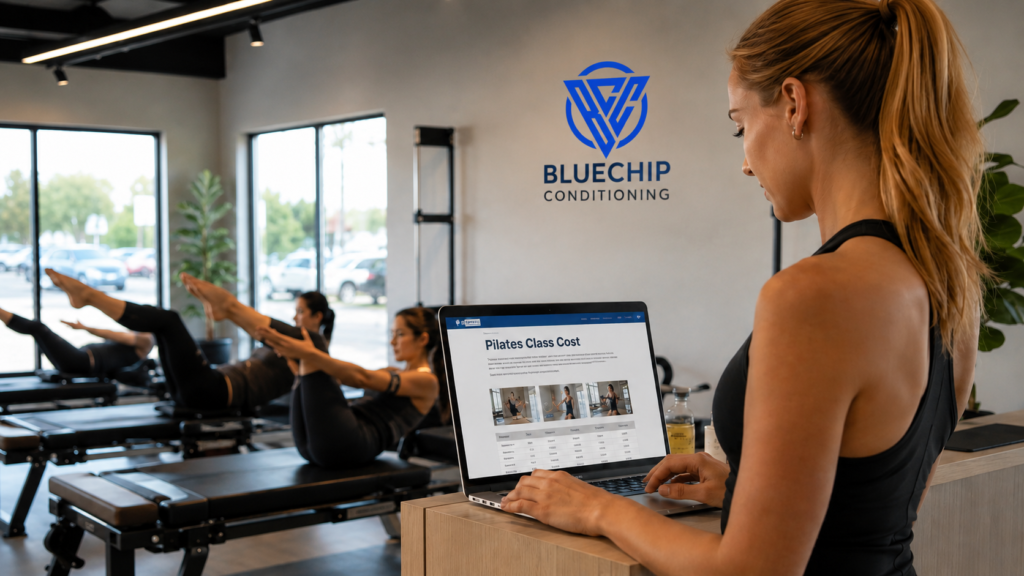
Introduction When people search for pilates class cost , they usually want a simple answer that helps them decide fast. They want to know what feels fair, what fits their goal, and whether the class is worth the money. At Blue Chip Conditioning, the price is tied to the type of support you need, the size of the class, and how personal you want the coaching to feel. That matters in a city like Las Vegas, where a beginner, an athlete, and someone coming back from injury may all need a different path. Key Takeaways What shapes pilates class cost in a Las Vegas studio? The biggest factor is attention. A class with more people usually has a lower price, while a smaller class gives you more coaching, more correction, and more room to ask questions. That is one reason pilates class cost can look very different from one studio to another. Another factor is the format. A basic group class is usually the most affordable entry point. A semi-private session sits in the middle. A one-on-one session is the most personal, so it usually has the highest price. At Blue Chip Conditioning, the menu is built around that idea. The studio offers group reformer classes, semi-private sessions, private Pilates, Pilates for dancers, elite athlete development training, and studio rental. The brand also describes itself as a specialized Pilates studio in Las Vegas focused on athletic enhancement, rehabilitation, and overall physical fitness. Is more expensive always better?Not always. The better choice is the one that matches your goal and how much coaching you need. What Blue Chip Conditioning includes in a pilates class las vegas experience A strong pilates class las vegas experience should feel organized, supported, and easy to follow. Blue Chip Conditioning says its classes are designed to give individualized attention, with proper form, alignment, and hands-on corrections. The studio also keeps group reformer classes small, with one client review noting classes that hold only up to 8 people. The first visit matters too. The studio’s price list shows a free 30-minute first demo class for new clients, a first reformer class at $20, and a new client special at $99 that includes 2 semi-privates and 2 group classes. That makes the entry point feel more approachable for someone testing the studio for the first time. For many readers, that is the real value behind pilates class cost. You are not just paying for time on a reformer. You are paying for coaching, structure, and a session style that is built to keep movement safe and purposeful. In a pilates class las vegas setting, that balance can matter more than a low headline price. A simple comparison that helps Group reformer classes are usually best for steady training and a lower monthly spend. Semi-private work is better when you want more correction without going fully private. Private sessions cost more, but they give the most tailored coaching and are often the best fit for injury recovery clients or athletes who need precision. pilates class cost at Blue Chip Conditioning: a clear look at the price structure The studio’s published pricing makes pilates class cost easier to understand because it breaks the options into clear levels. The first demo class is free for 30 minutes. The first reformer class is $20 for new clients. The standard group class packages begin at $25 per class for a 5-class pack, while the 10-class pack brings the rate down to $22 per class and the 20-class pack lowers it to $18 per class. Monthly memberships change the math even more. The Classic membership is $109 per month for up to 4 group classes, the Premium membership is $159 per month for up to 8 group classes, the Ultra membership is $199 per month for up to 12 group classes, and the Supreme membership is $249 per month for unlimited classes. Semi-private pricing is also published. The studio lists 4 semi-privates at $198 per month, 8 semi-privates at $318 per month, and 12 semi-privates at $398 per month. Private sessions start at $98 per session for an MVP session and $140 per session for an All-Star session. What is the lowest entry cost?For new clients, the free demo class is the lowest-friction way to start. What is the fastest way to lower per-class cost?A package or membership usually cuts the cost per visit. Why a pilates reformer studio las vegas often costs more than a general fitness class A pilates reformer studio las vegas experience usually has more coaching built into it than a standard gym class. The reformer itself adds equipment value, and the instruction is often more specific. That is part of why premium studios can cost more than a basic group workout. Blue Chip Conditioning’s pricing page shows that the studio’s model includes multiple class tiers, memberships, and private options rather than one flat drop-in rate. The difference is not only about equipment. It is also about the environment. The studio describes its classes as personalized and notes that they are built to help clients with strength, flexibility, confidence, and proper form. It also positions its semi-private sessions as a more tailored workout than a group class while still staying more affordable than private training. This is where pilates class cost and real value meet. A cheaper class can be fine for general movement. But if you want injury-aware coaching, better cueing, and a more personal experience, the higher price can make sense. Problem and solution Problem: Many people see a higher price and assume the class is overpriced.Solution: Look at what the session includes. If the class gives you cleaner form, better attention, and a safer pace, the cost may actually be better value over time. Best use cases for athletes, fitness enthusiasts, and recovery clients For athletes, the biggest win is control. Blue Chip Conditioning promotes elite athlete development training and says its Pilates work is designed for athletic enhancement. That kind of setting can help with
What Are the Different Types of Pilates and Which One Fits Your Body Goals?
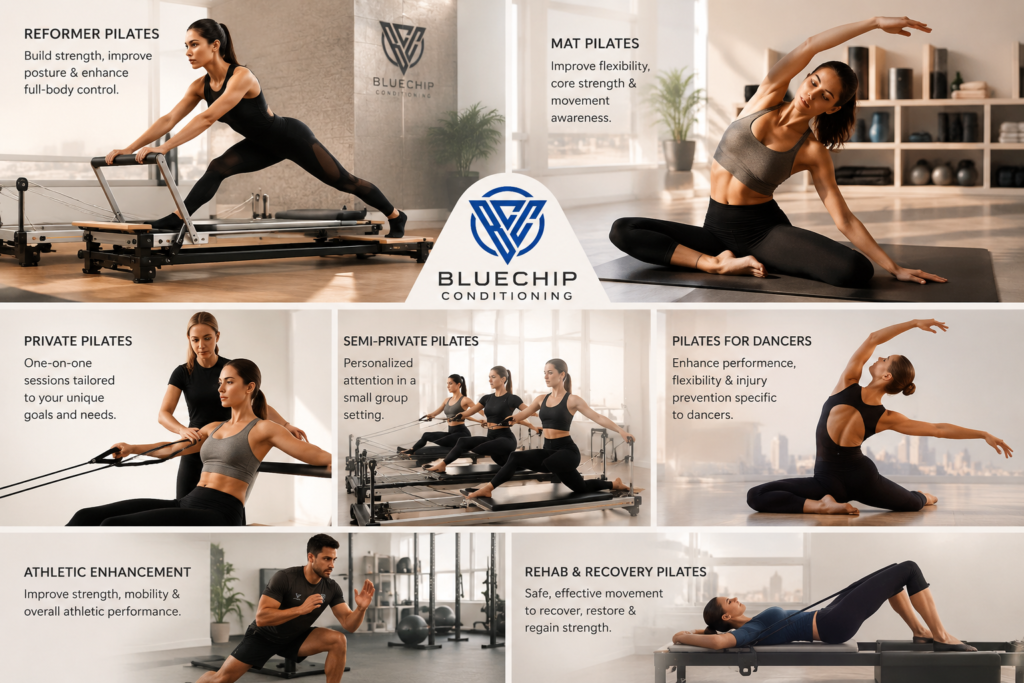
Introduction The types of pilates can look similar at first, but each one supports the body in a different way. Some styles build control and core strength. Others focus more on recovery, mobility, or athletic power. If you choose the wrong one, progress can feel slow and frustrating. That is why the best choice depends on your goal, your body, and your current level. In Las Vegas, people often start with a class that sounds popular, then discover they really needed something more specific. The right format saves time and helps you feel better faster. Key Takeaways Why the types of pilates matter for your goals The types of pilates matter because your body does not need every style for the same reason. A person building strength after time off needs something different from a runner training for speed. A dancer may need fine control and mobility, while an office worker may need posture support. Which style is best for beginners?The best beginner option is usually the one with the most guidance and the least pressure. At a well-run pilates class las vegas studio, the experience should feel clear from the start. You should know what the class is trying to do, how hard it will feel, and what your body should get from it. That clarity helps you stay consistent. A pilates class las vegas choice should feel specific, not generic. Mat Pilates Mat work uses your own body weight for resistance. It is simple, effective, and easy to scale. Many people like it because it builds awareness without needing complex equipment. One style people choose first is mat work, especially when they want a low-cost way to start. Mat Pilates is a strong choice for home practice too. It helps you learn alignment, breath control, and core engagement. If your goal is better body control, this is a solid base. Reformer Pilates The reformer adds springs, straps, and a moving carriage. That gives you resistance and support at the same time. This is often the most popular choice for people who want more coaching and more variety in each session. A good pilates reformer studio las vegas can make the reformer feel friendly instead of intimidating. The machine adjusts to your level, so a beginner and an advanced client can work in the same room with different settings. Clinical or rehabilitation-focused Pilates This style is slower and more targeted. It is often used for people who are rebuilding after pain, injury, or long periods of low activity. This category focuses less on performance and more on safe movement patterns. The goal is not to do more. The goal is to move better. That is why many injury recovery clients respond well to this style. It gives them space to rebuild trust in the body. Mat vs reformer: what changes most The biggest difference is support. Mat work asks more from your own stability. Reformer work gives you spring tension, feedback, and more ways to modify. In simple terms, mat can feel more open-ended, while reformer can feel more guided. For many people, these styles become easier to understand once they try both. Mat shows you how your body works without help. Reformer shows you how to challenge that same body with precision. If your goal is strength plus control, reformer usually wins. If your goal is learning the basics first, mat can be the cleaner starting point. A trusted pilates class las vegas studio should be able to explain both without pushing one style on everyone. Which types of pilates fit different body goals For athletes Athletes usually need better control under load, not random effort. They want mobility, stability, and cleaner patterns that carry into sport. For that reason, the types of pilates that use resistance and correction often work well here. A basketball player may need stronger hips. A golfer may need more rotation control. A runner may need better single-leg stability. The right class helps all of that show up in training, not just in theory. For fitness enthusiasts If you want a workout that feels smart and not chaotic, Pilates is a strong match. It can be challenging without being harsh. The types of pilates that use reformer springs or small-group coaching often give the best mix of strength and flow. This is where consistency matters. Two or three classes a week can make a clear difference in posture, core strength, and body awareness over time. That is one reason many people search for a pilates reformer studio las vegas that offers small classes and real attention. For injury recovery clients This group usually needs the most customization. Pain, stiffness, or old compensation patterns can change everything. The types of pilates that emphasize slower pacing, alignment, and instructor feedback are usually the safest place to begin. Many people return to exercise too fast after an injury. The safer move is to start with controlled sessions that rebuild strength before intensity. That approach lowers the chance of re-aggravating the area and helps the body relearn clean movement. How to choose the right class in 3 steps This is where the types of pilates become practical instead of confusing. Once you match the format to the goal, the decision gets much easier. A skilled pilates class las vegas instructor should help you make that choice without pressure. Do you need to be flexible before starting Pilates?No, Pilates is often used to improve flexibility and control over time. Can beginners do reformer classes?Yes, because spring settings and coaching can be adjusted to the person. What Blue Chip Conditioning offers in Las Vegas Blue Chip Conditioning is built around athletic enhancement, rehabilitation, and overall physical fitness. The studio offers group classes, semi-private sessions, private Pilates, Pilates for dancers, and athletic enhancement training. That range makes it easier to match the types of pilates to the goal instead of forcing everyone into one format. The pricing page also gives new clients a clear starting point. The studio lists
Why Pilates Training Is Becoming Popular in Las Vegas Fitness Studios
Pilates training is showing up everywhere in Las Vegas because people want workouts that feel effective without being punishing. In a city where busy schedules are the norm, the appeal is simple: stronger movement, better posture, and a lower-impact way to train that still delivers real results. At Blue Chip Conditioning, the demand makes sense. The studio’s focus on athletic enhancement, rehabilitation, and overall physical fitness fits the kind of results Las Vegas clients actually ask for: more control, better mobility, and a program that works for different bodies and goals. The Blue Chip Conditioning website emphasizes personalized coaching, hands-on corrections, and support, which builds trust. This article explains why the trend keeps growing and what today’s clients want. Why the Las Vegas market is responding to Pilates training Las Vegas fitness culture has changed. People still want intensity, but they are also more aware of recovery, injury prevention, and movement quality. That shift is one reason this method has moved from being seen as a niche option to a practical choice for a wide range of clients. The first reason is simplicity.Many people do not want a workout that leaves them wiped out for the rest of the day. They want something structured, guided, and useful. Pilates training gives them that. It builds core strength, improves alignment, and helps the body move with less compensation. For people who sit most of the day or stand for long hours, that matters. The second reason is versatility.A single studio can serve beginners, athletes, dancers, and people returning from injury. That is a big advantage in a city as diverse as Las Vegas. For people comparing pilates classes in las vegas, the appeal is usually the same: coaching, convenience, and a class style that feels manageable. Some clients are looking for mobility. Others are looking for conditioning that supports another sport. Others just want to feel less stiff after work. The same training system can serve all three without feeling watered down. A third reason is trust.People are more likely to stay with a routine when they see that the instructors pay attention to form. Blue Chip Conditioning emphasizes hands-on corrections, proper alignment, and personalized support, which makes the experience feel intentional rather than mass-produced. That level of attention helps explain why more people search for pilates classes in las vegas when they want something that feels guided and professional. What makes Pilates training different from a standard gym routine? Many people compare this method with traditional strength training and immediately notice one major difference: the focus is not just on effort. It is on control. Instead of rushing through reps, you learn how to move with precision, breathing, and consistency. That often leads to better body awareness, which is useful whether your goal is athletic performance or everyday comfort. Is Pilates only for beginners?No. It works for beginners, experienced exercisers, and athletes who need better control, stability, and recovery support. The method is also joint-friendly. That does not mean easy. It means the challenge comes from alignment, resistance, and concentration rather than repeated impact. For many people, especially those dealing with stiffness or old injuries, that makes it easier to stay consistent. Consistency is what creates long-term improvement. There is also a psychological reason people stick with it. Standard gym routines can feel repetitive if they are built only around machines and numbers. Pilates training feels more connected to how the body actually moves. That is important for anyone who wants to feel stronger in daily life, not just during a workout. When hard workouts are not helping A common problem is this:people train hard, but they still feel unbalanced, tight, or unstable. The solution is not always more intensity. Sometimes it is better movement quality. Pilates training helps close the gap by improving core engagement, posture, and control so the body starts working together instead of fighting itself. Another common problem is inconsistency. People quit routines that feel painful, confusing, or too aggressive. A structured studio environment solves that by giving people coaching, rhythm, and progress they can actually feel. That is one reason modern fitness studios in Las Vegas are leaning into this style of training. Why reformer-based classes are getting so much attention If there is one format driving a lot of the buzz, it is reformer-based work. The machine adds spring resistance, support, and range, which changes the experience in a very useful way. The machine assists where needed, challenges where needed, and gives the instructor more ways to scale difficulty. That is a big reason reformer pilates las vegas has become such a common search term. It also explains why reformer pilates las vegas is often the format people remember after the first trial class. People want a class that feels sophisticated but still approachable. They want structure, small class sizes, and visible feedback. also want to know the class is not just random exercise on a machine. They want a system with purpose. At Blue Chip Conditioning, reformer sessions are part of a wider service model that includes private Pilates, semi-private sessions, group reformer classes, Pilates for dancers, elite athlete development training, and studio rental. That mix matters because different clients need different levels of attention. Someone returning to movement after time away may want more support. A competitive athlete may want targeted work that supports speed, balance, and injury prevention. A dancer may need flexibility plus strength. Reformer work can be adapted for each of those needs, which is why reformer pilates las vegas remains such a practical choice. Here is the practical difference many clients notice after a few sessions: better control in the hips and trunk, smoother transitions, and less wasted movement. Those changes may seem small at first, but they carry over into sports, work, and daily life. That is why reformer classes often feel more valuable than a workout that only burns energy. For many people, reformer pilates las vegas feels more useful than a generic studio workout because
What Is the Real Pilates Reformer Cost? Everything Buyers Should Know
Pilates reformer cost can look confusing at first because studios, memberships, class packs, and private sessions all price the experience differently. On the Blue Chip Conditioning pricing page, the real numbers are not hidden: new clients can start with a free 30-minute demo class, a $20 first reformer class, a $99 starter special, and ongoing options that range from group class memberships to private sessions. For buyers in Las Vegas, the real question is not only what a reformer session costs, but what the experience includes, how often you plan to train, and whether you need small-group coaching or one-on-one attention. Blue Chip Conditioning positions its work around athletic enhancement, rehabilitation, and overall physical fitness, so the value conversation is broader than a single drop-in rate. What Does Pilates Reformer Cost Really Cover? The phrase pilates reformer cost can mean three different things: the price of a single class, the price of a membership, or the price of a more personalized training format. At Blue Chip Conditioning, the published options show that a first-time reformer class is $20, while standard group class pricing, semi-private training, and private sessions each move into different tiers depending on frequency and attention level. That difference matters because the reformer itself is only one part of the service. what are you actually paying for?you are paying for coaching, studio access, small class size, programming, and the level of individual correction built into the session. Blue Chip Conditioning emphasizes hands-on instruction, personalized workouts, and a supportive environment, which helps explain why the price structure is not one-size-fits-all. Why the Price Changes from Studio to Studio Pilates reformer cost changes because every studio packages the same movement system in a different way. Some studios lean toward high-volume group classes. Others focus on semi-private sessions, private coaching, or athletic performance programs. Blue Chip Conditioning combines reformer Pilates with athletic enhancement and rehabilitation, which makes its pricing model more comparable to specialized training than to a basic fitness class. This is where many buyers make the wrong comparison. They see one studio’s low intro rate and assume all reformer sessions should cost the same.Problem: that comparison ignores class size, instructor involvement, and the training objective.Solution: compare what is included, not just the headline number. On your website, the low entry offers are designed to help new clients test the studio, while the membership and session packages support longer-term training. The pricing ladder at Blue Chip Conditioning How Blue Chip Conditioning Structures Value Blue Chip Conditioning is built around tailored training, athletic potential, and highly personalized support. The homepage says the studio offers specialized training for athletic enhancement, rehabilitation, and overall physical fitness, and it highlights a commitment to hands-on corrections and individualized programming. That matters for cost because people usually pay more when the coaching is more specific. In practical terms, a group reformer class can be the most affordable way to stay consistent, while a private session can make more sense when form, injury recovery, or sport-specific goals are the priority. Blue Chip Conditioning is explicit about serving both elite athletes and people who simply want to move better in daily life. What Buyers in Las Vegas Should Compare First When people search pilates reformer cost, they usually want a clean answer. But the strongest buying decision comes from comparing the format, the session length, the instructor access, and the expiration window on packages. At Blue Chip Conditioning, for example, group class packs expire in 60, 90, or 120 days depending on the package, while semi-private plans run monthly and private sessions are available individually or in bundles. A smart comparison should always include these questions: For local buyers searching reformer pilates las vegas, the best choice is usually the one that matches your training rhythm rather than the lowest advertised rate. A cheaper class is not cheaper if you never go. A slightly higher package can be better value if it keeps you consistent for 8 to 12 weeks. That is the kind of tradeoff a serious studio price page should help you evaluate. Comparing Session Types Without Overcomplicating the Decision The pricing on the Blue Chip Conditioning page makes the structure easy to understand. Group classes are the most accessible entry point. Semi-private training costs more because the experience is more individualized. Private sessions sit at the top because they deliver one-on-one coaching and a reserved studio experience. In plain terms, the comparison looks like this: a group class is best for steady practice and lower cost; a semi-private session is best for focused correction and targeted goals; and a private session is best for maximum customization. If you are comparing pilates reformer studio las vegas options, this is the clearest lens to use because it keeps you focused on value, not just the price tag. Best-fit use cases Why Reformer Pilates Can Feel More Expensive but Still Be Worth It Some buyers see pilates reformer cost and expect a simple fitness class price. But reformer Pilates is built around equipment, precision, and coaching quality. At Blue Chip Conditioning, the value proposition is especially strong because the studio presents Pilates as a tool for strength, flexibility, balance, body control, and athletic performance. That is why the question should not only be “What does it cost?” It should also be “What do I get back from the cost?” If better movement, safer training, and stronger consistency are part of your goal, then the return on a well-structured reformer plan is often higher than the entry price suggests. This is especially true for people who want guidance instead of guessing their way through workouts. How to Choose the Right Starting Point If you are new to reformer training, the best way to approach pilates reformer cost is to start small, compare formats, and then scale up based on results. Blue Chip Conditioning gives buyers several entry points, which makes it easier to find the right fit without committing too early. Here is a simple way to decide: That
How Elite Athlete Development Builds Stronger, Faster, Injury-Resistant Athletes
Elite athlete development is no longer just about lifting heavier weights or running faster intervals. It is about building a body that can produce force, absorb stress, recover quickly, and stay dependable across a full season of training and competition. For athletes who want more than short bursts of performance, this approach creates a foundation that supports speed, power, mobility, and resilience together. The best programs do not chase one quality at the expense of another. They connect strength, movement efficiency, recovery, and sport-specific preparation in a way that makes progress more sustainable. That is why elite athlete development has become a serious advantage for coaches, parents, and athletes who want measurable performance without paying for it through avoidable injuries. What elite athlete development actually means This training model is a structured performance system built around the real demands of sport. It is not a random mix of workouts. It is a process that strengthens the muscles, joints, connective tissue, nervous system, and movement patterns that athletes use under pressure. The goal is simple: raise performance while lowering breakdown. A strong program usually starts with assessment. That may include movement screening, strength testing, mobility checks, landing mechanics, sprint mechanics, or position-specific needs. From there, training becomes more intentional. A sprinter does not need the same workload as a soccer player. A youth athlete does not need the same volume as a college competitor. The best plans reflect that reality. At its core, the model is about preparing the body to do three things well: generate force, transfer force, and repeat that process without losing quality. That is where many traditional fitness plans fall short. They may improve general conditioning, but they rarely build the exact movement efficiency and durability that sport demands. Is this approach only for professional athletes?No. It is useful for young athletes, high school competitors, college players, and adults who train at a serious level. Why stronger does not always mean better Many athletes think the path to better performance is always more intensity. In practice, that can create the opposite result. More intensity without structure often leads to stiffness, fatigue, and poor movement quality. That is where the real value of this method shows up. It balances stress and adaptation instead of stacking hard sessions until the body starts resisting progress. The goal is not to make athletes tired. The goal is to make them capable. Stronger athletes usually move with better control, more stability through the trunk and hips, and more efficient force production in the lower body. Faster athletes usually do not just have powerful legs; they also have better mechanics, cleaner timing, and a body that can keep position at speed. Injury-resistant athletes are rarely the ones who train the hardest every day. They are usually the ones who train with the most precision. Problem → Solution:When athletes only train for output, they often lose mobility and movement quality. The solution is to combine strength work with controlled mobility, landing practice, deceleration work, and recovery-based training that protects performance over time. The performance pillars that matter most A credible program usually stands on several pillars that work together instead of competing with each other. These are not trendy ideas. They are the basics that experienced coaches keep returning to because they produce reliable results. 1. Strength that transfers to sport General strength is useful, but transferable strength matters more. Athletes need force that can be used while moving, cutting, jumping, changing direction, and absorbing contact. This is why split squats, hinges, carries, sled work, and rotational training matter so much. They train the body to stay organized while producing power. Strength also helps protect joints. When the hips, trunk, and legs are able to share load well, the body does not dump stress into one weak area. Over time, that can reduce wear on the knees, hamstrings, ankles, and lower back. It is one reason the best programs are often built around compound movements rather than isolated effort alone. 2. Speed with control In elite athlete development, speed is not only about moving quickly in a straight line. It includes acceleration, deceleration, body position, rhythm, and direction change. A fast athlete who cannot stop or redirect well is still vulnerable. True speed training improves mechanics first, then layers on intensity. This is where quality coaching matters. Good technical work teaches the athlete how to project force into the ground, keep posture under load, and maintain alignment when fatigue rises. That attention to detail creates a much stronger base for game speed. 3. Mobility that supports output Mobility is often misunderstood. It is not about being loose for the sake of it. It is about having usable range of motion where the sport requires it. Hips, ankles, thoracic spine, and shoulders must all contribute to clean movement. Without that range, power leaks into compensations. Athletes who build mobility the right way usually move with less strain and better control. That is one reason many programs pair strength development with movement work that reinforces position, not just flexibility. 4. Recovery that protects adaptation In elite athlete development, recovery is not a luxury. It is part of training. Sleep, hydration, tissue work, breathing, downregulation, and intelligent session design all affect whether the body actually adapts. A poorly recovered athlete may still sweat through a workout, but the session often produces less benefit and more hidden fatigue. Simple recovery habits can have a large effect over a full training cycle. More consistent sleep can improve reaction time, decision-making, and tissue repair. Better nutrition can support output and reduce breakdown. Recovery is where training becomes usable. How elite athlete development reduces injury risk Injury prevention is not about promising that nothing will ever happen. That is unrealistic in sport. It is about lowering exposure to avoidable risk and improving the body’s ability to tolerate repeated demands. When people talk about injury-resistant athletes, they usually mean athletes who can absorb stress, recover, and keep performing without constant setbacks.